

Philippine president receives UAE’s chief envoy in Manila

1 / 3
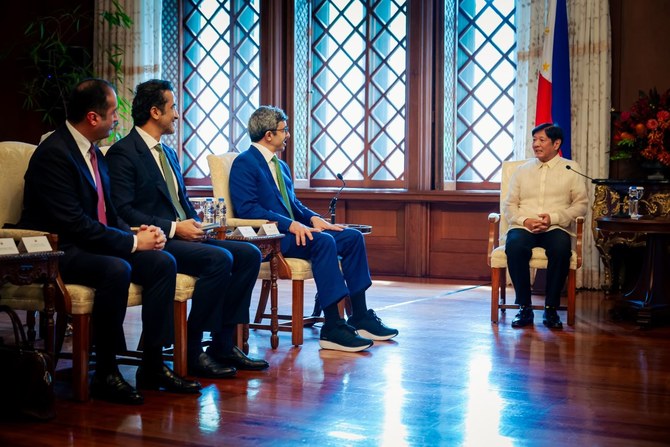
Philippine President Ferdinand R. Marcos Jr., right, welcomes UAE Foreign Affairs Minister Sheikh Abdullah bin Zayed Al-Nahyan and other senior Emirati officials during a meeting at Malacanan Palace in Manila. (WAM)
2 / 3
Philippine President Ferdinand R. Marcos Jr. welcomes UAE Foreign Affairs Minister Sheikh Abdullah bin Zayed Al-Nahyan and other senior Emirati officials during a meeting at Malacanan Palace in Manila. (WAM)
3 / 3
UAE Foreign Affairs Minister Sheikh Abdullah bin Zayed Al-Nahyan, left, with Philippine President Ferdinand R. Marcos Jr. and the first lady Louise Araneta-Marcos at Malacanan Palace in Manila. (WAM)
Short Url
Updated 05 June 2024
Follow

Philippine president receives UAE’s chief envoy in Manila

MANILA: Philippine President Ferdinand R. Marcos Jr. on Tuesday received UAE Foreign Affairs Minister Sheikh Abdullah bin Zayed Al-Nahyan and other senior Emirati officials during a meeting at Malacanan Palace in Manila.

During their meeting, part of Sheikh Abdullah’s working visit to Southeast Asian nations, the two officials exchanged wishes for the continued prosperity of their countries.

Marcos and Sheikh Abdullah also discussed bilateral relations and ways to boost cooperation, particularly on trade and investment, as both countries look forward to the 50th anniversary of the establishment of their diplomatic ties.

The UAE hosts the largest overseas Filipino community, with about 1 million expatriates as of last estimate, a number that is expected to increase further as the Gulf country looks to employ more qualified Filipino healthcare professionals through a planned government-to-government hiring system.

Sheikh Abdullah expressed his appreciation for the role of the Filipino community in supporting the UAE’s development plans in various sectors.

The meeting was attended by Mohammed Obaid Al-Qataam Al-Zaabi, the UAE ambassador to the Philippines, and Saeed Mubarak Al-Hajri, assistant minister for economic and trade affairs.


Japan reaffirms no-nukes pledge after senior official suggests acquiring weapons

Updated 3 sec ago
Follow

Japan reaffirms no-nukes pledge after senior official suggests acquiring weapons

  • The unnamed official said Japan needed nuclear weapons because of a worsening security environment
  • At a regular press briefing in Tokyo, Chief Cabinet Secretary Minoru Kihara said Japan’s nuclear policy had ‌not changed
TOKYO: Japan reaffirmed its decades-old pledge never to possess nuclear weapons on Friday after local media reported that a senior security official suggested the country should ​acquire them to deter potential aggressors. The unnamed official said Japan needed nuclear weapons because of a worsening security environment but acknowledged that such a move would be politically difficult, public broadcaster NHK and other outlets reported, describing the official as being from Prime Minister Sanae Takaichi’s office.
At a regular press briefing in Tokyo, Chief Cabinet Secretary Minoru Kihara said Japan’s nuclear policy had ‌not changed, but declined ‌to comment on the remarks or ‌to ⁠say whether ​the ‌person would remain in government. There is a growing political and public willingness in Japan to loosen its three non-nuclear principles not to possess, develop or allow nuclear weapons, a Reuters investigation published in August found.
This is driven in part by doubts over the reliability of US security guarantees under President Donald Trump and growing threats from nuclear-armed ⁠China, Russia and North Korea.
Japan hosts the largest overseas concentration of US military forces ‌and has maintained a security alliance with Washington ‍for decades.
Some lawmakers within Takaichi’s ‍ruling Liberal Democratic Party have said the United States should ‍be allowed to bring nuclear weapons into Japan on submarines or other platforms to reinforce deterrence. Takaichi last month stirred debate on her own stance by declining to say whether there would be any changes to the ​three principles when her administration formulates a new defense strategy next year.
“Putting these trial balloons out creates an opportunity ⁠to start to build consensus around the direction to move on changes in security policy,” said Stephen Nagy, professor at the department of politics and international studies at the International Christian University in Tokyo.
Beijing’s assertiveness and growing missile cooperation between Moscow and Pyongyang are “creating the momentum to really change Japan’s thinking about security,” he added.
Discussions about acquiring or hosting nuclear weapons are highly sensitive in the only country to have suffered atomic bombings, and risk unsettling neighboring countries, including China.
Ties between Tokyo and Beijing worsened last month after Takaichi said a ‌Chinese attack on Taiwan that also threatened Japan could constitute a “survival-threatening situation” and trigger a military response.