CHAKWAL, Pakistan: A public school in Pakistan’s Punjab province has set up a special center offering free education and speech and behavioral therapy to over a dozen children with autism spectrum disorder (ASD), a neurological and developmental disorder that affects how people interact with others, communicate, learn, and behave.
According to the non-profit Autism Society of Pakistan (ASP), around 350,000 children in the country have ASD, though there is no reliable official data to corroborate this figure. Autism spectrum disorders range from Asperger syndrome, a relatively mild communication disorder, to severe autism in which patients communicate little or not at all with others and may display severely debilitating behaviors such as rocking or banging their heads. About 40 percent of children with autism do not speak at all.
Autism is usually diagnosed between the ages of 3 and 5. There is no cure and no one knows the causes, but doctors are eager to identify autism as early as possible because therapeutic intervention can reduce its effects at an early age.
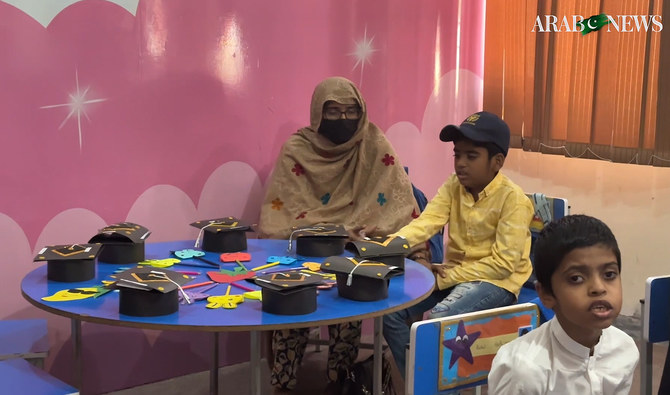
This intervention is exactly what is being offered at a special center established in the District Public School of Punjab’s Chakwal city last year. Seventeen children were initially enrolled in the center out of which two have graduated and gone on to attend mainstream schools, while 15 remain in the care of psychologists and therapists.
The center offers sensory, behavioral and speech therapy and has ADL (activities of daily living) classrooms where children are taught things like eating, bathing, brushing teeth, toileting, washing hands, dressing and undressing, and grooming. The center also has a separate bathroom and kitchen for children with ASD.
“A psychologist tests the children when the parents schedule a visit,” a teacher at the autism center, Umme Kulsoom, told Arab News. “We admit the child If they are diagnosed with autism level one,” the mildest, or “highest functioning” form of autism.
The work of Kulsoom and other teachers at the center is to determine the autistic child’s academic level by using various techniques such as testing their handgrip with pencils, coloring, drawing, and letter and sound recognition. Teachers the work with the children to improve their educational skills.
“Autism is a disorder in which the child’s focus and concentration needs to be worked on. Children can’t perform up to par academically as they have weak motor skills,” Kulsoom explained, saying the focus was on improving the child’s weaknesses before helping them pursue academics.
Psychologists working at the center give individual attention to each student to help them improve the performance of daily activities with sensory integration.
“It’s difficult to deal with these children as they have tantrums and mood swings but we are trained to handle them by using relaxation techniques to calm them down,” psychologist Maryam Jadoon said.
Psychologists at the center use a portage guide, a home-visiting educational service for pre-school children with additional support needs and their families, as well as applied behavioral analysis procedures that can help increase language and communication skills and improve attention, focus, social skills, memory, and academics.
The ADL room at the center has a bed, cupboard, hangers, and shirts to teach autistic children how to sleep, wake up, walk, comb their hair, brush their teeth, hand wash and dress.
Besides classwork, the teachers have also set up a dedicated WhatsApp group for parents on which they share videos and lessons to help them engage and teach children at home as well.
“We were not aware of autism before. When our daughter was diagnosed, we learned that there is a word like ‘autism’,” Javeria Arqam, a mother of two children with ASD, told Arab News.
“We visited different institutions in Chakwal, Islamabad, Karachi and Lahore before it, but the basic issue was that either they were offering [facilities for] academic or therapies. We were not able to find both of them together, but after coming here, we are getting almost all the facilities.
“QUITE WIDESPREAD”
The state-of-the-art autism center is the brainchild of the Punjab government and Chakwal Deputy Commissioner, Quratulain Malik.
“We provide speech therapy, clinical services, psychological assessments, cognitive disorders treatment and all other facilities required for boosting children’s confidence level,” Malik told Arab News.
“Ever since we have established this autism center, we have realized that the problem persists at quite a significant level, but parents were actually unaware,” she added.
“Now, they would bring their children and once they are diagnosed or once they are not diagnosed, at least they know where does the child stand. Many mothers who used to keep their child’s condition to themselves are now cooperative.”
Arab News sent a letter to the secretary of Punjab’s special education department seeking information on ASD figures and facilities, but didn’t receive a response till the filing of this report.
But while appreciating the efforts of the government, especially in providing free care for families that could not otherwise afford specialized care for ASD children, activists and experts said authorities needed to involve the private sector at public centers to improve facilities, clinical therapies, and education.
“Autism spectrum disorder is quite widespread in Pakistan as one in every three children is affected by it,” Maheen Gul-Malik, the founder of the Lahore Autism Center, told Arab News.
“The therapists and teachers hired in the public schools are not trained enough to extend individual attention to autistic children. There is also a need for constant monitoring of all activities at these centers through cameras.”


Government center in Pakistan’s Chakwal offers free education, therapy for children with autism
https://arab.news/vrwet
Government center in Pakistan’s Chakwal offers free education, therapy for children with autism

- Non-profit Autism Society of Pakistan says 350,000 children in the country have autism spectrum disaster
- 15 children currently enrolled at Chakwal center where they receive sensory, behavioral and speech therapy

OIC states discuss Islamophobia with UN officials, Pakistan envoy stresses solidarity
- OIC Core Group meets UN General Assembly president to discuss commemorations of International Day to Combat Islamophobia
- Pakistan top diplomat at UN says the observance symbolizes global unity against anti-Muslim prejudice and discrimination
ISLAMABAD: A group of Organization of Islamic Cooperation (OIC) member states on Tuesday discussed the upcoming commemoration of the International Day to Combat Islamophobia with senior United Nations officials, with Pakistan’s envoy describing the observance as a symbol of global solidarity against prejudice, hostility and discrimination directed at Muslims worldwide.
The International Day to Combat Islamophobia is observed annually on March 15, following its designation by the United Nations General Assembly in 2022, aimed at raising awareness of discrimination and violence targeting Muslims and promoting tolerance and inclusion.
Pakistan’s Permanent Mission to the United Nations said representatives of the OIC Core Group on Islamophobia met Annalena Baerbock, President of the General Assembly, along with the UN Special Envoy on Islamophobia and the High Representative of the UN Alliance of Civilizations.
“The International Day holds immense significance for the OIC and symbolizes global solidarity in combating Islamophobia,” Pakistan’s top diplomat at the UN, Ambassador Asim Iftikhar Ahmad, said during the meeting.
The OIC Core Group at the UN is an informal coordination bloc of Muslim countries that works within the United Nations system to align positions, draft statements and lead negotiations on issues of shared concern to OIC member states.
According to the Pakistani mission, the Core Group exchanged views with the General Assembly president on plans to mark the upcoming commemoration and ways to strengthen international engagement around the issue.
Ambassador Iftikhar recalled that the first such observance was held in 2023 under Pakistan’s chairmanship of the OIC Council of Foreign Ministers, followed by commemorations in 2024 and 2025.
He also welcomed the contributions of the UN Special Envoy in advancing international efforts to address anti-Muslim prejudice and promote tolerance.


