Joe Biden lands in France for D-Day anniversary, democracy speech

1 / 2
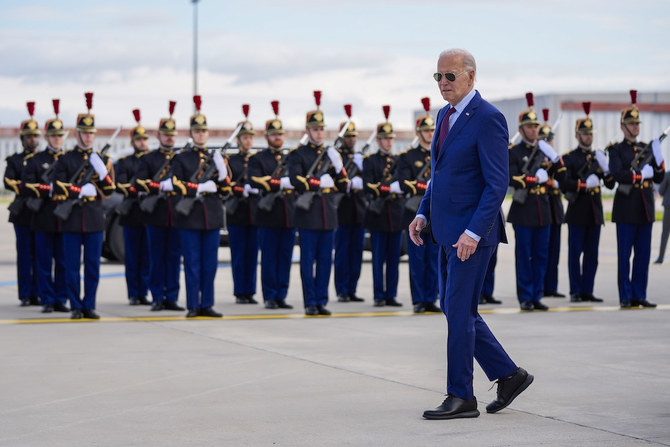
US president Joe Biden walks next to a French honor guard after arriving at Orly airport, south of Paris on June 5, 2024. Biden is in France to mark the 80th anniversary of D-Day. (AP)
2 / 2
President Joe Biden arrives to board Air Force One at Andrews Air Force Base on June 4, 2024 for a trip to France to mark the 80th anniversary of D-Day. (AP)
Short Url
Updated 05 June 2024
Follow

Joe Biden lands in France for D-Day anniversary, democracy speech

  • US leader will spend five days in France and attend D-Day celebrations in Normandy
  • Joe Biden will also meet the aged veterans who participated in the D-Day invasion

PARIS: President Joe Biden landed in France on Wednesday to commemorate the 80th anniversary of D-Day on a trip designed to underscore his commitment to US allies in Europe and contrast his vision of democracy with his 2024 political opponent Donald Trump.
Biden will spend five days in France and attend D-Day celebrations in Normandy, where US and allied forces stormed French beaches in an attack that helped defeat Nazi Germany in World War II, as well as deliver a high-profile speech and hold a formal state visit with President Emmanuel Macron.
While in Normandy Biden will sit down for talks with Ukraine President Volodymyr Zelensky about the war effort to repel Russian invaders, White House national security adviser Jake Sullivan told reporters aboard the presidential flight to Paris.
Biden’s remarks in Normandy, both on Thursday at the formal 80th anniversary ceremony and on Friday at the famed Pointe du Hoc cliffs, will center around the dangers of isolationism and the need to stand up to dictators, Sullivan said.
Biden will draw a connection from World War Two through the Cold War and creation of the NATO alliance to today, “where we face once again war in Europe, where NATO has rallied to defend freedom and sovereignty.”
In what promises to be an emotional moment, Biden will meet the aged veterans who participated in the D-Day invasion.
White House national security spokesperson John Kirby said the potential use of some $300 billion in frozen Russian assets to aid Ukraine would be discussed by Biden and Macron during the visit.
Biden, a Democrat, is running for re-election in November against Trump, a Republican, and has made preserving and strengthening US democracy a key part of his campaign in the aftermath of Trump’s chaotic four years in office.
Trump refused to accept the results of the 2020 election, which sparked a deadly attack on the US Capitol by his supporters on January 6, 2021; he has vowed to go after political opponents, deport immigrants and punish whistleblowers in a second term.
Trump has threatened to abandon NATO allies if they do not bolster their defense spending and some fear he would pull the United States out of the alliance altogether if he were elected president again.
Biden’s message on democracy could be complicated by his staunch backing of Israeli Prime Minister Netanyahu in Israel’s war with Hamas in Gaza, which has killed tens of thousands of Palestinians, after Hamas attacked Israel in October last year, killing over one thousand.
The International Criminal Court has charged Netanyahu with war crimes and some international allies and left-leaning voters in the United States want Biden to stop the flow of US military aid to Israel. The issue could hurt Biden in key states, including Michigan, in the November election.
The D-Day commemorations are set against a backdrop of a modern conflict in Europe, Russia’s more than 2-year war with Ukraine.
At a political fundraiser before his trip, Biden called the D-Day invasion “one of the most important moments in the history of defense of freedom and democracy in the history of the world” and said the sacrifices from that day must not be given up.
“Democracy is literally on the ballot this year. The future of democracy and freedom is at stake. We have brave soldiers who gave their lives on the beaches of Normandy who did their part,” he told donors in Connecticut on Monday.


Zelensky says Ukrainian air force needs to improve as Russian drone barrages take a toll

Updated 9 sec ago
Follow

Zelensky says Ukrainian air force needs to improve as Russian drone barrages take a toll

  • Zelensky said Friday he had discussed with his defense minister and the air force commander what new air defense measures Ukraine needs to counter the Russian barrages
  • Russia fired 328 drones and seven missiles at Ukraine overnight and in the early morning

KYIV: Ukrainian President Volodymyr Zelensky on Friday described the performance of the air force in parts of the country as “unsatisfactory,” and said that steps are being taken to improve the response to large-scale Russian drone barrages of civilian areas.
The repeated Russian aerial assaults have in recent months focused on Ukraine’s power grid, causing blackouts and disrupting the heating and water supply for families during a bitterly cold winter.
With the war about to enter its fifth year later this month following Russia’s all-out invasion of its neighbor, there is no sign of a breakthrough in US-led peace efforts following the latest talks this week.
Further US-brokered meetings between Russian and Ukrainian delegations are planned “in the near future, likely in the United States,” Zelensky said.
Zelensky said Friday he had discussed with his defense minister and the air force commander what new air defense measures Ukraine needs to counter the Russian barrages. He didn’t elaborate on what would be done.
Russia fired 328 drones and seven missiles at Ukraine overnight and in the early morning, the air force said, claiming that air defenses shot down 297 drones.
One person was killed and two others were injured in an overnight Russian attack using drones and powerful glide bombs on the central Dnipropetrovsk region, according to the head of the regional military administration, Oleksandr Hanzha.
A Russian aerial attack on the southern Zaporizhzhia region during early daylight hours injured eight people and damaged 18 apartment blocks, according to regional military administration head Ivan Fedorov.
A dog shelter in the regional capital was also struck, killing 13 dogs, Zaporizhzhia City Council Secretary Rehina Kharchenko said.
Some dogs were rushed to a veterinary clinic, but they could not be saved, she said. Seven other animals were injured and are receiving treatment.
Amid icy conditions in Kyiv, more than 1,200 residential buildings in multiple districts of the capital have had no heating for days due to the Russian bombardment of the power grid, according to Zelensky.
The UK defense ministry said Friday that Ukraine’s electricity network “is experiencing its most acute crisis of the winter.”
Mykola Tromza, an 81-year-old pensioner in Kyiv, said he has had his power restored, but recently went without heating and water at home for a week.
“I touched my nose and by God, it was like an icicle,” Tromza said. He said he ran up and down to keep warm.
Russia’s Defense Ministry said that air defenses downed 38 Ukrainian drones overnight, including 26 over the Bryansk region.
Bryansk Gov. Alexander Bogomaz said the attack briefly cut power to several villages in the region.
Another Ukrainian nighttime strike damaged power facilities in the Russian city of Belgorod, disrupting electricity distribution, Gov. Vyacheslav Gladkov said.
Local reports said that Ukrainian missiles hit a power plant and an electrical substation, cutting power to parts of the city.
Fierce fighting has also continued on the front line despite the frigid temperatures.
Ukraine’s Commander in Chief, Col. Gen. Oleksandr Syrskyi, said the front line now measures about 1,200 kilometers (750 miles) in length along eastern and southern parts of Ukraine.
The increasing technological improvements to drones on both sides mean that the so-called “kill zone” where troops are in greatest danger is now up to 20 kilometers (12 miles) deep, he told reporters on Thursday in comments embargoed until Friday.