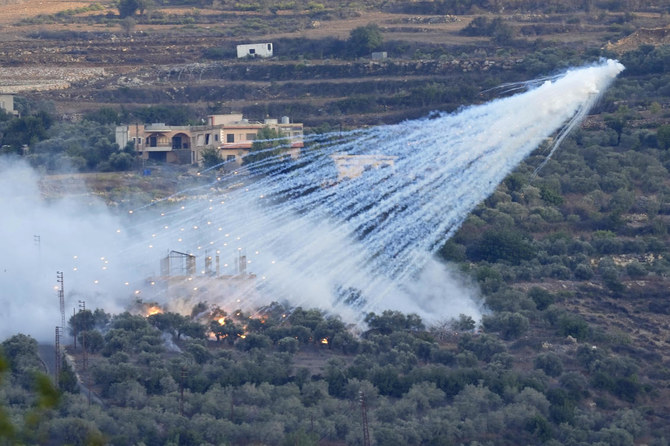
BEIRUT: A global human rights group claimed that Israel has used white phosphorus incendiary shells on residential buildings in at least five towns and villages in conflict-hit southern Lebanon, possibly harming civilians and violating international law, in a report published Wednesday.
Human Rights Watch said in its report that there was no evidence of burn injuries due to white phosphorus in Lebanon, but that researchers had “heard accounts indicating possible respiratory damage.”
Human rights advocates say it’s a crime under international law to fire the controversial munitions into populated areas.
Israel maintains it uses the white phosphorus only as a smokescreen and not to target civilians.
The white-hot chemical substance can set buildings on fire and burn human flesh down to the bone. Survivors are at risk of infections and organ or respiratory failure, even if their burns are small.
The HRW report includes interviews with eight residents in conflict-hit southern Lebanon, and the group says it has verified and geolocated images from almost 47 photos and videos that show white phosphorus shells landing on residential buildings in five Lebanese border towns and villages.
The Lebanese Health Ministry says at least 173 people have required medical care after exposure to white phosphorus.
The researchers found that the controversial incendiaries were used in residential areas in Kfar Kila, Mays Al-Jabal, Boustan, Markaba, and Aita Al-Shaab, towns that are among the hardest-hit in eight months of fighting.
The New York-based rights group alongside Amnesty International also accused Israel of using white phosphorus in residential areas in October 2023, less than a month after clashes began between the Israeli military and the powerful Hezbollah group along the southern Lebanon-Israel border, a day after the Israel-Hamas war broke out on Oct. 7.
In its report, HRW called on the Lebanese government to allow the International Criminal Court to investigate and prosecute “grave international crimes” within Lebanon since October 2023.
“Israel’s recent use of white phosphorus in Lebanon should motivate other countries to take immediate action toward this goal,” said HRW Lebanon Researcher Ramzi Kaiss.
More 400 people have been killed in Lebanon, most of them fighters but also including more than 70 civilians and noncombatants. In Israel, 15 soldiers and 10 civilians have been killed since October. Tens of thousands of people have been displaced on both sides of the border.


Israel hit Lebanon residential buildings with white phosphorous – rights group
https://arab.news/zmgwm
Israel hit Lebanon residential buildings with white phosphorous – rights group

- White-hot chemical substance can set buildings on fire and burn human flesh down to the bone
- Israel maintains it uses the white phosphorus only as a smokescreen and not to target civilians


Trump warns Iran of ‘very traumatic’ outcome if no nuclear deal
- Speaking a day after he hosted Netanyahu at the White House, Trump said he hoped for a result “over the next month”
WASHINGTON: US President Donald Trump threatened Iran Thursday with “very traumatic” consequences if it fails to make a nuclear deal — but Israeli Prime Minister Benjamin Netanyahu said he was skeptical about the quality of any such agreement.
Speaking a day after he hosted Netanyahu at the White House, Trump said he hoped for a result “over the next month” from Washington’s negotiations with Tehran over its nuclear program.
“We have to make a deal, otherwise it’s going to be very traumatic, very traumatic. I don’t want that to happen, but we have to make a deal,” Trump told reporters.
“This will be very traumatic for Iran if they don’t make a deal.”
Trump — who is considering sending a second aircraft carrier to the Middle East to pressure Iran — recalled the US military strikes he ordered on Tehran’s nuclear facilities during Israel’s 12-day war with Iran in July last year.
“We’ll see if we can get a deal with them, and if we can’t, we’ll have to go to phase two. Phase two will be very tough for them,” Trump said.
Netanyahu had traveled to Washington to push Trump to take a harder line in the Iran nuclear talks, particularly on including the Islamic Republic’s arsenal of ballistic missiles.
But the Israeli and US leaders apparently remained at odds, with Trump saying after their meeting at the White House on Wednesday that he had insisted the negotiations should continue.
- ‘General skepticism’ -
Netanyahu said in Washington on Thursday before departing for Israel that Trump believed he was laying the ground for a deal.
“He believes that the conditions he is creating, combined with the fact that they surely understand they made a mistake last time when they didn’t reach an agreement, may create the conditions for achieving a good deal,” Netanyahu said, according to a video statement from his office.
But the Israeli premier added: “I will not hide from you that I expressed general skepticism regarding the quality of any agreement with Iran.”
Any deal “must include the elements that are very important from our perspective,” Netanyahu continued, listing Iran’s ballistic missile program and its support for armed groups such as the Palestinian movement Hamas, Yemen’s Houthi rebels and Hezbollah in Lebanon.
“It’s not just the nuclear issue,” he said.
Despite their differences on Iran, Trump signaled his strong personal support for Netanyahu as he criticized Israeli President Isaac Herzog for rejecting his request to pardon the prime minister on corruption charges.
“You have a president that refuses to give him a pardon. I think that man should be ashamed of himself,” Trump said on Thursday.
Trump has repeatedly hinted at potential US military action against Iran following its deadly crackdown on protests last month, even as Washington and Tehran restarted talks last week with a meeting in Oman.
The last round of talks between the two foes was cut short by Israel’s war with Iran and the US strikes.
So far, Iran has rejected expanding the new talks beyond the issue of its nuclear program. Tehran denies seeking a nuclear weapon, and has said it will not give in to “excessive demands” on the subject.


