


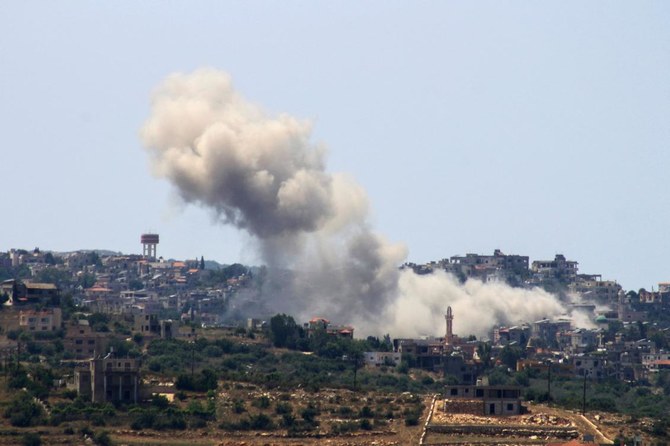
BEIRUT/JERUSALEM: Lebanon’s Hezbollah movement is not seeking to widen its conflict with Israel but is ready to fight any war imposed on it, its deputy leader was quoted as saying on Tuesday, as hostilities across the Lebanese-Israeli border remained intense.
Iran-backed Hezbollah and Israel have been exchanging fire for the past eight months in parallel with the Gaza war, raising concerns that an even wider conflict could break out between the heavily armed adversaries.
The hostilities between Israel and Hezbollah have been their worst since they waged war in 2006, and tens of thousands of people on both sides of the border have been forced to flee their homes.
Hezbollah deputy leader Sheikh Naim Qassem told broadcaster Al Jazeera that the group’s decision was not to “widen the war” but that it would fight one if it was imposed on it, according to a newsflash run before the interview was screened.
Israel’s war cabinet was due to meet later on Tuesday mainly to discuss the northern front, an Israeli official said.
Israeli government spokesperson David Mencer said the fighting in the area was “not a sustainable reality,” adding that Israel was committed to ensuring the return home of tens of thousands of Israelis evacuated from the north.
“It is up to Hezbollah to decide if this can be accomplished by diplomatic means or by force,” he said. “We are defending this country and no one should be surprised by our response.”
Amos Hochstein, a senior adviser to US President Joe Biden at the heart of diplomatic efforts seeking de-escalation, said last week a land border agreement between Israel and Lebanon implemented in phases could dampen the conflict.
Israel has gone to war numerous times in Lebanon.
“WE MUST... DESTROY THEM“
Earlier on Tuesday, Israeli far-right ministers Bezalel Smotrich and Itamar Ben-Gvir both urged more military action.
“There cannot be peace in Lebanon while our land is hit and people here are evacuated,” Ben-Gvir said following a tour in the northern city of Kiryat Shmona in a video statement shared on X. “They’re setting fires here, we must burn all of Hezbollah’s strongholds, destroy them. War!“
Ben-Gvir and Smotrich are members of Israel’s security cabinet but not of the war cabinet.
The violence, which has oscillated for months, escalated in recent days. Hezbollah announced on Tuesday it had launched a squadron of one-way attack drones at an Israeli military barracks for a second consecutive day, calling it a response to a deadly Israeli attack in Naqoura, Lebanon.
Sirens sounded in northern Israel, where rockets fired from Lebanon set off wildfires on Monday.


