Firefight with Indian soldiers leaves two Kashmir rebels dead

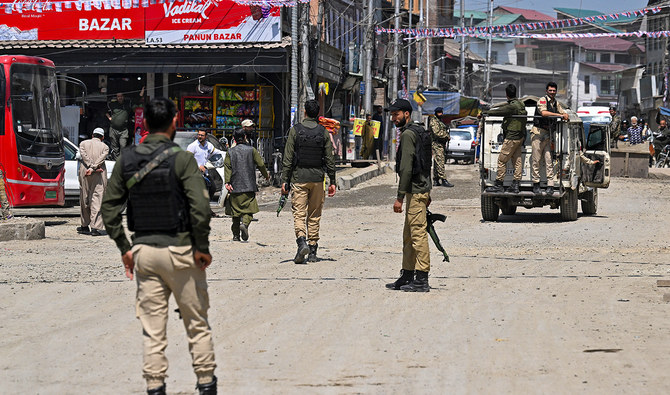
Security personnel patrol during an election campaign rally near Jamia Masjid mosque in Srinagar on May 6, 2024, ahead of the third phase voting in India's general election. (AFP/File)
Short Url
Updated 03 June 2024
Follow

Firefight with Indian soldiers leaves two Kashmir rebels dead

  • The armed encounter was triggered late Sunday when police and army contingents surrounded a house in the Pulwama district
  • Kashmir’s police chief told reporters the duo’s killing was ‘a very significant development’ in their fight against the insurgents

SRINAGAR: Two suspected rebels were killed in a firefight with soldiers in Indian-administered Kashmir, police said Monday, weeks after the disputed, mostly Muslim territory saw its highest voter turnout for decades in India’s general election.
The armed encounter was triggered late Sunday when police and army contingents surrounded a house in the southern Pulwama district after receiving intelligence that militants were there.
The bodies of the two slain rebels, both believed to be locals, were recovered from the site, police said in a post on social media platform X.
Kashmir’s police chief Vidhi Kumar Birdi told reporters the duo’s killing was “a very significant development” in their fight against the insurgents.
After the clash, hundreds of angry residents gathered near two houses gutted during the firefight, shouting “We want freedom,” an AFP journalist saw, in a rare protest.
Kashmir has been divided between India and Pakistan since their independence in 1947, and both claim the high-altitude territory in full.
Rebel groups have waged an insurgency since 1989, demanding independence or a merger with Pakistan.
The conflict has left tens of thousands of civilians, soldiers, and rebels dead.
Violence and anti-India protests have drastically fallen since 2019, when Prime Minister Narendra Modi’s government canceled the region’s limited autonomy.
Five rebels and an Indian air force corporal were killed in clashes since election campaigning in the territory began in April.
But it saw a 58.6 percent turnout at the polls, the election commission said Monday, a 30 percentage point jump from the last vote in 2019 and the highest in 35 years.
No separatist group had called for a boycott of the election — a first since the armed revolt against Indian rule erupted in the territory in 1989.
India regularly accuses Pakistan of supporting and arming the rebels, a charge Islamabad denies.


Bangladesh backtracks on initial interest to join Trump’s Gaza stabilization force

Updated 5 sec ago
Follow

Bangladesh backtracks on initial interest to join Trump’s Gaza stabilization force

  • Bangladesh currently faces various pressures from US, former ambassador says
  • Main parties contesting upcoming election distance themselves from government’s decisions

DHAKA: Facing domestic backlash, Bangladesh has backtracked on its initial interest in joining the US-planned military force in Gaza, with the interim administration saying it would leave the decision to the government appointed after next month’s polls.

The possibility of Bangladesh joining the International Stabilization Force — a part of US President Donald Trump’s controversial Gaza peace plan — was floated by National Security Adviser Khalilur Rahman last week, during his visit to Washington D.C., where he said he had “expressed Bangladesh’s interest in principle” to join it.

The announcement was immediately met with criticism from civil society at home, where any move perceived as undermining Bangladesh’s support for the Palestinians is unlikely to be popular.

Following the pushback, the country’s top diplomat, Foreign Affairs Adviser Touhid Hossain, told reporters on Wednesday that “no decision has yet been made” and that the caretaker Cabinet — which is overseeing Bangladesh until new leadership takes office after the February vote — “will not do anything … that the next government would need to completely reverse.”

Bangladesh will hold general elections on Feb. 12, and the main two parties contesting it — the Bangladesh Nationalist Party and Bangladesh Jamaat-e-Islami — have already distanced themselves from the caretaker government’s decisions.

“We will not blindly adhere to any policy that has been adopted by this interim government,” Nawshad Zamir, BNP’s international affairs secretary, told Arab News, while Jamaat’s spokesperson, Ahsanul Mahboob Zubair, said the party would “not take any such steps that violate the UN and existing international laws and stand in contrast to our people’s aspirations.”

While the UN’s approach to Trump’s plan is equivocal, the international force has been rejected by Palestinian groups in Gaza as a “form of deep international partnership in the war of extermination waged by the (Israeli) occupation against our people.”

More than 71,400 Palestinians have been killed and 171,000 wounded as a result of Israeli attacks since the start of its war on Gaza in October 2023, according to Gaza’s Ministry of Health. The true death toll is feared to be much higher, as many people have died due to injury and lack of access to healthcare and food  — caused by the Israeli military’s destruction of Gaza’s infrastructure, and the blocking of medical aid and food.

Most of the Muslim countries which took part in a US-organized Gaza summit in Sharm El-Sheikh in October and initially considered joining Trump’s stabilization force have either pulled out of the plan or postponed announcing their decision.

Bangladesh’s sudden expression of interest came as a surprise as it had neither been part of the Sharm El-Sheikh meeting nor historically involved in Middle Eastern politics.

Humayun Kabir, former Bangladeshi ambassador to the US, linked it to the current pressures Bangladesh was facing from the Trump administration, including increased taxation of remittances and visa restrictions.

“In this context, I think Bangladesh has expressed its interest to join the US-led Gaza force in a bid to neutralize these pressures to some extent,” Kabir told Arab News.

But the political cost of actually following through could be too high for those who would decide to implement it.

“The people of Bangladesh have unconditional support for Palestine,” Kabir said. “In this backdrop it would be politically difficult for the government to go for anything that goes against the interests of the Palestinians.”

For political scientist Prof. Amena Mohsin, Bangladesh’s involvement in the force would be against its longstanding position of solidarity.

“We can’t go against our long-held positions regarding Palestine. We shouldn’t get involved in any controversy initiated by the Western powers,” she said.

“I don’t think any decision of this kind would be popular or get people’s support in Bangladesh.”

Shahidul Alam, a prominent photographer and Time Magazine Person of the Year 2018, said it would be “betrayal.”

Alam, who last year represented Bangladesh in the Freedom Flotilla Coalition to break Israel’s illegal siege of Gaza, said that he understood there was geopolitical pressure on Bangladesh but participating in “this sham of a peacekeeping force” would be a shameful act that Bangladeshis would never live down.

“This so-called stabilization force is not about peace,” he said. “It is about disarming resistance. It is about legitimizing occupation. It is about finishing what bombs could not: the complete subjugation of a people who refuse to surrender their right to exist in dignity.”