

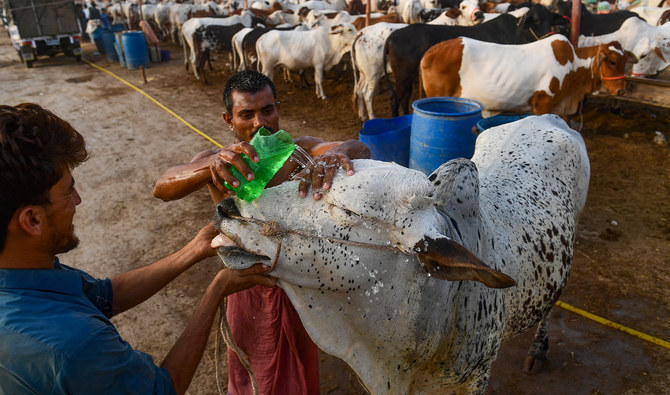

ISLAMABAD: The disaster management authority in Pakistan’s Punjab province recently shared guidelines on how to protect sacrificial animals from the heat wave, as temperatures in certain parts of the country last week surged past 50° Celsius.
Increased exposure to heat, and more heat waves, have been identified as one of the key impacts of climate change in Pakistan, with people experiencing extreme heat and seeing some of the highest temperatures in the world in recent years. The South Asian country of more than 241 million, one of the ten most vulnerable nations to climate change impacts, has also recently witnessed untimely downpours, flash floods and droughts.
Pakistan’s National Disaster Management Authority (NDMA) last week warned the heat wave would persist across parts of Sindh and Punjab in June, with temperatures likely to remain above 48 degrees Celsius.
Makeshift cattle markets have sprung up in various parts of the country as the Islamic Eid Al Adha, or the Feast of Sacrifice event nears. Muslims around the world slaughter an animal, usually a goat, sheep or cow on Eid Al Adha and distribute its meat among relatives and the poor.
“The provision of water for animals should be ensured in cattle markets,” an advisory by the Punjab Disaster Management Authority (PDMA) on Saturday said. “The PDMA has also issued directives for temporary shelters to be built in markets.”
The authority also called on cattle market owners to ensure health centers near their markets, warning that the heat wave is likely to persist throughout June.
“Through precautionary measures, one can ensure safety against the heat wave,” PDMA Punjab said. “Those buying and selling cattle in markets should adhere to precautionary measures.”
Pakistan’s Meteorological Department (Met) said on Monday that the weather is expected to remain hot in most parts of the country, adding that the country’s plain areas would expect “very hot” weather for the next 24 hours.
Climate change-induced extreme heat can cause illnesses such as heat cramps, heat exhaustion, heatstroke, and hyperthermia. It can make certain chronic conditions worse, including cardiovascular, respiratory, and cerebrovascular disease and diabetes-related conditions, and can also result in acute incidents, such as hospitalizations due to strokes or renal disease.
According to the Global Climate Risk Index, nearly 10,000 Pakistanis died while the country suffered economic losses worth $3.8 billion due to climate change impacts between 1999 and 2018. A deadly heat wave that hit Pakistan’s largest city of Karachi, the capital of Sindh, claimed 120 lives in 2015.
In 2022, torrential monsoon rains triggered the most devastating floods in Pakistan’s history, killing around 1,700 people and affecting over 33 million, a staggering number close to the population of Canada. Millions of homes, tens of thousands of schools and thousands of kilometers of roads and railways are yet to be rebuilt.


