

India awaits election results after deluge of disinformation

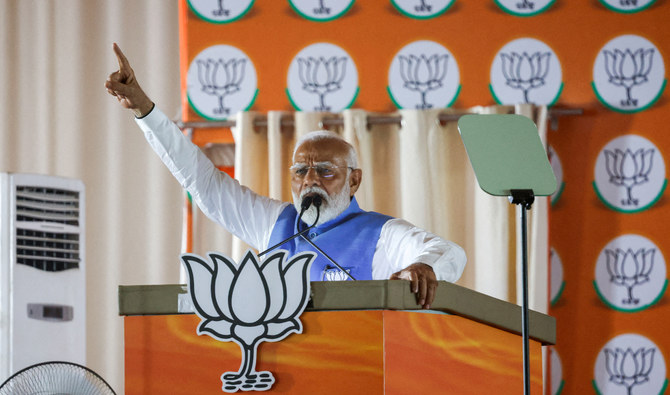
India's Prime Minister Narendra Modi gestures as he addresses supporters during an election campaign rally, in New Delhi, India, on May 22, 2024. (REUTERS)
Short Url
Updated 03 June 2024
Follow

India awaits election results after deluge of disinformation

  • India’s elections brought with it surge of false social media posts such as doctored videos, images with false captions
  • Some fake videos showed Bollywood stars endorsing opposition, as well as purporting to show a person casting multiple votes

NEW DELHI: India’s six-week election was staggering in its size and logistical complexity, but also in the “unprecedented” scale of online disinformation.

The biggest democratic exercise in history brought with it a surge of false social media posts and instant messaging, ranging from doctored videos to unrelated images with false captions.

Raqib Hameed Naik, from the US-based India Hate Lab, said they had “witnessed an unprecedented scale of disinformation” in the elections.

“Conspiracy theories... were vigorously promoted to deepen the communal divide,” said Naik, whose organization researches hate speech and disinformation.

With seven stages of voting stretched over six weeks, AFP factcheckers carried out 40 election-related debunks across India’s political divide.

There were fake videos of Bollywood stars endorsing the opposition, as well as those purporting to show one person casting multiple votes.

Some were crude or poked fun.

Others were far more sinister and sophisticated productions aimed to deliberately mislead.

All were widely shared.

Prime Minister Narendra Modi’s Hindu-nationalist Bharatiya Janata Party (BJP) came under fire for posts stoking sectarian tensions with India’s minority Muslim community of more than 200 million.

These included numerous videos, matching incendiary campaign speeches by Modi, falsely claiming his opponents were planning to redistribute India’s wealth in favor of Muslims.

Naik said such posts “aimed at stoking fear and animosity toward Muslims to polarize voters along religious lines.”

“The ruling party’s strategy of exploiting religious sentiments for electoral gain has not only undermined the integrity of the democratic process but also sowed dangerous seeds of division and hatred in society,” he said.

False information was detected across the political spectrum but the leader of the opposition Congress party, Rahul Gandhi, was one of the leading targets.

His statements, videos and photographs were shared on social media, but often incompletely or out of context.

One digitally altered video analyzed by AFP used Gandhi’s real boast that the opposition alliance would triumph, but flipped it to say Modi would win a third term when the result is declared on Tuesday.

Others purported to show Gandhi falsely appealing to people to vote for Modi.

Among the more egregious examples were those falsely linking him to India’s rival neighbors, Pakistan and China.

Those included a photograph that claimed Gandhi was waving the “Chinese constitution” during an election rally. It was in fact that of India.

Other posts portrayed Gandhi, a Hindu, as being against India’s majority religion, capitalizing on Modi’s efforts to cast himself as the country’s most staunch defender of the faith.

One video of a ruined Hindu temple, a real image from Pakistan, was widely shared.

However, the post falsely claimed it was from Gandhi’s constituency and that he was responsible for its destruction.

Another manipulated video falsely showed him refusing to accept a statue of a Hindu god.

One more claimed he was paying young people to support him on social media, when in reality he was talking about youth unemployment.

They were all widely shared by BJP supporters.

While political parties across the board have well-oiled digital outreach and social media teams, critics said the BJP’s sophisticated online campaign was driving posts.

Gandhi has alleged vast sums were “spent to distort my image” and blamed Modi’s party.

However, opposition parties also spread disinformation targeting the BJP and glorifying Congress.

Several digitally manipulated videos of two Bollywood actors criticizing the BJP and appealing to the public to vote for the Congress party were published.

Social media users also shared an old video to falsely accuse the ruling party of tampering with an electronic voting machine to rig the election in its favor.

“Overall, trust in content itself is falling,” said Joyojeet Pal, an expert in the role of technology in democracy from the University of Michigan.

Pal told AFP that Indian social media users widely understood the prevalence of disinformation and doctored content during the election.

“So there is a very good chance that they do not believe the doctored content to be real,” he said.

“However, there is a good chance they will forward these anyway because they align with their beliefs.”


Tarique Rahman-led BNP set to form Bangladesh’s next government after major election win

Updated 5 sec ago
Follow

Tarique Rahman-led BNP set to form Bangladesh’s next government after major election win

  • Jamaat-e-Islami, banned during Hasina’s government, won 68 seats
  • Majority of Bangladeshis endorsed sweeping reforms in national referendum

DHAKA: The Bangladesh Nationalist Party, led by Tarique Rahman, is set to form the country’s next government after securing a more than two-thirds majority in the first elections since a student-led uprising in 2024 ousted ex-prime minister, Sheikh Hasina.

The BNP has won at least 209 seats out of the 299 contested, according to the latest election results released by the Election Commission on Friday, paving the way for Rahman to become the country’s next prime minister.

Jamaat-e-Islami, banned during Hasina’s 15 years in power, has registered its best performance yet, winning at least 68 seats and emerging as the main opposition party.

The National Citizen Party, which was born out of the 2024 protests, was in third place with six seats, including for its leader Nahid Islam, while Hasina’s Awami League was barred from participating in the elections.

The majority of Bangladeshis also reportedly voted “yes” in a national referendum on the “July National Charter” that was held alongside the general vote on Thursday.

Named after the month when the uprising that toppled Hasina began, the charter is aimed at achieving sweeping democratic reforms to prevent authoritarian administrations, including term limits for premiers, stronger presidential powers and greater judicial independence, while also proposing increased representation of women in parliament.

The BNP-led government is likely to follow the commitments made under the charter, said Prof. A.S.M. Amanullah, vice chancellor of the National University in Dhaka, adding that the implementation of the July charter was also included in the party’s election manifesto that covers reform of the state and rebuilding of the economy.

“Mr. Tarique Rahman is a highly trained politician, highly sensitive politician, and he takes decisions based on facts. I believe he prepared himself to run this country locally and play a role internationally,” Amanullah told Arab News.

Rahman is the son of former Prime Minister Khaleda Zia and former President Ziaur Rahman. He returned to Bangladesh late last year after nearly two decades of self-imposed exile in the UK, and assumed BNP’s leadership days later, following his mother’s death from a prolonged illness.

In an interview with Arab News earlier this week, the 60-year-old pledged to pursue accountability for the former leadership and meet the political and economic expectations of the youth movement that brought about the change.

The new government is likely to be a mix of young and old politicians, Amanullah said, with Jemaat-e-Islami set to balance out the BNP’s rule.

“This is a very good size of opposition to press the issues or to challenge the government on different issues, different policies and decisions of the government. I’m hopeful about Jemaat,” he said.

“The way the people voted for these major two parties, the BNP and Jemaat, I think if they could work jointly, Bangladesh should see a stable political situation in the near future.”

Mohiuddin Ahmad, a political analyst and researcher, described Jemaat-e-Islami as “the most organized party” in Bangladesh and that it would therefore play an “instrumental” role as the opposition party.

Voter turnout averaged 59.44 percent, the EC said, with many Bangladeshis considering this week’s vote as their first “free and fair” election after more than 17 years.

“Such a result of an election we haven’t actually experienced before,” Muhiuddin Iqbal, a history student at Dhaka University, told Arab News.

“The festive feeling has not gone yet, so we’re very much excited about it and hopeful for the future.”