

Ultra-Orthodox protesters block Jerusalem roads ahead of Israeli court decision on draft exemptions

1 / 2
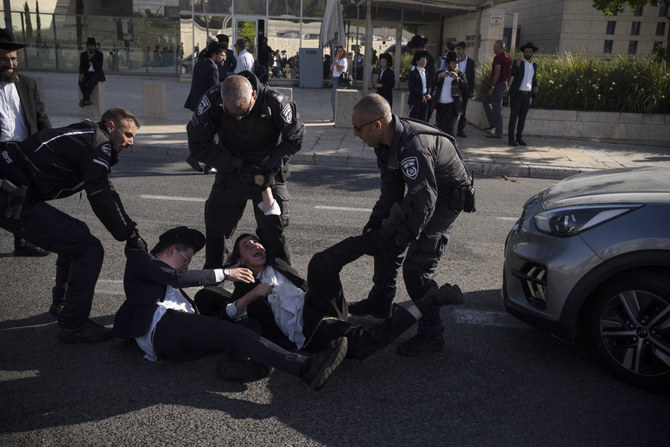
Israeli police disperse Ultra-Orthodox Jews blocking a highway near Bnei Brak, Israel, on June 2, 2024, during a protest against possible changes to regarding the laws for military drafts from which the ultra-Orthodox have traditionally received exemptions. (AP)
2 / 2
Israeli police officers disperse ultra-Orthodox Jewish men during a protest against army recruitment in Jerusalem on June 2, 2024. (AP)
Short Url
Updated 03 June 2024
Follow

Ultra-Orthodox protesters block Jerusalem roads ahead of Israeli court decision on draft exemptions

  • Most Jewish men and women in Israel are required to serve mandatory military service at the age of 18.
  • But the politically powerful ultra-Orthodox have traditionally received exemptions if they are studying full-time in religious seminaries

Dozens of ultra-Orthodox protesters blocked roads in Jerusalem on Sunday as Israel’s Supreme Court heard arguments in a landmark case challenging a controversial system of exemptions from military service granted to the religious community.

The court is looking at the legality of the exemptions, which have divided the country and threatened to collapse Prime Minister Benjamin Netanyahu’s governing coalition. A decision is expected in the coming weeks.
Most Jewish men and women in Israel are required to serve mandatory military service at the age of 18. But the politically powerful ultra-Orthodox have traditionally received exemptions if they are studying full-time in religious seminaries. These exemptions have infuriated the wider general public, especially as hundreds of soldiers have been killed in the war with Hamas.
During Sunday’s arguments, government lawyers told the judges that forcing ultra-Orthodox men to enlist would “tear Israeli society apart.” The court suggested a target of enlisting 3,000 ultra-Orthodox men a year –- more than double the current levels but still less than 25 percent of their overall numbers.
In Jerusalem, Israeli police cleared protesters from roads, and forcefully removed those who briefly blocked the city’s light rail. Demonstrators chanted “to prison and not to the army.”
In March, the court ordered an end to government subsidies for many ultra-Orthodox men who do not serve in the army.
Netanyahu faces a court-ordered deadline of June 30 to pass a new law that would end the broad exemptions. But he depends on ultra-Orthodox parties to prop up his government, and ending the exemptions could cause them to leave and trigger new elections.


Algeria inaugurates strategic railway to giant Sahara mine

President Tebboune attended an inauguration ceremony in Bechar. (AFP file photo)
Updated 02 February 2026
Follow

Algeria inaugurates strategic railway to giant Sahara mine

  • The mine is expected to produce 4 million tons per year during the initial phase, with production projected to triple to 12 million tons per year by 2030
  • The project is financed by the Algerian state and partly built by a Chinese consortium

ALGEIRS: Algerian President Abdelmadjid Tebboune on Sunday inaugurated a nearly 1,000-kilometer (621-mile) desert railway to transport iron ore from a giant mine, a project he called one of the biggest in the country’s history.
The line will bring iron ore from the Gara Djebilet deposit in the south to the city of Bechar located 950 kilometers north, to be taken to a steel production plant near Oran further north.
The project is financed by the Algerian state and partly built by a Chinese consortium.
During the inauguration, Tebboune described it as “one of the largest strategic projects in the history of independent Algeria.”
This project aims to increase Algeria’s iron ore extraction capacity, as the country aspires to become one of Africa’s leading steel producers.
The iron ore deposit is also seen as a key driver of Algeria’s economic diversification as it seeks to reduce its reliance on hydrocarbons, according to experts.
President Tebboune attended an inauguration ceremony in Bechar, welcoming the first passenger train from Tindouf in southern Algeria and sending toward the north a first charge of iron ore, according to footage broadcast on national television.
The mine is expected to produce 4 million tons per year during the initial phase, with production projected to triple to 12 million tons per year by 2030, according to estimates by the state-owned Feraal Group, which manages the site.
It is then expected to reach 50 million tons per year in the long term, it said.
The start of operations at the mine will allow Algeria to drastically reduce its iron ore imports and save $1.2 billion per year, according to Algerian media.