


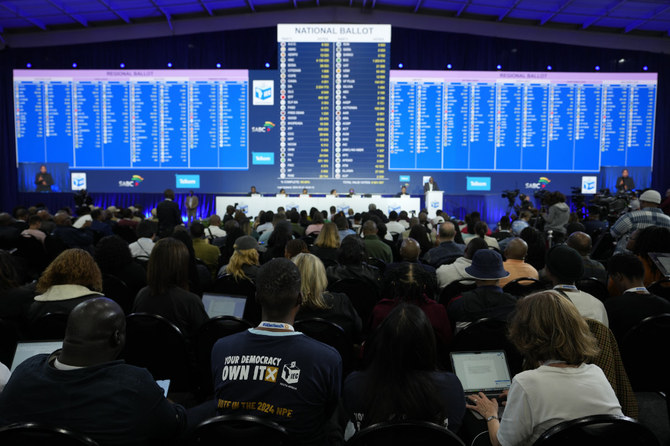

CAPE TOWN, South Africa: It was a historic day for South Africa. The political party that ended the racially divisive era of apartheid and sent global hopes soaring with a vibrant new democracy has lost its three-decade grip on power, according to election results Saturday.
For the first time, the African National Congress will have to form a coalition to govern South Africa, whose role on the global stage is growing as it takes Israel to court over its actions in Gaza and assumes the presidency of the Group of 20 nations late this year.
Here’s what might lie ahead for a leading voice for the developing world after the ANC lost its dominance at home.
Challenging Israel over Gaza
South Africa has become the most visible critic of Israel’s actions in Gaza by accusing it of genocide in a case at the International Court of Justice, the UN’s top court.
The case has been largely driven by the ANC, which has long identified with the Palestinian cause and sees in Gaza and the occupied West Bank uncomfortable parallels with the distant “homelands” created for South Africa’s Black people by the former white-controlled government under the brutal system of apartheid.
Israel vehemently denies the allegations of genocide. The ANC’s loss of its parliamentary majority in this week’s election made news in Israel.
The case at the world court could go on for years, meaning a new South African coalition government will inherit it. The ANC likely will form a governing deal with one or more of South Africa’s three main opposition parties — the centrist Democratic Alliance, the far-left Economic Freedom Fighters and the populist new MK Party of former President Jacob Zuma.
The Democratic Alliance, which received around 21 percent of the vote, has said it doesn’t agree with the genocide case against Israel and would rather see South Africa push for a mediated settlement in the Israel-Hamas war. The EFF is seen to be at least as pro-Palestinian as the ANC and has also accused Israel of genocide. The position of the MK Party, formed late last year, is not clear.
G20 presidency lies ahead
South Africa has long been seen as a leading representative of the African continent in the world, and on Dec. 1 it assumes the prominent presidency of the Group of 20 nations — 20 leading rich and developing nations. South Africa will take over from Brazil, which is using its presidency to push for greater representation of developing nations on the global stage.
South Africa is the only African nation in the G20. The ANC and its new governing partner or partners will need to look beyond South African politics and find a common stance on pressing global issues such as climate change, conflict and reforms of international financial institutions.
“Regardless of the electoral outcome, deep-seated elements of South African foreign policy will persist, such as championing the rights of Palestinians and calling for international institutions to reform to better reflect the priorities of African states,” Michelle Gavin wrote last month for the Council on Foreign Relations.
And then there’s Russia
South Africa’s diplomacy under the ANC has drawn attention for its historic pro-Moscow stance that continued after Russia’s full-scale invasion of Ukraine more than two years ago. While the United States and others in the West have long recognized the ANC’s ties to Russia — they go back to the fight against apartheid — the US-South Africa relationship was seriously strained when the ANC government allowed Russian and Chinese warships to conduct drills off its coast in early 2023.
The main opposition Democratic Alliance has been strongly critical of the ANC over its relationship with Russia, accusing it of betraying its claimed position of nonalignment and neutrality with regards to the war in Ukraine and the larger tensions between Russia and the West.
Gavin suggested that an “unstable” governing coalition could hurt South Africa as a gateway for foreign investors and “push the country even closer to Russia and China.”


