Saudi youth set to lead the charge for project management: PMOGA MD  

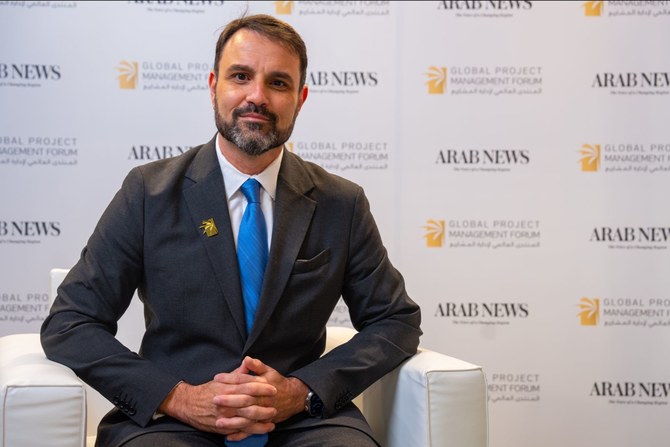
Americo Pinto, managing director of the Project Management Office Global Alliance, speaking to Arab News. AN
Short Url
Updated 02 June 2024
Follow

Saudi youth set to lead the charge for project management: PMOGA MD  

RIYADH: Saudi Arabia’s drive toward a brighter future is significantly impacting today’s youth and tomorrow’s leaders in the project management sector, according to a top official.  

Speaking to Arab News during the Global Project Management Forum in Riyadh, Americo Pinto, managing director of the Project Management Office Global Alliance, highlighted the young people in the Kingdom as the cornerstone for substantial development.  

The two-day annual event being held in the Saudi capital highlights the latest developments in the field of project management across various sectors and is set to attract more than 2,000 participants. 

Pinto observed a proactive approach in the region toward preparing future leaders, and said: “I really see a region and a country (Saudi Arabia) that is looking to prepare their leaders for the future, and the future is now.”  

He added that he believes the impact of the investments and cultural changes will be evident for years to come.  

Reflecting on the region’s unique energy and enthusiasm for project management, Pinto stated: “It’s something that is interesting to observe from a little distance, especially comparing with other regions where maybe we have project management as something more mature in terms of topic.  

“But here I feel a different kind of energy and it makes me really happy because it’s great to be part of it.”  

Pinto expressed a particular enthusiasm for working with individuals from the Middle East, specifically Saudi Arabia.   

“I have a special joy in working with people from the Middle East and Saudi Arabia. I see people, especially young leaders, seeking knowledge and exchange experience,” he remarked.   

Pinto further highlighted that the Middle East region currently holds the highest number of PMOGA members, indicating great potential for PM development.  

Moreover, Pinto stated that Saudi companies have been an active participant in the annual PMO Global Awards, with the Kingdom’s Saudi Post, also known as SPL, winning the World PMO of the Year in 2023.  

“It’s interesting that each year we have more companies from Saudi Arabia participating. Last year, we had nine, this year we have 20. I don’t know, but in a few times, it will become the Saudi Arabia awards,” he quipped.  

Speaking about industry trends, Pinto explained that artificial intelligence represents the most significant trend in the project management sector.  

The technology presents a multitude of possibilities and is rapidly becoming essential for companies seeking to enhance their operations and overall results, he explained.  

“Every company should embrace AI as a great possibility to increase activity and results as a whole,” Pinto noted, emphasizing the transformative potential of AI in the project management office.  

Pinto added, “PMO leaders should be very concerned about that (AI), but as I said, in a positive way, because it can bring a lot of benefits for any PMO.”   

He highlighted the importance of PMO leaders recognizing AI’s potential to significantly impact their area, ultimately leading to greater efficiency and effectiveness in project management.  

Pinto anticipates that AI will be used for calculating possibilities and predicting outcomes in recent years.  

“AI is something that will change the game. It will enable us to do things we cannot do today,” he stated.  

Founded in 2017, PMOGA is a global community with more than 17,000 members in more than 125 countries. The alliance was acquired by the Project Management Institute, the leading authority in project management, earlier last year. 


From 2 hours to 30 minutes: Qiddiya Bullet Train to cut Riyadh travel time by 75% 

Updated 6 sec ago
Follow

From 2 hours to 30 minutes: Qiddiya Bullet Train to cut Riyadh travel time by 75% 

RIYADH: Qiddiya is set to become significantly more accessible under plans to link the entertainment and tourism hub to King Salman International Airport and the King Abdullah Financial District through the new Qiddiya Bullet Train, Asharq Al Awsat reported

The project will reduce travel time to around 30 minutes, down from nearly two hours using other transport options, representing a 75 percent cut in commuting time. Operational speeds are expected to reach 250 km per hour, according to the Royal Commission for Riyadh City. 

The railway forms part of a broader transport strategy aimed at improving connectivity across the capital and enhancing mobility between key destinations, in line with population growth and urban expansion in western and southwestern Riyadh. 

In a related development, the commission announced the awarding of the Red Line extension of the Riyadh Metro to Diriyah. The expansion includes 7.1 km of tunnel and 1.3 km of elevated track, with stations at King Saud University and Diriyah. The latter is expected to serve as a future interchange with the planned Line 7. 

Officials estimate the project could remove around 150,000 cars from daily traffic, improving access to tourist destinations such as Bujairi Terrace and Wadi Safar, while supporting more sustainable mobility patterns. 

Bandar Al-Saadoun, vice chairman of Khaleejiah Holding, told Asharq Al-Awsat that the Diriyah development ranks among the largest projects under Vision 2030. He pointed to additional landmark initiatives in Wadi Safar, alongside the Opera House project and King Salman Grand Mosque. 

He said extending the Red Line along King Abdullah Road to Diriyah would generate strong real estate demand, particularly as the rail network integrates routes from King Salman International Airport through KAFD, Diriyah and the New Murabba development. 

Al-Saadoun added that roughly 30 projects have been announced in Qiddiya, raising the prospect of gradual real estate growth along corridors connected to the rail line. The project’s links to major developments — including Expo 2030 Riyadh, New Murabba and The Avenues — as well as the airport, which is expected to become one of the world’s largest by 2030, are likely to reinforce demand. 

Real estate analyst Khaled Almobid said large-scale transport projects such as the Qiddiya Bullet Train do more than lift prices; they reshape market structure and asset values over the medium and long term. 

Historically, properties within one to three km of transport stations see capital appreciation and rising investment demand, particularly for undeveloped “white land,” which often transitions into higher-density projects, he said. 

Almobid expects a dual impact: both redistribution of demand within Riyadh and genuine market expansion driven by what he called “manufactured demand” from Qiddiya, which is projected to attract 17 million visitors and generate 325,000 jobs. He also anticipates a population shift toward western Riyadh and areas surrounding the new stations. 

Land prices near Qiddiya have already risen between 30 percent and 40 percent since 2023, reflecting early market anticipation, he said, predicting more sustainable growth once operations begin and prices align with the tangible value of cutting travel time to 30 minutes between the airport, KAFD and Qiddiya. 

Residential and tourism-related real estate are likely to lead the next phase, supported by Saudi Arabia’s goal of raising homeownership to 70 percent and attracting 150 million annual visitors by 2030, with mixed-use locations along the rail corridor expected to draw the strongest investment interest.