

Exit polls project victory for Modi in India’s election 

1 / 2
Supporters of the ruling Bharatiya Janta Party (BJP) holds cut-outs of India's Prime Minister Narendra Modi during an election campaign rally in Amritsar on May 30, 2024 (AFP)
2 / 2
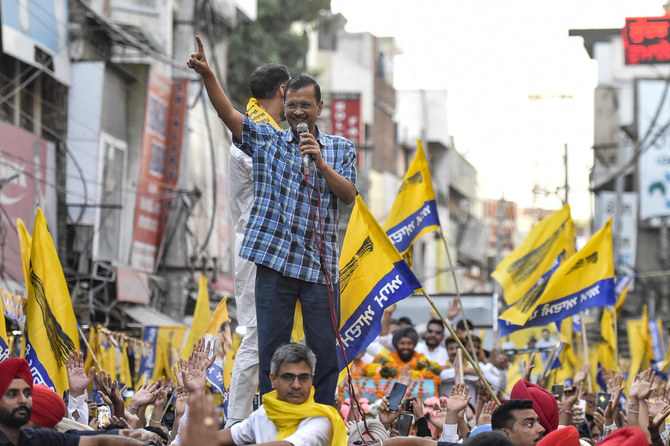
Arvind Kejriwal, chief minister of the capital Delhi and a key opposition leader, is among several leaders of the bloc under criminal investigation. (AFP)
Short Url
Updated 02 June 2024
Follow

Exit polls project victory for Modi in India’s election 

  • Prediction has ruling alliance winning two-thirds majority
  • Projections have had a mixed record on predicting elections in the past

NEW DELHI: Indian Prime Minister Narendra Modi is poised to return for a rare third five-year term as the country’s premier, according to exit polls that have projected a clear victory for the alliance led by his Bharatiya Janata Party.

Major exit polls conducted by Indian TV stations and agencies showed the ruling National Democratic Alliance, or NDA, winning a two-thirds majority in the 543-member lower house of parliament, where 272 is needed for a simple majority.

The polls, published on Saturday evening ahead of official results due on June 4, would mean that the NDA would easily beat the opposition INDIA alliance, a coalition of parties led by the formerly ruling Indian National Congress, and leave Modi with a strong mandate to form the next government.

“I can say with confidence that the people of India have voted in record numbers to reelect the NDA government,” Modi wrote on X, without providing evidence of his claim.

“The opportunistic INDI Alliance failed to strike a chord with the voters. They are casteist, communal and corrupt. This alliance, aimed to protect a handful of dynasties, failed to present a futuristic vision for the nation.”

The exit polls predicted the BJP and its allies winning 350 to 380 seats, making these projections likely higher compared to when the NDA won 352 lower house seats in the 2019 general elections, with the BJP accounting for 303 of them. 

The opposition, meanwhile, was projected to win between 125 and 182 seats.

The early unofficial results were the first indications of the shape of India’s next government. They were released after a ban on the publication of opinion polls imposed at the start of the polls was lifted on Saturday evening, following the end of the final round of voting in the seven-phase election, in which more than 968 million people were registered to vote.

The opposition dismissed the exit polls and ahead of their publication had called them “prefixed.”

“It is a fantasy poll and a Modi poll. It is not an exit poll, it is a Modi media poll. It is his fantasy poll,” Congress leader Rahul Gandhi told the media on Sunday.

As India’s exit polls have had a mixed record on predicting elections in the past, political analysts are also doubting their accuracy.

“It does not reflect the ground reality and most of the exit polls are erroneous and contradictory,” Umakant Lakhera, Delhi-based political analyst, told Arab News.

“The reliable ground reports from some of the major states like West Bengal and Uttar Pradesh suggest that the opposition alliance is doing quite good and gaining major seats.”

Satish K. Singh, former consulting editor of Delhi-based Hindi channel Zee News and political analyst, said the exit polls were not trustworthy.

“I don’t trust exit polls at all. This is the tool of propaganda. This is done with a view to creating a certain kind of opinion; it is also fixed and stage managed,” Singh said.

“I don’t think the BJP will be getting as many seats as the exit polls are predicting. The BJP might have an edge, it has an advantage, but the contest is close if the voting and counting process are transparent.”

If the official results back up the exit polls, Modi’s BJP victory will come unscathed by issues of inflation, unemployment and rising inequality, which were among the main concerns of Indian voters prior to the election, surveys revealed.

“If the BJP manages to win despite all the pressing issues facing the country, the credit would go to the captive media, non-stop propaganda and the open practice of majoritarian politics,” Singh said.

“The opposition could not invade this ecosystem.” 


Coast Guard is pursuing another tanker helping Venezuela skirt sanctions, US official says

Updated 22 December 2025
Follow

Coast Guard is pursuing another tanker helping Venezuela skirt sanctions, US official says

  • US oil companies dominated Venezuela’s petroleum industry until the country’s leaders moved to nationalize the sector, first in the 1970s and again in the 21st century under Maduro and his predecessor, Hugo Chávez

WEST PALM BEACH, Florida: The US Coast Guard on Sunday was pursuing another sanctioned oil tanker in the Caribbean Sea as the Trump administration appeared to be intensifying its targeting of such vessels connected to the Venezuelan government.
The pursuit of the tanker, which was confirmed by a US official briefed on the operation, comes after the US administration announced Saturday it had seized a tanker for the second time in less than two weeks.
The official, who was not authorized to comment publicly about the ongoing operation and spoke on the condition of anonymity, said Sunday’s pursuit involved “a sanctioned dark fleet vessel that is part of Venezuela’s illegal sanctions evasion.”
The official said the vessel was flying a false flag and under a judicial seizure order.
The Pentagon and Department of Homeland Security, which oversees the US Coast Guard, deferred questions about the operation to the White House, which did not offer comment on the operation.
Saturday’s predawn seizure of a Panama-flagged vessel called Centuries targeted what the White House described as a “falsely flagged vessel operating as part of the Venezuelan shadow fleet to traffic stolen oil.”
The Coast Guard, with assistance from the Navy, seized a sanctioned tanker called Skipper on Dec. 10, another part of the shadow fleet of tankers that the US says operates on the fringes of the law to move sanctioned cargo. It was not even flying a nation’s flag when it was seized by the Coast Guard.
President Donald Trump, after that first seizure, said that the US would carry out a “blockade” of Venezuela. It all comes as Trump has ratcheted up his rhetoric toward Venezuelan President Nicolás Maduro.
This past week Trump demanded that Venezuela return assets that it seized from US oil companies years ago, justifying anew his announcement of a “blockade” against oil tankers traveling to or from the South American country that face American sanctions.
Trump cited the lost US investments in Venezuela when asked about his newest tactic in a pressure campaign against Maduro, suggesting the Republican administration’s moves are at least somewhat motivated by disputes over oil investments, along with accusations of drug trafficking. Some sanctioned tankers already are diverting away from Venezuela.
US oil companies dominated Venezuela’s petroleum industry until the country’s leaders moved to nationalize the sector, first in the 1970s and again in the 21st century under Maduro and his predecessor, Hugo Chávez. Compensation offered by Venezuela was deemed insufficient, and in 2014, an international arbitration panel ordered the country’s socialist government to pay $1.6 billion to ExxonMobil.
Maduro said in a message Sunday on Telegram that Venezuela has spent months “denouncing, challenging and defeating a campaign of aggression that goes from psychological terrorism to corsairs attacking oil tankers.”
He added: “We are ready to accelerate the pace of our deep revolution!”
Sen. Rand Paul, R-Kentucky, who has been critical of Trump’s Venezuela policy, called the tanker seizures a “provocation and a prelude to war.”
“Look, at any point in time, there are 20, 30 governments around the world that we don’t like that are either socialist or communist or have human rights violations,” Paul said on ABC’s’ “This Week.” ”But it isn’t the job of the American soldier to be the policeman of the world.”
The targeting of tankers comes as Trump has ordered the Defense Department to carry out a series of attacks on vessels in the Caribbean and eastern Pacific Ocean that his administration alleges are smuggling fentanyl and other illegal drugs into the United States and beyond.
At least 104 people have been killed in 28 known strikes since early September. The strikes have faced scrutiny from US lawmakers and human rights activists, who say the administration has offered scant evidence that its targets are indeed drug smugglers and that the fatal strikes amount to extrajudicial killings.
Trump has repeatedly said Maduro’s days in power are numbered. White House chief of staff Susie Wiles said in an interview with Vanity Fair published last week that Trump “wants to keep on blowing boats up until Maduro cries uncle.”
Sen. Tim Kaine, D-Virginia, told NBC’s “Meet the Press” on Sunday that Trump’s use of military to mount pressure on Maduro runs contrary to Trump’s pledge to keep the United States out of unnecessary wars.
Democrats have been pressing Trump to seek congressional authorization for the military action in the Caribbean.
“We should be using sanctions and other tools at our disposal to punish this dictator who is violating the human rights of his civilians and has run the Venezuelan economy into the ground,” Kaine said. “But I’ll tell you, we should not be waging war against Venezuela. We definitely should not be waging war without a vote of Congress.