Over 62,140 Pakistani pilgrims arrive in Saudi Arabia for this year’s Hajj

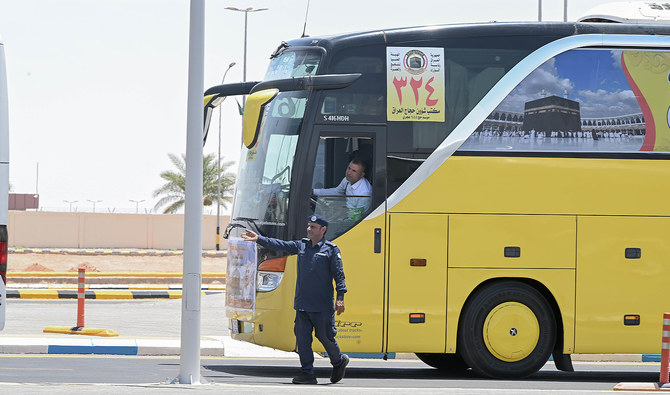
A bus awaits for Hajj pilgrims in Makkah, Saudi Arabia on June 2, 2024. (SPA)
Short Url
Updated 02 June 2024
Follow

Over 62,140 Pakistani pilgrims arrive in Saudi Arabia for this year’s Hajj

  • Pakistan welcomes 46,648 pilgrims under government scheme, 15,500 under private scheme
  • This year 179,210 Pakistani pilgrims are expected to perform annual Islamic pilgrimage 

ISLAMABAD: The Pakistan Hajj Mission (PHM) has so far welcomed 62,148 pilgrims in the cities of Makkah and Madinah under both government and private schemes since May 9, an official of the country’s religion ministry said this week. 

Hajj is one of the five pillars of Islam and requires every adult Muslim to undertake the journey to the holy Islamic sites in Makkah at least once in their lifetime if they are financially and physically able.
Pakistan has a Hajj quota of 179,210 pilgrims this year, of which around 70,000 people will perform the pilgrimage under the government scheme, while the rest will use private tour operators.

This year’s pilgrimage is expected to run from June 14 till June 19.

“So far, 46,648 pilgrims have arrived via 185 flights under the government scheme, while 15,500 have arrived under the private scheme,” Muhammad Umar Butt, a spokesperson for Pakistan’s Ministry of Religious Affairs (MoRA) said on Saturday. 

An additional 22,090 Pakistani pilgrims are expected to arrive in Makkah over the next nine days, Butt said. This year, the PHM will host over 70,105 pilgrims under the government scheme and more than 80,000 under the private scheme. 

He said the PHM is making use of two toll-free helplines and four WhatsApp numbers to address pilgrims’ complaints.

“Additionally, the spokesman said two central hospitals and a dozen dispensaries in the Haram are providing medical facilities to pilgrims, with 322 doctors and medical staff on duty,” the state-run Associated Press of Pakistan (APP) said. 

A total of 511 Hajj Moavineen or facilitators, including Pakistani civilians and uniformed personnel, are working to provide pilgrims with travel, accommodation, and food facilities.


Pakistan, ADB inch toward $2 billion financing agreement for railway upgrade venture

Updated 5 sec ago
Follow

Pakistan, ADB inch toward $2 billion financing agreement for railway upgrade venture

  • The 480-kilometer Karachi-Rohri railway section is part of the $7 billion Main Line-1 project
  • ADB official confirms talks, says any potential assistance will be subject to due diligence

KARACHI: Talks between Pakistan and the Asian Development Bank (ADB) over a $2 billion loan agreement to complete the first phase of a multibillion-dollar railway upgradation project have reached an “advanced level,” officials privy to the matter said on Wednesday.

The 480-kilometer Karachi-Rohri railway section is part of the $7 billion Main Line-1 (ML-1) project, which Islamabad has long sought to implement under the China-Pakistan Economic Corridor (CPEC) project. 

The ML-1 upgrade is the largest infrastructure scheme under the over $60 billion CPEC project, with Beijing originally pledging $6.67 billion for it in 2016. However, financing has stalled for nearly a decade.

The ML-1 project aims to modernize Pakistan’s 1,250-kilometer strategic railway corridor stretching from Kotri city in Sindh to the eastern city of Attock in Punjab. It will feature over 90 operational stations and a dedicated freight track.

“The talks with ADB have reached an advanced level for securing financing to complete the Karachi-Rohri project,” said a Pakistan Railways official, who was privy to the negotiations, on condition of anonymity.

“The project is expected to cost about $2 billion.” 

Pakistan and China formed a consortium of bilateral and multilateral partners, which includes the ADB and the Asian Infrastructure Investment Bank (AIIB) in September 2025, to finance the ML-1 project.

Pakistan Railways Chief Executive Officer Amir Ali Baloch said the government has placed the ML-1 upgradation at the top of its infrastructure agenda.

“The government has prioritized the upgradation of ML-1,” Baloch told Arab News. 

The ML-1 project’s first phase will be executed under the proposed $2 billion financing arrangement through the military-run National Logistics Corporation (NLC), Baloch disclosed without elaborating further about the NLC’s role. 

“Phase-1 (Karachi-Rohri) of the $6.7 billion ML-1 project is expected to break ground in July with financing support from ADB,” he said. 

Pakistan has recently moved to revive long-delayed railway modernization plans and is lining up financing timelines for work on the country’s most critical train corridors.

The push comes as the government seeks to expand freight capacity, boost regional trade and upgrade decades-old infrastructure to ensure economic growth. 

The modernization of Pakistan’s mainline tracks, particularly ML-1, ML-2 and ML-3, has remained stalled for years due to financing delays and shifting priorities.

The latest timelines provided by officials indicate Islamabad is now trying to fast-track the process by combining multilateral support with domestic financing arrangements.

If executed, the projects would mark the largest overhaul of Pakistan’s railway system in its history.

“Additionally, rehabilitation of the 1,000-kilometer ML-3 is likely to commence in April,” Baloch said.

ML-3 corridor stretches from Rohri to Taftan in Pakistan’s southwestern Balochistan province via the Sibbi and Quetta cities. The track’s rehabilitation would enhance Pakistan’s regional freight connectivity toward Turkiye via Iran, the Pakistan Railways CEO added. 

The latest timelines provided by railway officials indicate Islamabad is now trying to fast-track the process by combining multilateral support with domestic financing arrangements. If executed, the projects would mark the largest overhaul of Pakistan’s railway system.

An ADB spokesperson confirmed that “regular” dialogue had taken place between the government and the bank. However, he stressed that no final commitments have been made.

“The Government of Pakistan and ADB have regular discussions on railway sector development, including the ML-1 project,” the spokesperson said.

Any potential ADB assistance would be subject to “comprehensive due diligence and consideration” under the bank’s policies and procedures before any commitment is made, he added.