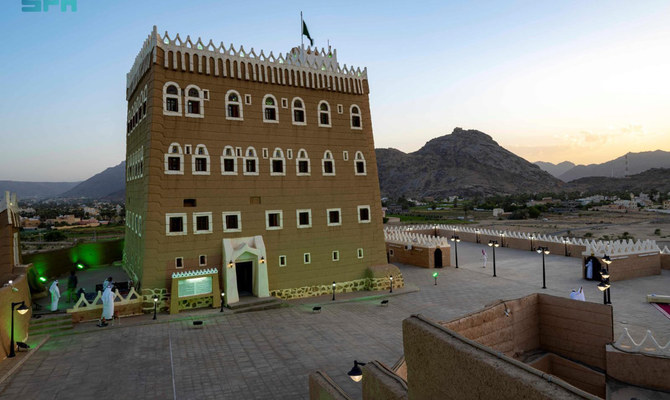


RIYADH: Najran’s ancient citadel, Al-Aan Palace, is a landmark of Najrani architecture and heritage. With its unique design, the structure has become a magnet for tourists visiting the southern region to explore its history and culture.
Najran, in the southwest of Saudi Arabia, is a region known for its vibrant culture and rich history. Surrounded by the Sarawat Mountains, it stands out for its mudbrick architecture, winding streets and bustling souks.
Al-Aan Palace — also known as Saadan Palace, because it is situated in the village of Saadan — was built in the 1600s on top of Al-Aan Mountain, and its inhabitants would have enjoyed a mesmerizing view of the surrounding landscape.
Saudi architect Khalid Al-Ojyan, from the Royal Commission of Riyadh City, told Arab News about the concept behind the palace and how it was built.
“Al-Aan Palace is a heritage landmark in Saudi Arabia,” he said. “(It) was built in 1100 AH (1688) by Shaikh Mohammad Ismail and HibatuAllah Al-Makrami, the governors of the region.”
Najani architecture was heavily influenced by the natural materials available, Al-Ojyan said. The mixture of rocks and mud created mudbricks, which have been commonly used in the region for centuries.
The palace was largely constructed using these mudbricks, although other natural materials also feature. For example, the ceilings showcase the intricate use of natural materials such as wood from palm tree trunks as well as tamarisk and sidr trees, along with palm fronds, highlighting the region’s reliance on its natural resources and the craftsmanship of its builders.
The circular and rectangular towers surrounding the palace were likely added for strategic defense purposes, Al-Ojyan said.
He highlighted the shape and size of the palace windows, which were also designed to provide protection. On each of the palace’s four stories, the window size increases. The lower levels of the building were designed with smaller windows to protect against intruders.
The palace was renovated by the Saudi Heritage Commission five years ago, both externally and internally, the architect added.
The palace’s architectural features — the mudbrick construction, the use of other natural materials, and its defensive features — all contribute to the experience that Al-Aan Palace provides for visitors while showcasing the culture, heritage, and ingenious building practices of Najran.