

Hopes rise on Sudan as Egypt pushes peace talks

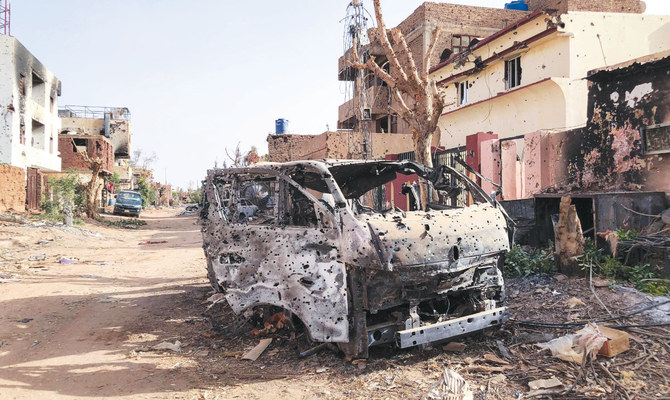
The conflict in Sudan has killed thousands and sparked a humanitarian disaster. (AFP/File)
Short Url
Updated 01 June 2024
Follow

Hopes rise on Sudan as Egypt pushes peace talks

  • Al-Burhan government urged to ease demands over forum set for June

CAIRO: Egypt’s plans to host a conference in coming weeks that will bring together rival Sudanese political forces has raised hopes of restoring peace in the conflict-racked country, according to analysts.

The government of Gen. Abdel Fattah Al-Burhan has already welcomed the Egyptian initiative, according to Sudan’s Ministry of Foreign Affairs.

Masad Faiez, an Egyptian political analyst, said the Sudanese statement tried to set “some conditions” for the participation of the state’s representative.

“I think these are tough conditions,” he told Arab News. “But from what I know, Egypt is currently trying to unify all parties to ensure lasting and ongoing peace.”

Faiez said Egypt “believes that the conflict is a Sudanese issue and is inviting all active national factions to participate in a future political process.”

Cairo will exert all possible efforts to help Sudan overcome the crisis it faces, and end the conflict’s damaging effects on the Sudanese people, and the security and stability of the region, he said.

According to the Egyptian Ministry of Foreign Affairs, the conference will seek to reach a consensus on building comprehensive and lasting peace in Sudan.

Regional and international partners will attend the forum, which will rely on “a national dialogue based on a purely Sudanese vision,” the ministry said.

The Sudanese statement specifically opposed the participation of three parties referred to as “patrons” of the Rapid Support Forces.

Sudan also claimed that regional and international organizations had remained silent about the “crimes of the Rapid Support Forces,” and insisted on the African Union’s non-participation unless steps were taken to lift the suspension of Sudan’s activities in the organization.

Akmal Ziyada, a political expert on African affairs, said the Sudanese regime will likely ease its demands in order to achieve peace and unity.

Egypt looks forward to “active participation from all Sudanese civil political forces, and concerned regional and international partners, working together to ensure the conference’s success in achieving the aspirations of the brotherly Sudanese people,” he said.

The Sudanese Unionist Democratic Party, led by Mohammed Osman Al-Mirghani, also welcomed the Egyptian initiative.

Hatem Al-Sir, a political adviser to Al-Mirghani, said the importance of the Egyptian initiative stems from the historical and fraternal ties between the two peoples, and a “firm belief that the solution to the Sudanese crisis must be purely Sudanese,” and include all national factions.

Hassan Al-Mir, a member of the Egyptian parliament, told Arab News that Egypt has a vision for “resolving the crisis in Sudan, primarily because the stability of this country and the African region is one of the mainstays of Egypt’s national security.”

Cairo had led many efforts to contain the Sudan crisis, he said.

Egypt “respects the will of the Sudanese people, opposes foreign interventions in Sudan’s crisis, emphasizes the protection of institutions, and coordinates with neighboring countries to lessen the humanitarian impact,” Al-Mir said.


Syria welcomes US House vote to end ‘Caesar Act’ sanctions

Updated 10 sec ago
Follow

Syria welcomes US House vote to end ‘Caesar Act’ sanctions

  • Representatives back defense bill that includes provisions to scrap wide-ranging sanctions imposed on former leader Bashar Assad
  • Syria’s new government says vote is ‘pivotal moment’ for country as it attempts to rebuild its economy

LONDON: A vote by the US House of Representatives in favor of ending tough sanctions on Syria was welcomed by Damascus on Thursday as a “pivotal moment.”

The “Caesar Act” sanctions regime was imposed in 2020 against former President Bashar Assad’s government over the human-rights abuses carried out during the civil war.

The move to repeal the sanctions, seen as a crucial step for the Syrian Arab Republic’s economic recovery, is contained in a wide-ranging defense bill that the lower house of Congress backed on Thursday.

The Syrian Foreign Ministry said the vote “paves the way for a broader economic recovery and the return of opportunities long denied to Syrians.”

The ministry described it as a first step toward improving trade flows, and increasing the availability of essential goods, and medical supplies.

The National Defense Authorization Act, or NDAA, will now pass to the US Senate where a vote is expected to be held by the end of the year.

Assad was forced from power a year ago after a rapid military campaign by opposition forces brought the 13-year conflict to an end.

The new president, Ahmad Al-Sharaa, who led the offensive, has made ending Syria’s isolation a priority as he attempts to rebuild the country’s shattered economy.

President Donald Trump said in May that he planned to lift all sanctions on Syria and many have already been removed or suspended.

The Caesar Act, which imposed the toughest restrictions on trade and investment in Syria, requires Congressional approval to be overturned.

Along with repealing the act, the bill requires the White House to provide regular reports confirming that Syria’s government is fighting Daesh militants and upholding religious and ethnic minority rights, Reuters reported.

Syria’s foreign minister, Asaad Al-Shaibani, said the step toward repealing the Caesar Act was a “triumph for justice but also a recognition of the strength and resilience of the Syrian people.”

He said it reflected the success of Syrian diplomacy with the US.

Al-Sharaa has held talks with Trump three times, including an initial meeting in Riyadh in May on the sidelines of a US-GCC summit.

The Syrian president traveled to Washington in September where he was hosted at the White House. Speaking after the meeting, Trump said the US would do “everything we can to make Syria successful.”

During the visit, Syria confirmed that it would join the global coalition against Daesh.

Removing international sanctions on Syria would allow foreign investment to flow into the country, where the cost of rebuilding is estimated to be more than $200 billion.

Syrian Central Bank Gov. Abdulkader Husrieh told Reuters recently that the repeal of US sanctions was “a miracle” and that the economy was growing faster than expected.

The Caesar Act targeted individuals, companies and institutions linked to Assad, and sanctioned foreign entities from funding them.

The legislation was named after a code name given to a Syrian military photographer who smuggled thousands of photos documenting torture and war crimes by the Syrian regime out of the country.