Pakistan’s top court says live-streaming anti-graft law amendments case risked political misuse

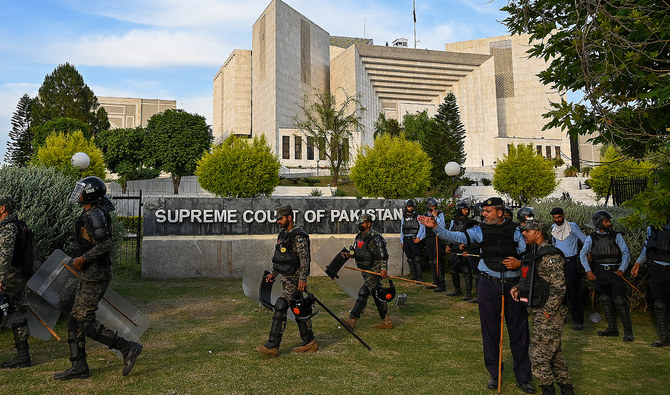
In this file photo, taken on May 11, 2023, Paramilitary soldiers stand guard outside the Supreme Court of Pakistan in Islamabad. (AFP/File)
Short Url
Updated 01 June 2024
Follow

Pakistan’s top court says live-streaming anti-graft law amendments case risked political misuse

  • Supreme Court decided not to live-stream the proceedings after ex-PM Khan joined from jail via video link
  • The top court says in a written order the decision to live-stream a hearing exclusively falls within its domain

ISLAMABAD: Pakistan’s top court on Saturday explained why it decided not to live-stream the last two hearings of a case related to anti-graft law amendments when former Prime Minister Imran Khan joined the proceedings via video link from jail, saying it was to prevent the broadcast’s political misuse.
Khan, who was incarcerated last year in August on corruption charges, has since been convicted in several legal cases after prison trials. He has frequently claimed innocence in all the cases against him, calling them part of a strategy to keep him away from the country’s political arena.
Khan originally challenged the amendments made by Prime Minister Shehbaz Sharif’s previous administration in May 2022 to the National Accountability Bureau (NAB) Ordinance, which reduced several powers of the country’s anti-graft body. He requested to participate in the Supreme Court hearing over the matter last month after being largely kept out of the public eye by the authorities since his arrest in August.
The court granted him permission to join the proceedings via video link, although it opted not to live-stream the proceedings as it had done previously.
“When the head of a political party wants to be heard, who is not an Advocate of this Court, there is a real probability that these hearings may be used for political purposes and point scoring and in respect of matters which do not concern these appeals,” the court said in a written order issued in response to an appeal filed by the advocate-general of Khyber Pakhtunkhwa province to live-stream the proceedings.
The application called the court’s decision to live-stream some of the hearings and refusing to televise others a “discrimination.”
“This was a paramount consideration when we had dismissed the [advocate-general’s] application,” it continued. “And, our apprehension proved correct later in the day. When Mr. [Imran Khan] Niazi addressed this Court on (30 May 2024) he also mentioned other cases, the general elections held on 8 February 2023, a commission of inquiry and his incarceration; all these matters have nothing to do with the subject matter of these appeals.”
The Supreme Court said it could not have allowed this since it would have thwarted “proper administration of justice.”
It noted that discussions of unrelated matters could skew public perception and undermine the right to a fair hearing and trial for others involved in them.
“While a request to live broadcast or live-stream may be submitted, and may also be objected to, it is clarified that this, as matters presently stand, is in the exclusive domain of this Court,” it added.


Pakistan remembers Benazir Bhutto, first woman PM in Muslim world, on death anniversary

Updated 27 December 2025
Follow

Pakistan remembers Benazir Bhutto, first woman PM in Muslim world, on death anniversary

  • Bhutto was daughter of ex-PM Zulfikar Ali Bhutto who was hanged during reign of former military ruler Gen. Zia-ul-Haq
  • Year before assassination in 2007, Bhutto signed landmark deal with rival Nawaz Sharif to prevent army interventions

ISLAMABAD: Prime Minister Shehbaz Sharif and other Pakistani leaders on Saturday paid tribute to Benazir Bhutto, the first woman prime minister in the Muslim world who was assassinated 18 years ago in a gun and bomb attack after a rally in the city of Rawalpindi.

Born on Jun. 21, 1953, Bhutto was elected premier for the first time in 1988 at the age of 35. She was deposed in 1990, re-elected in 1993, and ousted again in 1996, amid allegations of corruption and mismanagement which she denied as being politically motivated.

Bhutto only entered politics after her father was hanged in 1979 during military ruler Gen. Zia-ul-Haq’s reign. Throughout her political career, she had a complex and often adversarial relationship with the now ruling Sharif family, but despite the differences signed a ‘Charter of Democracy’ in 2006 with three-time former PM Nawaz Sharif, pledging to strengthen democratic institutions and prevent military interventions in Pakistan in the future.

She was assassinated a year and a half later.

“Mohtarma Benazir Bhutto took exemplary steps to strengthen the role of women, protect the rights of minorities, and make Pakistan a peaceful, progressive, and democratic state,” PM Shehbaz Sharif, younger brother of ex-PM Nawaz Sharif, said in a statement on Saturday.

“Her sacrifices and services are a beacon of light for the nation.”

President Asif Ali Zardari, Bhutto’s widower, said Bhutto believed in an inclusive Pakistan, rejected sectarianism, bigotry and intolerance, and consistently spoke for the protection of minorities.

“Her vision was of a federation where citizens of all faiths could live with dignity and equal rights,” he said. “For the youth of Pakistan, her life offers a clear lesson: speak up for justice, organize peacefully and do not surrender hope in the face of adversity.”

Powerful families like the Bhuttos and the Sharifs of Pakistan to the Gandhis of India and the Bandaranaike family of Sri Lanka have long dominated politics in this diverse region since independence from British colonial rule. But none have escaped tragedy at the hands of rebels, militants or ambitious military leaders.

It was Zulfikar Ali Bhutto, Bhutto’s father, who founded the troubled Bhutto dynasty, becoming the country’s first popularly elected prime minister before being toppled by the army in 1977 and later hanged. Both his sons died in mysterious circumstances.

Before her assassination on Dec. 27, 2007, Bhutto survived another suicide attack on her motorcade that killed nearly 150 people as she returned to Pakistan after eight years in exile in October 2007.

Bhutto’s Oxford-educated son, Bilawal Bhutto-Zardari, now leads her Pakistan Peoples Party, founded by her father, and was foreign minister in the last administration of PM Shehbaz Sharif.

Aseefa Bhutto Zardari, Bhutto’s daughter who is currently the first lady of Pakistan, said her mother lived with courage and led with compassion in life.

“Her strength lives on in every voice that refuses injustice,” she said on X.

Pakistan has been ruled by military regimes for almost half its history since independence from Britain in 1947. Both former premiers Imran Khan and the elder Sharif, Nawaz, have alleged that they were ousted by the military after they fell out with the generals. The army says it does not interfere in politics.