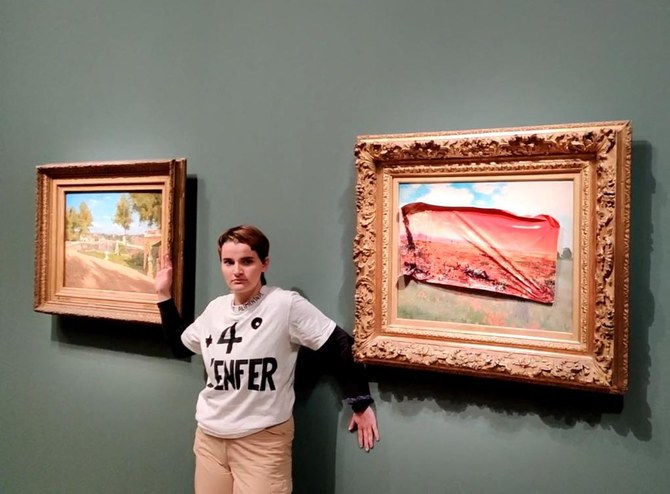
PARIS: A climate activist was arrested on Saturday for sticking an adhesive poster on a Monet painting at the Musee d’Orsay in Paris to draw attention to global warming, a police source told AFP.
The action by the woman, a member of “Riposte Alimentaire” (Food Response) — a group of environmental activists and defenders of sustainable food production — is the latest in a string of protests aimed at drawing attention to global warming by defacing art.
In a video posted on X, the woman — introducing herself as a “concerned citizen” --- is seen placing a blood-red poster over the “Coquelicots” (Poppy Field) painting by Claude Monet, a French Impressionist artist.
In the video she said of the poster covering Monet’s art that “this nightmarish image awaits us if no alternative is put in place.”
She added: “At four degrees, we can expect hell,” a reference to forecasts saying that Earth’s temperature could rise by 4 Celsius over pre-industrial levels by 2050.
Monet’s painting, completed in 1873, shows people with umbrellas strolling in a blooming poppy field and is part of a special Musee d’Orsay show called “Paris 1874, Inventing Impressionism” that features 130 works by 31 artists.
A restoration expert examined the painting which suffered no permanent damage, the Musee d’Orsay told AFP, adding that it had been put back on the wall.
“The exhibition is entirely accessible to the public again,” a spokesperson said.
The museum would file a criminal complaint, the spokesperson added.
Some of Monet’s works have sold for tens of millions of dollars, with his painting “Meules” (“Haystacks“) even fetching over $110 million including fees at an auction in 2019.
Riposte Alimentaire has claimed responsibility for several attacks on art in France in a bid to draw attention to the climate crisis and deteriorating food quality.
They included an attack on the world’s most famous portrait, the “Mona Lisa,” in the Louvre in January when two protesters hurled soup at the bullet-proof glass protecting Leonardo da Vinci’s masterwork, saying they had a right to “healthy and sustainable food.”
The attackers were sentenced by a Paris court to carry out volunteer work for a charity organization.
Already in 2022, a man had thrown a custard pie at the Mona Lisa because, he said, artists were not focusing enough on “the planet.”
In February, Riposte Alimentaire protesters again threw soup at a painting, this time in Lyon, southeast France, targeting another Monet painting, “Springtime.”
Last month activists also belonging to the group stuck flyers around “Liberty Leading the People,” a painting by Eugene Delacroix in the Louvre.
In April, two of its members were arrested at the Musee d’Orsay, which is dedicated to 19th-Century art, suspected of preparing an action there.
Riposte Alimentaire calls itself a “French civil resistance movement which aims to spur a radical societal change for the environment and society.”
“We love art,” the movement has said, “but future artists will have nothing to paint on a burning planet.”
Monet appears to be a favorite target for climate activists elsewhere, too, with paintings by the Impressionist having previoiusly come under attack in Potsdam, Germany, and in Stockholm.


![]()

Climate activist arrested for attacking Monet painting in Paris
Short Url
https://arab.news/5vxu8
Climate activist arrested for attacking Monet painting in Paris
- Action is the latest in a string of protests aimed at drawing attention to global warming by defacing art


Latest updates


Recommended


© 2026 SAUDI RESEARCH & PUBLISHING COMPANY, All Rights Reserved And subject to Terms of Use Agreement.