

Pakistan slashes petrol price by Rs4 amid confusion about bigger cut

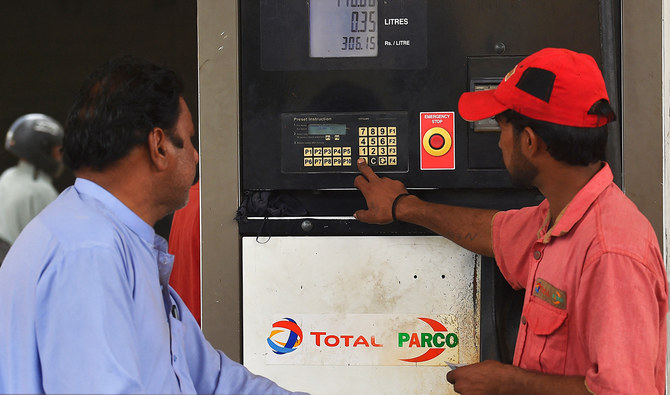
An employee prepares to fill petrol in a vehicle at a fuel station in Karachi on September 1, 2023. (AFP/File)
Short Url
Updated 01 June 2024
Follow

Pakistan slashes petrol price by Rs4 amid confusion about bigger cut

  • The confusion stemmed from a statement issued by PM Sharif's office saying he had directed authorities to reduce petrol price by Rs15.4
  • Finance Division says the Oil & Gas Regulatory Authority has worked out new prices, based on price variations in the international market

KARACHI: The Pakistani government on Saturday reduced the price of petrol by Rs4 per liter, the Finance Division announced, amid confusion about bigger cuts in petroleum prices.

The confusion stemmed from a statement issued by Prime Minister Shehbaz Sharif's office that said late Friday the premier had directed authorities to reduce petrol price by Rs15.4 and diesel by Rs7.9.

However, the price of petrol was slashed by only Rs4.74, while that of hi-speed diesel was reduced by Rs3.86, according to a notification issued by the Finance Division early Saturday.

"The prices of Petroleum products have seen a decreasing trend in the international market during the last fortnight," the notification read. "The Oil & Gas Regulatory Authority (OGRA) has worked out the consumer prices, based on the price variations in the international market."

A liter of petrol now costs Rs268.36, while that of high-speed diesel sells for Rs270.22.

Pakistan revises petroleum prices every fortnight. On May 15, the Pakistani government slashed the price of petrol by Rs15.39 per liter in view of declining global energy prices, bringing major relief to consumers reeling from record inflation over the past two years.

The South Asian country significantly increased fuel prices after securing a short-term, $3 billion loan from the International Monetary Fund (IMF) last year.

The rising rates also led to spiraling inflation in the country, though the government started offering relief to the people by gradually bringing down the petroleum prices.

Pakistan is already in talks with the IMF to secure another loan which is expected to be bigger in terms of size and duration.


Pakistan to discuss regional issues, economic ties at UAE summit this week

Updated 12 December 2025
Follow

Pakistan to discuss regional issues, economic ties at UAE summit this week

  • Deputy PM Ishaq Dar to attend Sir Bani Yas Forum from Dec. 12-14, says Pakistan foreign office
  • Senior statemen, policymakers expected to discuss security and economic cooperation at summit

ISLAMABAD: Pakistan’s Deputy Prime Minister Ishaq Dar will attend the Sir Bani Yas Forum in the UAE from Dec. 12-14 to discuss regional issues with world leaders and explore economic partnerships, the foreign ministry said on Friday. 

The three-day summit features senior statesmen, policymakers and global experts from around the world with discussions likely to revolve around key regional and international issues such as peace, security and economic cooperation.

Dar, who is also Pakistan’s foreign minister, attended the 15th edition of the Bani Yas Forum last year. He is attending this year’s summit at the invitation of his UAE counterpart, Sheikh Abdullah bin Zayed Al Nahyan, the foreign office said. 

“During the Forum, the Deputy Prime Minister/Foreign Minister will engage with international leaders and experts on matters related to regional stability, sustainable development, and the expansion of economic partnerships,” the statement said. 

“He will also present Pakistan’s perspectives on promoting dialogue, addressing regional challenges, and fostering enhanced opportunities for economic cooperation.”

The Forum is expected to feature important discussions on Israel’s war in Gaza and the fragile ceasefire in the Middle East. 

Pakistan has consistently criticized Israel for violating the ceasefire in Gaza and has called on the international community to intervene and ensure the fragile agreement does not collapse. 

Islamabad has also been eyeing economic partnerships with regional allies, particularly Gulf countries, at such global summits in recent months. 

It has entered into economic, defense, trade and investment agreements with traditional allies such as China, Saudi Arabia, UAE, Qatar and Central Asian states in recent months.