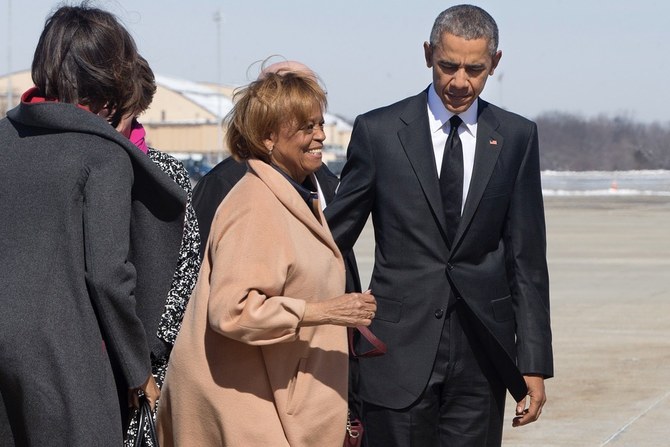
Marian Robinson, mother of Michelle Obama, dies at 86

Marian Robinson smiles as she prepares to board Air Force One with President Barack Obama in 2015. (AP)
Short Url
Updated 01 June 2024
Follow

Marian Robinson, mother of Michelle Obama, dies at 86

WASHINGTON: Marian Robinson, mother of former US first lady Michelle Obama, who provided support and stability, especially during the eight years of Barack Obama’s presidency, died on Friday, the Obama and Robinson families said. She was 86.
Fondly called the “first grandma,” Robinson played a pivotal role in helping care for her granddaughters, Malia and Sasha Obama, during their early years at the White House.
“With a healthy nudge, she agreed to move to the White House with Michelle and Barack. We needed her. The girls needed her. And she ended up being our rock through it all,” the family statement read, adding she died “peacefully” on Friday morning.
Born in 1937 on Chicago’s South Side, Robinson was one of seven children. Her parents separated during her teenage years and she witnessed the extreme highs and lows of race relations in the United States.
Her father was not allowed to join a union or work for larger construction firms due to the color of his skin and hence “grew mistrustful of a world that seemed to have little place for him,” the family said its statement. Yet, her daughter and son-in-law made it to the White House when Barack Obama became the first Black US president.
The glamor of the White House was never a great fit for Robinson, according to the family.
Rather than hobnobbing with Oscar winners or Nobel laureates, she preferred spending her time upstairs with a TV tray, in the room outside her bedroom with big windows that looked out at the Washington Monument, the family statement said. It added that she made great friends “with the ushers and butlers, the folks who make the White House a home.”
Robinson got married in 1960 and had two children, including the former first lady. She also worked as a teacher and a secretary, the family said.
During her eight years at the White House, the family said she would often sneak outside the gates to buy greeting cards at nearby stores and sometimes other customers would recognize her saying she resembled the first lady’s mother.
“Oh, I get that a lot,” she would smile and reply.


US judge blocks Trump plans to end of deportation protections for South Sudanese migrants

Updated 7 sec ago
Follow

US judge blocks Trump plans to end of deportation protections for South Sudanese migrants

  • Kelley issued the order after four migrants from South Sudan along with African Communities Together, a non-profit group, sued

BOSTON: A federal judge on Tuesday blocked plans ​by US President Donald Trump’s administration to end temporary protections from deportation that had been granted to hundreds of South Sudanese nationals living in the United States.
US District Judge Angel Kelley in Boston granted an emergency request by several South Sudanese nationals and an immigrant rights group to prevent the temporary protected status they had been granted from expiring as planned after January 5.
The ruling is a temporary victory for immigrant advocates and a setback for the Trump administration’s broader effort to curtail the humanitarian program. It is the latest in a series of legal ‌challenges to the ‌administration’s moves to end similar protections for nationals from several ‌other ⁠countries, including ​Syria, Venezuela, ‌Haiti and Nicaragua.
Kelley issued the order after four migrants from South Sudan along with African Communities Together, a non-profit group, sued. The lawsuit alleged that action by the US Department of Homeland Security was unlawful and would expose them to being deported to a country facing a series of humanitarian crises.
Kelley, who was appointed by Democratic former President Joe Biden, issued an administrative stay that temporarily blocks the policy pending further litigation.
She wrote that allowing it to take effect before the courts had time ⁠to consider the case’s merits “would result in an immediate impact on the South Sudanese nationals, stripping current beneficiaries of lawful status, ‌which could imminently result in their deportation.”
Homeland Security Department spokesperson ‍Tricia McLaughlin said in a statement that the ‍judge’s ruling ignored Trump’s constitutional and statutory authority and that the temporary protected status extended to ‍South Sudanese nationals “was never intended to be a de facto asylum program.”
Conflict has ravaged South Sudan since it won independence from Sudan in 2011. Fighting has persisted in much of the country since a five-year civil war that killed an estimated 400,000 people ended in 2018. The US State Department advises citizens not ​to travel there.
The United States began designating South Sudan for temporary protected status, or TPS, in 2011.
That status is available to people whose home countries ⁠have experienced natural disasters, armed conflicts or other extraordinary events. It provides eligible migrants with work authorization and temporary protection from deportation.
About 232 South Sudanese nationals have been beneficiaries of TPS and have found refuge in the United States, and another 73 have pending applications, according to the lawsuit.
Homeland Security Secretary Kristi Noem published a notice on November 5 terminating TPS for South Sudan, saying the country no longer met the conditions for the designation.
The lawsuit argues the agency’s action violated the statute governing the TPS program, ignored the dire humanitarian conditions that remain in South Sudan, and was motivated by discrimination against migrants who are not white in violation of the US Constitution’s Fifth Amendment.
“The singular aim of this mass deportation agenda is to remove as many Black and Brown immigrants from this ‌country as quickly and as cruelly as possible,” Diana Konate, deputy executive director of policy and advocacy at African Communities Together, said in a statement.