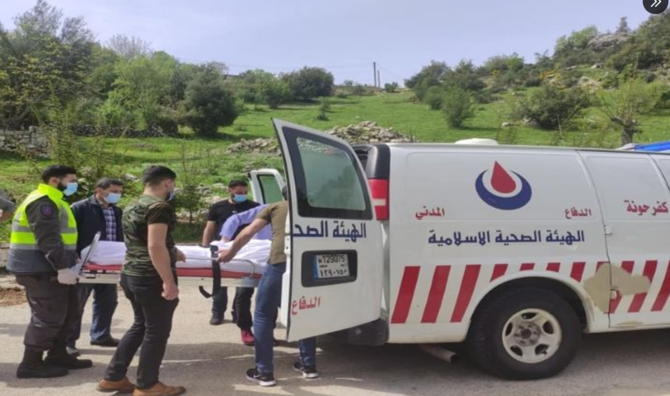
Ambulance strike kills paramedic in southern Lebanon

A military drone in Naqoura deliberately struck an ambulance, killing a paramedic and injuring one other person. (X/@sawtlebnan)
Short Url
Updated 31 May 2024
Follow

Ambulance strike kills paramedic in southern Lebanon

  • Critics rap Mikati government for spending $1 million of public money on war compensation
  • Hezbollah launches attacks with Burkan rockets, assault drones hit targets

BEIRUT: A series of attacks by Hezbollah on Friday targeted multiple Israeli military sites with heavy Burkan missiles and suicide drones.
The strikes followed Israeli raids on Aitaroun, Houla, and the pro-Hezbollah border village of Maroun Al-Ras overnight on Thursday and into the early hours.
As aerial attacks on Lebanese targets continued, two Hezbollah members were killed. A military drone in Naqoura deliberately struck an ambulance, killing a paramedic and injuring one other person.
While ambulances and ambulatory units in Odaisseh, Blida, and Hanin have previously been targeted by artillery shelling, this is the first time an Israeli drone has targeted a medical vehicle.
In separate statements, Hezbollah said it struck the Branit barracks — headquarters of the Israeli army’s 91st division — with heavy Burkan missiles, “hitting it directly and destroying part of it.”
The group also targeted “the Baghdadi outpost with heavy Burkan missiles, hitting it directly,” as well as “a building used by the enemy’s soldiers in the Al-Manara settlement.”
Hezbollah said it also attacked Iron Dome launchpads in the Al-Zaoura bunker and a building used by Israeli soldiers in the Shomera settlement.
The two Hezbollah members who died were named as Samer Kamel Yassin, aged 42, and 54-year-old Hussein Mohammed Atwi, both from Houla.
Israeli media said two missiles landed in western Galilee without triggering sirens and claimed a building in Metula was hit when an anti-armor missile launched from Lebanon landed in the area.
Sirens sounded in several northern settlements warning of possible drone infiltration. The explosion of air interception rockets was heard over the Marjayoun Valley in southern Lebanon and Israel launched shells toward Al-Wazzani and raided Naqoura.
Israeli army spokesperson Avichay Adraee wrote on X: “Israeli military raids targeted four Hezbollah military buildings in Aitaroun and Markaba in southern Lebanon.”
The Israeli airstrikes, which have been ongoing for 237 days, have caused extensive damage to homes and buildings in the border towns, leaving the areas 90 percent uninhabited.
The number of displaced people who have relocated to Beirut’s southern suburbs has reached around 100,000.
The Cabinet has approved $1 million (93 billion Lebanese pounds) in compensation for civilian victims and aid for the displaced. However, the decision has sparked political protests.
Critics have condemned the government for spending so much public money on compensation for a war the Lebanese people did not choose while it struggles to pay public sector and military salaries.
They said Hezbollah “decided on its own to launch its rockets at Israel on Oct. 8 from the south, dragging Lebanon into the war.”
Objections came from the head of the Lebanese Forces Party, Samir Geagea, the head of the Lebanese Kataeb Party, MP Sami Gemayel, MP Nadim Gemayel, and other figures.
Caretaker Prime Minister Najib Mikati has repeatedly stated that Lebanon, suffering from an economic crisis, cannot bear the burdens of the southern war.
Parliamentary Speaker Nabih Berri expressed his deep concern weeks ago about “the extent of the destruction along the southern border, with initial estimates indicating massive losses.”
He noted: “The conditions for rebuilding what was destroyed by the Israeli attacks accompanying the 2006 war may not be the same today.”
On Thursday, Amos Hochstein, senior adviser for energy and investment to the US president, said in an interview with Carnegie Endowment for International Peace that he did not expect everlasting peace between Hezbollah and Israel.
“A land border agreement between Israel and Lebanon implemented in phases, by removing some of the motivations for conflict, and establishing recognized borders for the first time between the two countries, could dampen the simmering and deadly conflict between the two countries,” he said.


Gaza amputees struggle to rebuild lives as the enclave faces shortages of prosthetic limbs

Updated 2 sec ago
Follow

Gaza amputees struggle to rebuild lives as the enclave faces shortages of prosthetic limbs

NUSEIRAT: Sitting in her wheelchair, Haneen Al-Mabhouh dreams of rebuilding her family, of cradling a new baby. She dreams of walking again. But with her leg gone, her life in Gaza is on hold, she says, as she waits to go abroad for further treatment.
An Israeli airstrike in July 2024 smashed her home in central Gaza as she and her family slept. All four of her daughters were killed, including her 5-month-old baby. Her husband was severely burned. Al-Mabhouh’s legs were crushed under the rubble, and doctors had to amputate her right leg above the knee.
“For the past year and a half, I have been unable to move around, to live like others. For the past year and a half, I have been without children,” she said, speaking at her parents’ home.
The 2-month-old ceasefire in Gaza has been slow to bring help for thousands of Palestinians who suffered amputations from Israeli bombardment over the past two years. The World Health Organization estimates there are some 5,000 to 6,000 amputees from the war, 25 percent of them children.
Those who lost limbs are struggling to adapt, faced with a shortage of prosthetic limbs and long delays in medical evacuations out of Gaza.
The WHO said a shipment of essential prosthetic supplies recently made it into Gaza. That appears to be the first significant shipment for the past two years.
Previously, Israel had let in almost no ready-made prosthetic limbs or material to manufacture limbs since the war began, according to Loay Abu Saif, the head of the disability program at Medical Aid for Palestinians, or MAP, and Nevin Al Ghussein, acting director of the Artificial Limbs and Polio Center in Gaza City.
The Israeli military body in charge of coordinating aid, known as COGAT, did not respond when asked how many prosthetic supplies had entered during the war or about its policies on such supplies.
‘My future is paralyzed’
Al-Mabhouh was asleep with her baby girl in her arms when the strike hit their home in Nuseirat, she said. For several weeks while recovering in the hospital, Al-Mabhouh had no idea her children had been killed.
She underwent multiple surgeries. Her hand still has difficulty moving. Her remaining leg remains shattered, held together with rods. She needs a bone graft and other treatments that are only available outside of Gaza.
She was put on the list for medical evacuation 10 months ago but still hasn’t gotten permission to leave Gaza.
Waiting for her chance to go, she lives at her parents’ house. She needs help changing clothes and can’t even hold a pen, and remains crushed by grief over her daughters. “I never got to hear her say ‘mama,’ see her first tooth or watch her take her first steps,” she said of her baby.
She dreams of having a new child but can’t until she gets treatment.
“It’s my right to live, to have another child, to regain what I lost, to walk, just to walk again,” she said. “Now my future is paralyzed. They destroyed my dreams.”
Medical evacuations remain slow
The ceasefire has hardly brought any increase in medical evacuations for the 16,500 Palestinians the UN says are waiting to get vital treatment abroad — not just amputees, but patients suffering many kinds of chronic conditions or wounds.
As of Dec. 1, 235 patients have been evacuated since the ceasefire began in October, just under five a day. In the months before that, the average was about three a day.
Israel last week said it was ready to allow patients and other Palestinians to leave Gaza via the Israeli-held Rafah crossing between Gaza and Egypt. But it’s unsure that will happen because Egypt, which controls the crossing’s other side, demands Rafah also be opened for Palestinians to enter Gaza as called for under the ceasefire deal.
Dr. Richard Peeperkorn, the WHO’s representative in the occupied Palestinian territory, told The Associated Press that the backlog is caused by the lack of countries to host the evacuated patients. He said new medevac routes need to be opened, especially to the Israeli-occupied West Bank and east Jerusalem, where hospitals are ready to receive patients.
For those waiting, life grinds to a standstill
Yassin Marouf lies in a tent in central Gaza, his left foot amputated, his right leg barely held together with rods.
The 23-year-old and his brother were hit by Israeli shelling in May as they returned from visiting their home in northern Gaza that their family had been forced to flee. His brother was killed. Marouf lay bleeding on the ground, as a stray dog attacked his mangled left leg.
Doctors say his right leg will also need to be amputated, unless he can travel abroad for operations that might save it. Marouf said he can’t afford painkillers and can’t go to the hospital regularly to have his bandages changed as they’re supposed to.
“If I want to go to the bathroom, I need two or three people to carry me,” he said.
Mohamed Al-Naggar had been pursuing an IT degree at the University of Palestine before the war.
Seven months ago, shrapnel pierced his left leg during strikes on the house where his family was sheltering. Doctors amputated his leg above the knee. His right leg was also badly injured and shrapnel remains in parts of his body.
Despite four surgeries and physical therapy, the 21-year-old Al-Naggar can’t move around.
“I’d like to travel abroad and put on a prosthetic and graduate from college and be normal like young people outside Gaza,” he said.
Gaza faces prosthetic limb shortage
Some 42,000 Palestinians have suffered life-changing injuries in the war, including amputations, brain trauma, spinal cord injuries and major burns, the WHO said in an October report.
The situation has “improved slightly” for those with assistance needs but “there is still a huge overall shortage of assistive products,” such as wheelchairs, walkers and crutches. Gaza has only eight prosthetists able to manufacture and fit artificial limbs, the WHO said in a statement to the AP.
The Artificial Limbs and Polio Center in Gaza City, one of two prosthetics centers still operating in the territory, received a shipment of material to manufacture limbs just before the war began in 2023, said its director, Al Ghussein. Another small shipment entered in December 2024, but nothing since.
The center has been able to provide artificial limbs for 250 cases over the course of the war, but supplies are running out, Al Ghussein said.
No pre-made prosthetic legs or arms have entered, according to Abu Saif of MAP, who said Israel does not ban them, but its procedures cause delays and “in the end they ignore it.”
Ibrahim Khalif wants a prosthetic right leg so he can get a job doing manual labor or cleaning houses to support his pregnant wife and children.
In January, he lost his leg when an Israeli airstrike hit Gaza City while he was out getting food.
“I used to be the provider for my kids, but now I’m sitting here,” Khalif said. “I think of how I was and what I’ve become.”