BHUBANESWAR: At least 24 people died of suspected heatstroke in India’s eastern states of Bihar and Odisha on Thursday, and the heatwave in the region is expected to continue until Saturday, authorities said.
India has been experiencing a blisteringly hot summer and a part of capital Delhi recorded the country’s highest ever temperature at 52.9 degrees Celsius (127.22°F) this week, though that may be revised with the weather department checking the sensors of the weather station that registered the reading.
While temperatures in northwestern and central India are expected to fall in the coming days, the prevailing heatwave over east India is likely to continue for two days, said the India Meteorological Department (IMD), which declares a heatwave when the temperature is 4.5 C to 6.4 C higher than normal.
A total of 14 people died in Bihar on Thursday, officials said, including 10 people involved in organizing the seven-phase national elections that are currently underway.
Parts of Bihar are voting in the final round of polling on Saturday.
The deaths of 10 people were also reported in the government hospital in Odisha’s Rourkela region on the same day, authorities told Reuters, prompting the Odisha government to advise against outdoor activities between 11 a.m. and 3 p.m. when temperatures peak.
Three people died of suspected heatstroke in Jharkhand state, neighboring Bihar, local media reported.
In Delhi, where high temperatures have been causing birds and wild monkeys to faint or fall sick, the city zoo is relying on pools and sprinklers to bring relief to its 1,200 occupants.
“We have shifted to a summer management diet, which includes a more liquid diet as well as all the seasonal fruits and vegetables which contain more water,” Sanjeet Kumar, director of the zoo, told news agency ANI.
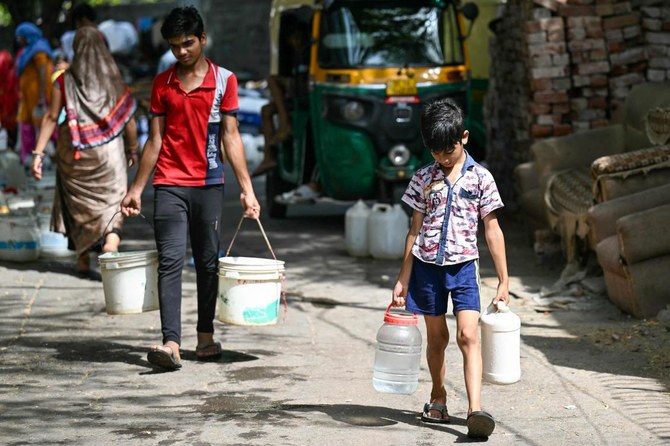
Delhi, where the temperature was 45.4 C on Friday afternoon, recorded its first heat-related death this week and is facing an acute water shortage.
Billions of people across Asia have been grappling with soaring temperatures- a trend scientists say has been worsened by human-driven climate change.
India’s neighbor Pakistan has also seen a spike in forest fires as temperatures soar, going as high as 52.2 C last week.
India is the world’s third-biggest greenhouse gas emitter but has set a target of becoming a net-zero emitter by 2070.
While heat is affecting some of the country, the northeastern states of Manipur and Assam have been battered by heavy rainfall after Cyclone Remal, with several areas inundated on Friday.
Monsoon rains also hit the coast of the country’s southernmost Kerala state on Thursday, two days earlier than expected.


![]()


At least 24 dead in eastern India as temperatures soar
Short Url
https://arab.news/re8bn
At least 24 dead in eastern India as temperatures soar
- The prevailing heatwave over east India is likely to continue for two days
- A total of 14 people died in Bihar


ICE agents can’t make warrantless arrests in Oregon unless there’s a risk of escape, US judge rules
- US District Judge Mustafa Kasubhai issued a preliminary injunction in a proposed class-action lawsuit
- Case targets Department of Homeland Security’s practice of arresting immigrants they happen to come across
PORTLAND, Oregon: US immigration agents in Oregon must stop arresting people without warrants unless there’s a likelihood of escape, a federal judge ruled Wednesday.
US District Judge Mustafa Kasubhai issued a preliminary injunction in a proposed class-action lawsuit targeting the Department of Homeland Security’s practice of arresting immigrants they happen to come across while conducting ramped-up enforcement operations — which critics have described as “arrest first, justify later.”
The department, which is named as a defendant in the suit, did not immediately comment in response to a request from The Associated Press.
Similar actions, including immigration agents entering private property without a warrant issued by a court, have drawn concern from civil rights groups across the country amid President Donald Trump’s mass deportation efforts.
Courts in Colorado and Washington, D.C., have issued rulings like Kasubhai’s, and the government has appealed them.
In a memo last week, Todd Lyons, the acting head of US Immigration and Customs Enforcement, emphasized that agents should not make an arrest without an administrative arrest warrant issued by a supervisor unless they develop probable cause to believe that the person is in the US illegally and likely to escape from the scene before a warrant can be obtained.
But the judge heard evidence that agents in Oregon have arrested people in immigration sweeps without such warrants or determining escape was likely.
The daylong hearing included testimony from one plaintiff, Victor Cruz Gamez, a 56-year-old grandfather who has been in the US since 1999. He told the court he was arrested and held in an immigration detention facility for three weeks even though he has a valid work permit and a pending visa application.
Cruz Gamez testified that he was driving home from work in October when he was pulled over by immigration agents. Despite showing his driver’s license and work permit, he was detained and taken to the ICE building in Portland before being sent to an immigration detention center in Tacoma, Washington. After three weeks there, he was set to be deported until a lawyer secured his release, he said.
He teared up as he recounted how the arrest impacted his family, especially his wife. Once he was home they did not open the door for three weeks out of fear and one of his grandchildren did not want to go to school, he said through a Spanish interpreter.
Afterward a lawyer for the federal government told Cruz Gamez he was sorry about what he went through and the effect it had on them.
Kasubhai said the actions of agents in Oregon — including drawing guns on people while detaining them for civil immigration violations — have been “violent and brutal,” and he was concerned about the administration denying due process to those swept up in immigration raids.
“Due process calls for those who have great power to exercise great restraint,” he said. “That is the bedrock of a democratic republic founded on this great constitution. I think we’re losing that.”
The lawsuit was brought by the nonprofit law firm Innovation Law Lab, whose executive director, Stephen Manning, said he was confident the case will be a “catalyst for change here in Oregon.”
“That is fundamentally what this case is about: asking the government to follow the law,” he said during the hearing.
The preliminary injunction will remain in effect while the lawsuit proceeds.
US District Judge Mustafa Kasubhai issued a preliminary injunction in a proposed class-action lawsuit targeting the Department of Homeland Security’s practice of arresting immigrants they happen to come across while conducting ramped-up enforcement operations — which critics have described as “arrest first, justify later.”
The department, which is named as a defendant in the suit, did not immediately comment in response to a request from The Associated Press.
Similar actions, including immigration agents entering private property without a warrant issued by a court, have drawn concern from civil rights groups across the country amid President Donald Trump’s mass deportation efforts.
Courts in Colorado and Washington, D.C., have issued rulings like Kasubhai’s, and the government has appealed them.
In a memo last week, Todd Lyons, the acting head of US Immigration and Customs Enforcement, emphasized that agents should not make an arrest without an administrative arrest warrant issued by a supervisor unless they develop probable cause to believe that the person is in the US illegally and likely to escape from the scene before a warrant can be obtained.
But the judge heard evidence that agents in Oregon have arrested people in immigration sweeps without such warrants or determining escape was likely.
The daylong hearing included testimony from one plaintiff, Victor Cruz Gamez, a 56-year-old grandfather who has been in the US since 1999. He told the court he was arrested and held in an immigration detention facility for three weeks even though he has a valid work permit and a pending visa application.
Cruz Gamez testified that he was driving home from work in October when he was pulled over by immigration agents. Despite showing his driver’s license and work permit, he was detained and taken to the ICE building in Portland before being sent to an immigration detention center in Tacoma, Washington. After three weeks there, he was set to be deported until a lawyer secured his release, he said.
He teared up as he recounted how the arrest impacted his family, especially his wife. Once he was home they did not open the door for three weeks out of fear and one of his grandchildren did not want to go to school, he said through a Spanish interpreter.
Afterward a lawyer for the federal government told Cruz Gamez he was sorry about what he went through and the effect it had on them.
Kasubhai said the actions of agents in Oregon — including drawing guns on people while detaining them for civil immigration violations — have been “violent and brutal,” and he was concerned about the administration denying due process to those swept up in immigration raids.
“Due process calls for those who have great power to exercise great restraint,” he said. “That is the bedrock of a democratic republic founded on this great constitution. I think we’re losing that.”
The lawsuit was brought by the nonprofit law firm Innovation Law Lab, whose executive director, Stephen Manning, said he was confident the case will be a “catalyst for change here in Oregon.”
“That is fundamentally what this case is about: asking the government to follow the law,” he said during the hearing.
The preliminary injunction will remain in effect while the lawsuit proceeds.
Latest updates


Recommended


© 2026 SAUDI RESEARCH & PUBLISHING COMPANY, All Rights Reserved And subject to Terms of Use Agreement.