

US, China to resume military-to-military dialogue in ‘coming months’: Austin

1 / 2
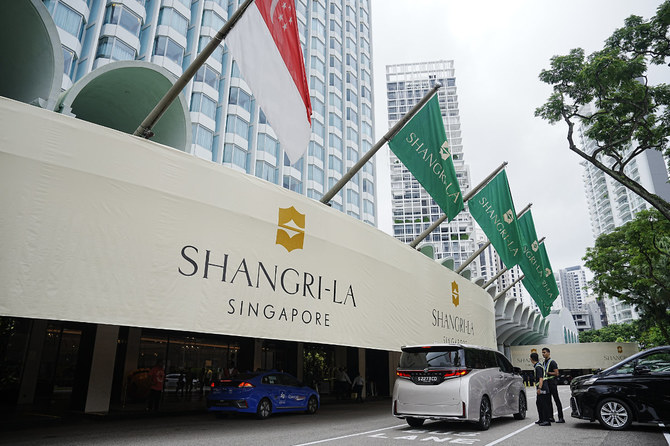
A front view of the Shangri-La Hotel, the venue for the 21th International Institute for Strategic Studies Shangri-La Dialogue, Asia's annual defense and security forum, in Singapore, on May 31, 2024. (AP)
2 / 2
Participants walk at the lobby of the Shangri-La Hotel, the venue for the 21th International Institute for Strategic Studies Shangri-La Dialogue, Asia's annual defense and security forum, in Singapore, on May 31, 2024. (AP)
Short Url
Updated 31 May 2024
Follow

US, China to resume military-to-military dialogue in ‘coming months’: Austin

  • China's growingly assertive actions in the South China Sea has led to an increasing number of direct conflicts with other countries in the region
  • This year’s conference comes just a week after China held massive military drills around Taiwan

SINGAPORE: The US and China will resume military-to-military communications “in the coming months,” US Defense Secretary Lloyd Austin said Friday, as Beijing hailed the “stabilizing” security relations between the countries.
Austin met with his Chinese counterpart Dong Jun on the sidelines of the Shangri-La Dialogue in Singapore in the first substantive face-to-face talks between the two defense chiefs in 18 months.
Dong and Austin met for over an hour at the luxury hotel hosting the security forum that is attended by defense officials from around the world and in recent years has become a barometer of US-China relations.
Austin said telephone conversations between US and Chinese military commanders would resume “in the coming months,” according to a readout released by the Pentagon.
He also welcomed plans for a “crisis-communications working group” with China by the end of the year, the statement said.
Describing the talks as “positive,” Chinese defense spokesman Wu Qian told reporters that military-to-military relations were “currently stopping their decline and stabilizing.”
But Wu cautioned that it was not possible for Beijing and Washington to solve all bilateral problems in one meeting, highlighting their thorniest dispute over Taiwan, which China considers part of its territory.
This year’s Shangri-La Dialogue comes a week after China held military drills around self-ruled Taiwan and warned of war over the US-backed island following the inauguration of President Lai Ching-te, who Beijing has described as a “dangerous separatist.”
“The Taiwan issue is purely China’s internal affairs, external forces have no right to interfere, and the United States’ actions seriously violate the one China principle,” Wu said, referring to Washington’s decision to congratulate Lai and send a delegation to the ceremony.
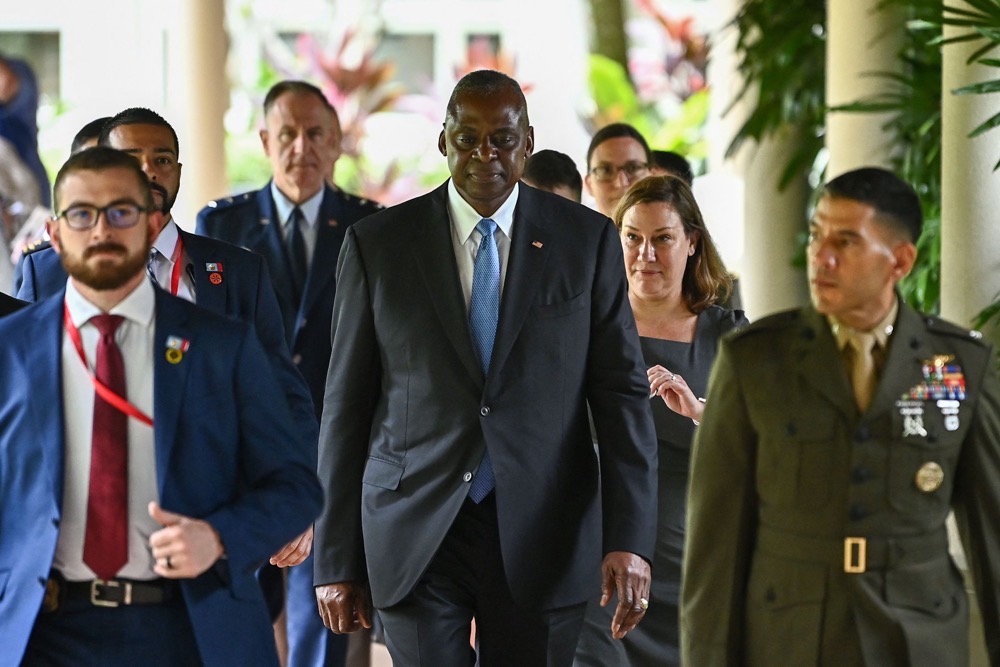


Austin and Dong will also give speeches in Singapore this weekend. (AFP)

Austin said China’s military exercises were “provocative” and insisted it should not use Taipei’s “political transition... as a pretext for coercive measures.”
US President Joe Biden’s administration and China have been stepping up communication to ease friction between the nuclear-armed rivals, with Secretary of State Antony Blinken visiting Beijing and Shanghai last month.
A key focus has been the resumption of military-to-military dialogue, which is seen as critical to preventing flashpoint disputes from spinning out of control.
China scrapped military communications with the United States in 2022 in response to then-US House Speaker Nancy Pelosi’s visit to Taiwan.
Tensions between Washington and Beijing were further stoked by issues including an alleged Chinese spy balloon that was shot down over US airspace, a meeting between Taiwan’s then-president Tsai Ing-wen and Pelosi’s successor Kevin McCarthy and American military aid for Taipei.
China is also furious over the US’ deepening defense ties in the Asia-Pacific, particularly with the Philippines, and its regular deployment of warships and fighter jets in the Taiwan Strait and South China Sea.
Beijing views this as part of a decades-long US effort to contain it.
The two sides agreed after a summit between Chinese leader Xi Jinping and Biden last November to restart high-level military talks, including over military operations near Taiwan, Japan and in the South China Sea.
Chinese and American forces have had a series of close encounters in the disputed waterway that China claims almost entirely.
While meeting Dong, Austin underscored the importance of “high seas freedom of navigation,” especially in the South China Sea, and insisted that the US would continue to “fly, sail and operate” wherever international law allowed, the Pentagon readout said.
Philippine President Ferdinand Marcos, who has sought to deepen defense cooperation with the US as he stands up to Chinese actions in waters off the Southeast Asia country, will deliver the Shangri-La Dialogue’s keynote speech on Friday.
Austin and Dong will also give speeches in Singapore this weekend in which they are expected to touch on a range of their nations’ pressure points.
Their meeting on Friday follows a phone call between them in April, and offers hope of further military talks to cool tensions.


Congressional Black Caucus and civil rights leaders unite to counter Trump administration’s agenda

Updated 4 sec ago
Follow

Congressional Black Caucus and civil rights leaders unite to counter Trump administration’s agenda

  • Rep. Yvette Clarke of New York, caucus chair, lamented the concerted effort to roll back civil rights underlying voting access and dismantling of social programs 
  • Civil rights leaders and Democratic lawmakers have already filed dozens of lawsuits against the administration’s anti-DEI policies

WASHINGTON: The Congressional Black Caucus and major civil rights groups on Tuesday marked Black History Month by relaunching a national plan to mobilize against what they say are the Trump administration’s efforts to weaken legal protections for minority communities.
The assembled leaders voiced outrage over the series of policy actions President Donald Trump has implemented since his return to the White House, as well as the president’s personal conduct, but offered few concrete details about what they’re prepared to do in response to the administration.
“Over the past year, we have seen a concerted effort to roll back civil rights underlying voting access, dismantle social programs and concentrate power in the hands of the wealthy and well-connected, at the expense of our community,” said Rep. Yvette Clarke, D-N.Y., chair of the Congressional Black Caucus.
Clarke, who spoke in front of leaders from major civil rights organizations and her Democratic colleagues, promised the caucus would “legislate, organize, mobilize our communities.” The coalition, which spoke privately before the press conference, discussed how to protect voters ahead of the fall midterms and how to build a policy agenda for Democrats should the party win back power in either chamber of Congress next year.
“It’s an all-hands-on-deck moment, and every tool available to the leadership collectively has got to be deployed to get this thing turned around,” House Minority Leader Hakeem Jeffries, D-N.Y., told The Associated Press after the press conference.
Jeffries did not rule out mass protests, organizing boycotts and further legal action as potential steps organizers may take.
The leaders’ warnings come at a moment when the Trump administration has continued its crusade against diversity, equity and inclusion across the US government, in higher education and the private sector.
At the start of his second term, Trump signed multiple executive orders banning the use of “illegal DEI” in government agencies, as well as organizations that interact with the federal government. Trump has threatened to withhold funds from major companies, non-profit groups and state governments as part of the administration’s efforts to upend DEI.
The administration has also sought to redefine the nation’s culture and how history is taught in museums, classrooms and other educational settings. It also prioritized investigating and prosecuting civil rights cases of potential discrimination against white people through both the Justice Department’s civil rights division and the Equal Employment Opportunity Commission, among other agencies.
Civil rights leaders and Democratic lawmakers have already filed dozens of lawsuits against the administration’s anti-DEI policies.
Locked out of power in both chambers of Congress, Democrats have fewer ways to conduct oversight or limit the actions of the Trump administration. And civil rights leaders, who were largely knocked on the back foot by a deluge of policy changes over the last year, are attempting to regroup ahead of this year’s midterm elections.
Progressive civil rights leaders, who are broadly unhappy with the administration’s entire agenda, have argued that the president’s agenda on immigration, voting rights, the economy and other issues is exploiting hard-won policies that civil rights leaders had, for decades, used to ensure anti-discrimination and economic advancement for Black communities.
“This is about how this administration is using the tools we built as a Black community to ensure that all of our people are protected,” said Maya Wiley, president and CEO of the Leadership Conference on Civil and Human Rights.
Progressive state leaders and civil rights groups have also stepped up their efforts elsewhere. A coalition of state attorneys general and civil rights groups this month launched a coalition to promote DEI and accessibility policies through more aggressive legal action.
“State attorneys general are in a unique position to defend these fundamental rights, and this campaign will ensure everyone is heard and shielded from those who aim to weaken civil rights,” Illinois Attorney General Kwame Raoul said in a statement on Monday announcing the initiative.
The initiative includes Democratic attorneys general from fourteen states District of Columbia, as well as over a dozen civil rights groups from across the country. The group intends to launch inquiries and file lawsuits across the country into instances where, the leaders argue, organizations may be violating anti-discrimination laws in response to the rollback of DEI policies by major companies and the Trump administration.
The effort faces an uncertain and shifting legal landscape.
Federal courts remain divided over the use of race in hiring and anti-discrimination in the workplace. And the conservative-majority on the Supreme Court has ruled against the use of race in college admissions. Several justices have voiced skepticism about how race and other characteristics can be used by government agencies and private institutions, even if a policy was meant to combat discrimination.
On Tuesday, the assembled civil rights leaders repeatedly acknowledged the uphill battle that their movement faced on multiple fronts. Some said that the administration’s policy decisions may set up stark political battles in the coming years.
Marc Morial, president of the National Urban League, said: “We commit today to fight and fight and fight until hell freezes over, and then, I can assure you, we will fight on the ice.”