

France’s Macron urges Abbas to ‘reform’ Palestinian Authority with ‘prospect of recognition’

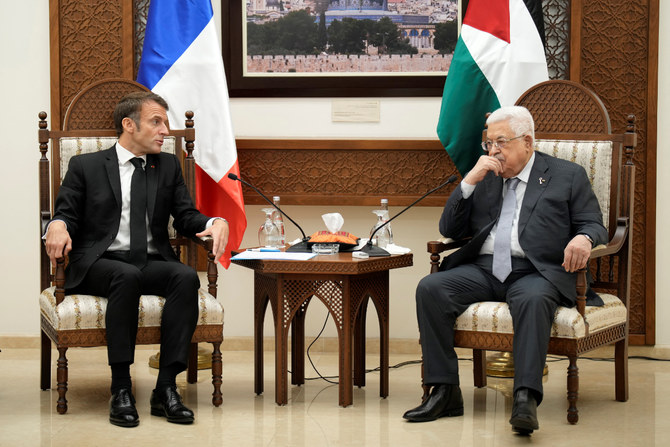
This photo taken on October 24, 2023, shows French President Emmanuel Macron (L) meeting with Palestinian President Mahmoud Abbas in the West Bank city of Ramallah.(Pool/AFP/File)
Short Url
Updated 30 May 2024
Follow

France’s Macron urges Abbas to ‘reform’ Palestinian Authority with ‘prospect of recognition’

  • In a statement, Macron said France supports “a reformed and strengthened Palestinian Authority, able to carry out its responsibilities throughout the Palestinian territories"

PARIS: French President Emmanuel Macron urged Palestinian Authority chief Mahmoud Abbas to “implement necessary reforms,” offering the “prospect of recognition of the state of Palestine” during a phone call Wednesday, his office said.

Macron “highlighted France’s commitment to building a common vision of peace with European and Arab partners, offering security guarantees for Palestinians and Israelis,” as well as “making the prospect of recognition of a state of Palestine part of a useful process,” Macron’s Elysee Palace said.
The readout of the call with the chief of the Palestinian Authority (PA) in the West Bank follows Tuesday’s official recognition for a Palestinian state by fellow European nations Spain, Ireland and Norway, which drew ire from Israel.
Macron’s Foreign Minister Stephane Sejourne earlier Wednesday accused France’s neighbors of “political positioning” ahead of June 9 European elections, rather than seeking a solution to the Israeli-Palestinian conflict.
Macron had said Tuesday that he would be prepared to recognize a Palestinian state, but such a move should “come at a useful moment” and not be based on “emotion.”
France supports “a reformed and strengthened Palestinian Authority, able to carry out its responsibilities throughout the Palestinian territories, including in the Gaza Strip, for the benefit of the Palestinian people,” Macron told Abbas on Wednesday, according to the Elysee Palace readout.
Abbas’s office said in a statement that he expressed the Palestinian government’s commitment to “reform” during the talks with Macron.
He called on “European countries that have not recognized the state of Palestine to do so.”
Current fighting in Gaza, controlled by the PA’s rival Hamas, was sparked by the militant group’s unprecedented October 7 attack on southern Israel.
That attack resulted in the deaths of 1,189 people, mostly civilians, according to an AFP tally based on Israeli official figures.
Militants also took 252 hostages, 121 of whom remain in Gaza, including 37 the Israeli army says are dead.
Israel’s retaliatory offensive has killed at least 36,171 people in Gaza, mostly civilians, according to the Hamas-run territory’s health ministry.
Macron called civilian casualties “intolerable” and offered his “sincere condolences to the Palestinian people” for the bombing of a displaced people’s camp in Rafah in southern Gaza.
He told Abbas that Paris was “determined to work with Algeria and its partners on the UN Security Council” so the body “makes a strong statement on Rafah.”
Algeria’s draft resolution calls on Israel to immediately halt military action in Rafah.


Syria Kurds impose curfew in Qamishli ahead of govt forces entry

Updated 2 sec ago
Follow

Syria Kurds impose curfew in Qamishli ahead of govt forces entry

QAMISHLI: Kurdish forces imposed a curfew on Kurdish-majority Qamishli in northeastern Syria on Tuesday, ahead of the deployment of government troops to the city, an AFP team reported.
The curfew came after Syrian security personnel entered the mixed Kurdish-Arab city of Hasakah and the countryside around the Kurdish town of Kobani on Monday, as part of a comprehensive agreement to gradually integrate the Kurds’ military and civilian institutions into the state.
The Kurds had ceded territory to advancing government forces in recent weeks.
An AFP correspondent saw Kurdish security forces deployed in Qamishli and found the streets empty of civilians and shops closed after the curfew came into effect early on Tuesday.
It will remain in force until 6:00 am (0300 GMT) on Wednesday.
The government convoy is expected to enter the city later on Tuesday and will include a limited number of forces and vehicles, according to Marwan Al-Ali, the Damascus-appointed head of internal security in Hasakah province.
The integration of Kurdish security forces into the interior ministry’s ranks will follow, he added.
Friday’s deal “seeks to unify Syrian territory,” including Kurdish areas, while also maintaining an ongoing ceasefire and introducing the “gradual integration” of Kurdish forces and administrative institutions, according to the text of the agreement.
It was a blow to the Kurds, who had sought to preserve the de facto autonomy they exercised after seizing vast areas of north and northeast Syria in battles against Daesh during the civil war, backed by a US-led coalition.
Mazloum Abdi, head of the Kurdish-led Syrian Democratic Forces (SDF), had previously said the deal would be implemented on the ground from Monday, with both sides to pull forces back from frontline positions in parts of the northeast, and from Kobani in the north.
He added that a “limited internal security force” would enter parts of Hasakah and Qamishli, but that “no military forces will enter any Kurdish city or town.”