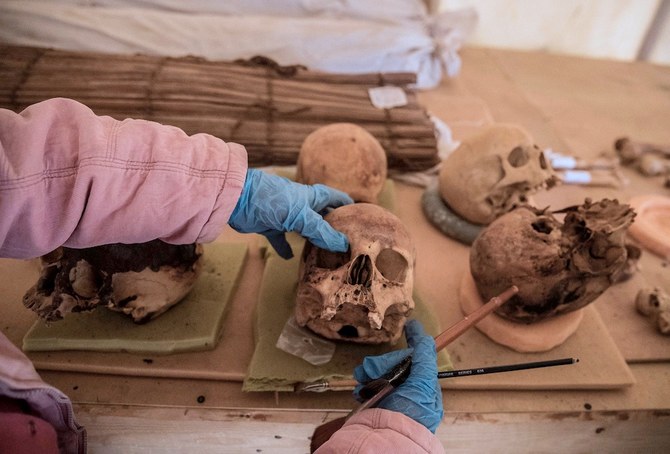

LONDON: Ancient Egyptians may have discovered the existence of cancer and practiced surgery to treat it, a new study has found.
A team of international researchers studied two human skulls, discovering “extraordinary” evidence that places the already distinguished medical practices of Ancient Egypt in a new light.
Historical texts documenting medicine in Ancient Egypt already revealed tremendous knowledge, including the ability to treat disease, traumatic injury and dental issues.
But researchers say that the civilization may have broken through a “medical knowledge frontier” in treating cancer, Sky News reported.
Lead author Prof. Edgard Camaros, a paleopathologist at the University of Santiago de Compostela, said: “This finding is unique evidence of how ancient Egyptian medicine would have tried to deal with or explore cancer more than 4,000 years ago.
“This is an extraordinary new perspective in our understanding of the history of medicine.”
Scientists in the study examined two skulls held at the University of Cambridge’s Duckworth Collection.
The first, of a man estimated to be 30 to 35 years of age, was dated to between 2687 and 2345 B.C.
The second skull is of a woman older than 50, dated to between 663 and 343 B.C.
Microscopic viewing of the male skull showed a “big-sized lesion,” resulting in likely tissue destruction and about 30 metastasized lesions, said Tatiana Tondini, a researcher at the University of Tubingen.
But researchers later discovered cuts around the lesions, suggesting the precise medical use of a metal instrument.
“When we first observed the cutmarks under the microscope, we could not believe what was in front of us,” added Tondini, the first author of the study in the “Frontiers of Medicine” journal.
“We see that although ancient Egyptians were able to deal with complex cranial fractures, cancer was still a medical knowledge frontier.
“We wanted to learn about the role of cancer in the past, how prevalent this disease was in antiquity and how ancient societies interacted with this pathology.”
The female skull that was examined also featured a large lesion “consistent with a cancerous tumour that led to bone destruction,” Sky News reported.
The discovery may also lead to reappraisals of the proliferation of cancer and carcinogens throughout human history.
However, researchers cautioned against making definitive statements based on the study.
Prof. Albert Isidro, the study’s co-author and a surgical oncologist at the University Hospital Sagrat Cor, said: “It seems ancient Egyptians performed some kind of surgical intervention related to the presence of cancerous cells, proving that ancient Egyptian medicine was also conducting experimental treatments or medical explorations in relation to cancer.
“This study contributes to a changing of perspective and sets an encouraging base for future research in the field of paleo-oncology, but more studies will be needed to untangle how ancient societies dealt with cancer.”