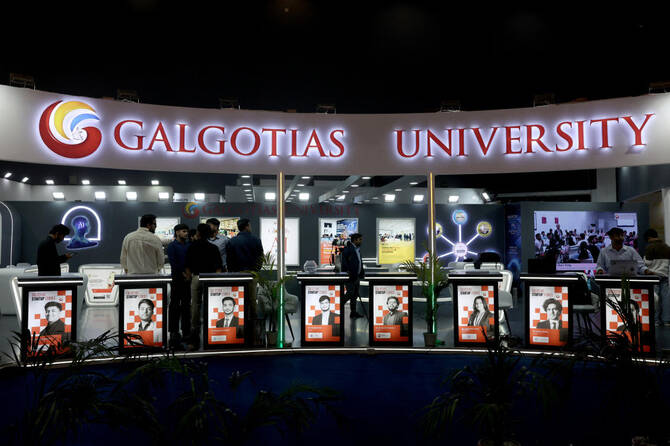
NEW DELHI: An Indian university has been asked to vacate its stall at the country’s flagship AI summit after a staff member was caught presenting a commercially available robotic dog made in China as its own creation, two government sources said.
“You need to meet Orion. This has been developed by the Center of Excellence at Galgotias University,” Neha Singh, a professor of communications, told state-run broadcaster DD News this week in remarks that have since gone viral.
But social media users quickly identified the robot as the Unitree Go2, sold by China’s Unitree Robotics for about $2,800 and widely used in research and education globally.
The episode has drawn sharp criticism and has cast an uncomfortable spotlight on India’s artificial intelligence ambitions.
The embarrassment was amplified by IT Minister Ashwini Vaishnaw, who shared the video clip on his official social media account before the backlash. The post was later deleted.
Both Galgotias and Singh have subsequently said the robot was not a university creation and the university had never claimed otherwise.
The stall remained open to visitors as of Wednesday morning with university officials fielding questions from media about accusations of plagiarism and misrepresentation.
Galgotias has yet to receive any communication about being kicked out from the event, a representative at the booth said.
The India AI Impact summit at Bharat Mandapam in New Delhi, which runs until Saturday, has been billed as the first major AI gathering hosted in the Global South. Prime Minister Narendra Modi, Google’s Sundar Pichai, OpenAI’s Sam Altman and Anthropic’s Dario Amodei will address the gathering on Thursday.
The event has also faced broader organizational difficulties since opening, with delegates reporting overcrowding and logistical issues.
That said, there has been more than $100 billion of investment in India AI projects pledged during the summit, including investments from the Adani Group conglomerate, tech giant Microsoft and data center firm Yotta.
India’s biggest opposition party, Congress, was among those expressing outrage.
“The Modi government has made a laughing stock of India globally with regard to AI,” it said on social media, citing the robot incident.


India tells university to leave AI summit after presenting Chinese robot as its own, sources say
https://arab.news/j9n5p
India tells university to leave AI summit after presenting Chinese robot as its own, sources say

- Social media users quickly identified the robot as the Unitree Go2, sold by China’s Unitree Robotics for about $2,800
- Orion, the robotic dog, was claimed to have been developed at the Center of Excellence at Galgotias University


Cambodia takes back looted historic artifacts handled by British art dealer
- The objects were returned under a 2020 agreement between the Ministry of Culture and Fine Arts and the family of the late Douglas Latchford, a British art collector and dealer who allegedly had the items smuggled out of Cambodia
PHNOM PENH, Cambodia: Cambodian officials on Friday received more than six dozen historic artifacts described as part of the country’s cultural heritage that had been looted during decades of war and instability.
At a ceremony attended by Deputy Prime Minister Hun Many, the 74 items were unveiled at the National Museum in Phnom Penh after their repatriation from the United Kingdom.
The objects were returned under a 2020 agreement between the Ministry of Culture and Fine Arts and the family of the late Douglas Latchford, a British art collector and dealer who allegedly had the items smuggled out of Cambodia.
“This substantial restitution represents one of the most important returns of Khmer cultural heritage in recent years, following major repatriations in 2021 and 2023 from the same collection,” the Culture Ministry said in a statement. “It marks a significant step forward in Cambodia’s continued efforts to recover, preserve, and restore its ancestral legacy for future generations.”
The artifacts were described as dating from the pre-Angkorian period through the height of the Angkor Empire, including “monumental sandstone sculptures, refined bronze works, and significant ritual objects.” The Angkor Empire, which extended from the ninth to the 15th century, is best known for the Angkor Wat archaeological site, the nation’s biggest tourist attraction.
Latchford was a prominent antiquities dealer who allegedly orchestrated an operation to sell looted Cambodian sculptures on the international market.
From 1970 to the 1980s, during Cambodia’s civil wars and the communist Khmer Rouge ‘s brutal reign, organized looting networks sent artifacts to Latchford, who then sold them to Western collectors, dealers, and institutions. These pieces were often physically damaged, having been pried off temple walls or other structures by the looters.
Latchford was indicted in a New York federal court in 2019 on charges including wire fraud and conspiracy. He died in 2020, aged 88, before he could be extradited to face charges.
Cambodia, like neighboring Thailand, has benefited from a trend in recent decades involving the repatriation of art and archaeological treasures. These include ancient Asian artworks as well as pieces lost or stolen during turmoil in places such as Syria, Iraq and Nazi-occupied Europe. New York’s Metropolitan Museum of Art is one of the prominent institutions that has been returning illegally smuggled art, including to Cambodia.
“The ancient artifacts created and preserved by our ancestors are now being returned to Cambodia, bringing warmth and joy, following the country’s return to peace,” said Hun Many, who is the younger brother of Prime Minister Hun Manet.


