KARACHI: For the past eight years, Mariam Hassan’s biggest concern while out doing her work as a TV health reporter in Karachi has been to limit her water intake lest she has to use the toilet.
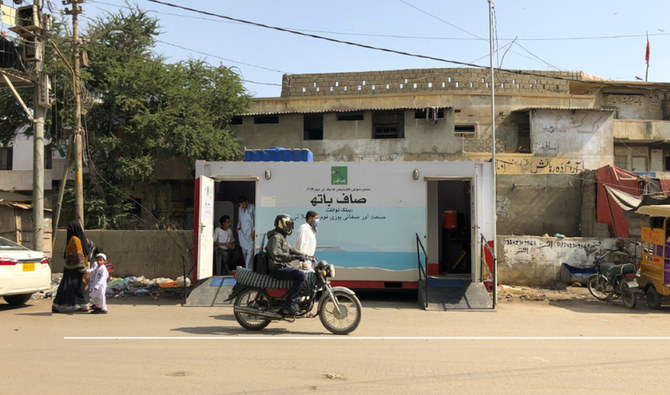
Hassan’s problem speaks to one of Pakistan’s most serious public health concerns: public toilets. World Bank data shows 79 million people in the country do not have access to a proper toilet while a recent UNICEF study says 25 million people still practice open defecation.
The lack of toilets for public use is not just a matter of public health but also about safety, women’s rights and human dignity, rights advocates and urban planners say. Indeed, the problem is especially difficult for women, who are not allowed to use the same toilet facilities as men in the conservative Muslim country.
“There is no place available for women and the places that are available are so dirty that you can’t even imagine going there,” Hassan told Arab News, echoing the sentiment of dozens of women interviewed on the subject this week in Karachi, Pakistan’s largest city and home to over 20 million people.
She recounted an instance in 2018 when she worked tirelessly from 7am until 10 at night covering a protest in the city’s Azizabad area without being able to find a single public restroom in the surroundings.
“At last our cameraperson took me to his relative’s house which was quite embarrassing as you’re going to a stranger’s house just to use the restroom,” Hassan said.
The Sindh High Court, troubled by how many Pakistanis don’t have access to public toilets in the country’s commercial hub, has ordered the government to build new facilities and do maintenance work on existing ones. During the proceedings of the case earlier this month, it was revealed that none of the 182 graveyards, 33 prominent markets, 42 roads, 970 bus stops and 133 hospitals in the city has public toilets on their premises.
Asked about the issue, Karachi Mayor Murtaza Wahab Siddiqui, whose Pakistan Peoples Party (PPP) has been ruling the Sindh province since 2008, acknowledged that access to toilets was an issue that had not received due attention in the provincial capital.
“Whether they are public parks, public spaces, buildings or shopping malls, these washrooms were part of the original plan,” he told Arab News. “And as an end result, today, it is evident that this basic necessity is not available to the public the way it should be in public areas.
“The existing toilets and washrooms that have either been encroached upon or converted [into other structures], we will speak to the relevant building associations through the Sindh Building Control Authority so that those washrooms can be reactivated to ensure that people have access to this basic necessity.”
Siddiqui said even before the high court’s ruling, steps had been taken by the Karachi Metropolitan Corporation (KMC) to refurbish old toilets in the city’s zoo and two parks and there were plans to construct washrooms along Karachi’s main thoroughfares and redo washrooms in shopping areas that had fallen into disrepair or been turned into shops or other facilities.
MOBILITY
Rights activists say public toilets are essential infrastructure for cities to guarantee citizens’ right to sanitation and their comfort to circulate in public spaces. In Karachi, the lack of public toilets has particularly impeded women’s ability to go about their daily business, whether as working women out in the field and traveling to jobs or housewives out for shopping or other errands.
“Women also need to travel, women can also go to the market, do shopping, and go to their jobs,” Muhammad Toheed, an urban planner and geographer, said. “Whether women are going on a trip or going to the market, they should mentally prepare themselves that they may not find a restroom facility along the way.”
Javed Ahmed, a city dweller in his 60s, reminisced about a time around three decades ago when the city used to have public toilets but said they had gradually disappeared due to a lack of maintenance and “societal conduct.”
“Later on, perhaps they also introduced mobile toilets. I have seen those vehicles that used to roam around, but they have vanished also,” he said, adding that people from the working classes, especially laborers and rickshaw and taxi drivers, and women, gravely required access to restrooms in public spaces.
“Throughout the city, if I may say, public toilets are nowhere to be seen, and if they are present somewhere, half of them are locked or closed,” Summaiya Khursheed, a working professional, said as she shopped at a local market.
“Just like water and food are your basic necessities, toilets are also among your basic needs. Entire markets have been built for women, but it’s not considered that toilets are also a basic necessity for women.”
Housewife Uzma Hassan outlined the steps women had to take before leaving home, knowing they would not be able to find usable toilets.
“It’s stressful that we have to do it before leaving. We mentally prepare ourselves before leaving, thinking that there won’t be any toilets available. [We worry about] what we would have to do and what not to do, and we shop hurriedly so we may get free quickly to go back home,” she told Arab News.
“There are so many markets open in Karachi, with all kinds of people living here but there should be toilets in these markets and parks. The Sindh government should think about this because it is a very big issue, especially for women.”


In Pakistan’s largest city, women are bound by a common misery: no public toilets
https://arab.news/46b4v
In Pakistan’s largest city, women are bound by a common misery: no public toilets

- Public toilets are a rare sight in Karachi, city of 20.3 million, which activists say severely impacts women’s mobility, safety
- Sindh High Court this month ordered local authorities to construct bathrooms in markets, parks, hospitals, other public places

Kazakhstan president to explore trade, connectivity cooperation in first state visit to Pakistan tomorrow
- Kazakhstan President Kassym-Jomart Tokayev to visit Pakistan from Feb. 3-4 with high-level delegation, says Pakistan’s foreign office
- Kazakh president to meet Pakistani counterpart, hold talks with PM Shehbaz Sharif and address Pakistan-Kazakhstan Business Forum
ISLAMABAD: Kazakhstan President Kassym-Jomart Tokayev will explore bilateral cooperation with Pakistan in trade, regional connectivity, logistics and other sectors when he undertakes his first state visit to the country this week, Pakistan’s foreign office said on Monday.
Tokayev will arrive in Pakistan leading a high-level delegation comprising senior cabinet ministers and high-ranking officials from Feb. 3-4, the Pakistani foreign office said in a statement.
Tokayev is expected to meet his Pakistani counterpart President Asif Ali Zardari, hold talks with Prime Minister Shehbaz Sharif and address the Pakistan-Kazakhstan Business Forum during the visit, the foreign office said.
“The visit will provide the two sides an important and timely opportunity to undertake a comprehensive review of bilateral relations, discuss new avenues for broadening cooperation, particularly in trade, logistics, regional connectivity, people-to-people contacts, and explore collaboration at regional and international forums,” the statement said.
The foreign office said Tokayev’s visit reflects the strengthening bonds between Pakistan and Kazakhstan, their mutual commitment to transforming historic and cultural affinities into robust cooperation, as well as their common desire for peace and progress in the region.
Relations between Pakistan and Kazakhstan are rooted in shared Islamic heritage and a growing strategic partnership, with Pakistan offering landlocked Central Asian republics access to southern seaports for global trade. Pakistan was among the first countries to recognize Kazakhstan when it gained independence in December 1991 and formally established diplomatic relations with it on Feb. 24, 1992.
The two countries have held regular interactions over the past couple of years on the sidelines of the Shanghai Cooperation Organization (SCO) meetings and other international events. Kazakhstan’s Deputy Prime Minister Murat Nurtleu visited
Pakistan in September 2025 to discuss economic and trade cooperation with Islamabad.
Islamabad and Astana engage with each other to promote business and political ties via three forums mainly, which are: Bilateral Political Consultations, the Intergovernmental Joint Commission on Trade, Economic, Scientific, Technological and Cultural Cooperation, and the Joint Business Council.
According to the government of Kazakhstan, bilateral trade between the two countries amounted to $53.7 million in 2024. Pakistan’s main exports to Kazakhstan include citrus fruits, pharmaceutical products, garments, soap, sports equipment and gear and others.
Kazakhstan’s exports to Pakistan primarily include onions and garlic, dried leguminous vegetables, oats, buckwheat and other cereal grains, seeds and fruits of other oil-bearing crops, among others.


