

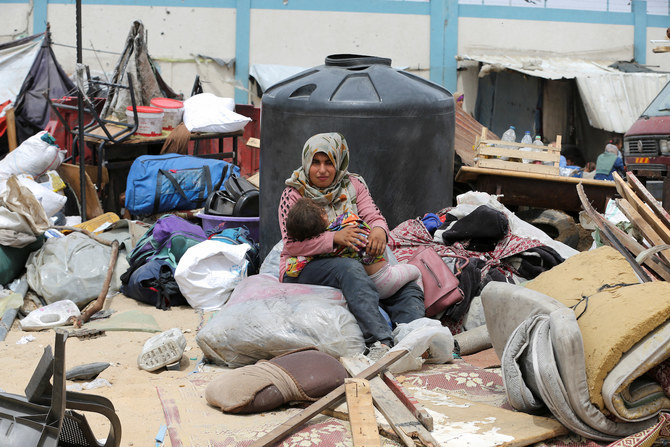

CAIRO: Israeli strikes on a tent camp in an evacuation area west of Rafah killed at least 21 on Tuesday, Gaza health authorities said, and tanks advanced to the center of the southern Gaza city for the first time after a night of heavy bombardment.
Two days after an Israeli airstrike on another camp stirred global condemnation, Gaza emergency services said four tank shells hit a cluster of tents in Al-Mawasi, a coastal area that Israel had advised civilians in Rafah to move to for safety.
At least 12 of the dead were women, according to medical officials in the Hamas-run Palestinian enclave. An Israeli military spokesperson said: “As of this time, we are not aware of this incident.”
In central Rafah, tanks and armored vehicles mounted with machine guns were spotted near Al-Awda mosque, witnesses told Reuters. The Israeli military said its forces continued to operate in the Rafah area, without commenting on reported advances into the city center.
International unease over Israel’s three-week-old Rafah offensive has turned to outrage after an attack on Sunday set off a blaze in a tent camp in a western district of the city, killing at least 45 people. Israel said it had targeted Hamas commanders and had not intended to cause civilian casualties.
Global leaders voiced horror at the fire in a designated “humanitarian zone” of Rafah where families uprooted by fighting elsewhere had sought shelter, and urged the implementation of a World Court order last week for a halt to Israel’s assault.
Tuesday’s attack occurred in an area designated by Israel as an expanded humanitarian zone, to which it had called on civilians in Rafah to evacuate for their own safety when it launched its incursion in early May.
In a diplomatic move purportedly aimed at reining in the violence, Spain, Ireland and Norway were to officially recognize a Palestinian state on Tuesday.
The three countries have said they hope their decision will accelerate efforts toward securing a ceasefire in Israel’s war against Hamas militants, now in its eighth month, that has reduced much of the densely populated territory to rubble.
Residents said Rafah’s Tel Al-Sultan neighborhood, the scene of Sunday’s night-time strike in which tents and shelters were set ablaze as families settled down to sleep, was still being bombarded.
“Tank shells are falling everywhere in Tel Al-Sultan. Many families have fled their houses in western Rafah under fire throughout the night,” one resident told Reuters via a chat app.
Around one million people — many repeatedly displaced by shifting waves of the war — have fled the Israeli offensive in Rafah since early May, the UN agency for Palestinian refugees (UNRWA) reported on Tuesday.
A video obtained by Reuters showed families on the move again, carrying their belongings through Rafah’s shattered streets, their weary children trailing behind them.
“There are a lot of attacks, smoke and dust. It is death from God...The (Israelis) are hitting everywhere. We’re tired,” said Moayad Fusaifas, pushing along belongings on two bicycles.
Israel says it’s in combat near Egypt border
Since Israel launched its incursion by seizing control of the Rafah border crossing with Egypt three weeks ago, tanks had probed around the outskirts and entered some eastern districts but had not yet rumbled into the city in full force.
In recent days, Israeli tanks have thrust toward western neighborhoods and taken up positions on the Zurub hilltop in western Rafah. On Tuesday, witnesses reported gunbattles between Israeli troops and Hamas-led fighters in the Zurub area.
Witnesses in central Rafah said the Israeli military appeared to have brought in remote-operated armored vehicles and there was no immediate sign of personnel in or around them. An Israeli military spokesperson had no immediate comment.
The Israeli military said it operated overnight along the Philadelphi Corridor that separates Gaza from Egypt “based on intelligence indicating the presence of terror targets.”
Israeli troops were engaged in close-quarter combat and were locating tunnel shafts, weapons and militant infrastructure, it said in a statement.
Israel has kept up attacks despite the ruling by the International Court of Justice on Friday ordering it to stop given a high risk of civilian casualties. Israel has argued that the top UN court’s decision had left it some scope for military action there.
The ICJ also reiterated calls for the immediate and unconditional release of hostages held in Gaza by Hamas.
More than 36,000 Palestinians have been killed in Israel’s offensive, Gaza’s health ministry says. Israel launched its air and ground war after Hamas-led militants attacked southern Israeli communities on Oct. 7, killing around 1,200 people and seizing more than 250 hostages, according to Israeli tallies.
Israel says it wants to root out Hamas fighters holed up in Rafah and rescue hostages it says are being held in the area.
In Jabalia in the northern Gaza Strip, one of the largest of the enclave’s eight historic refugee camps, Israeli forces have been engaged in fierce fighting with Hamas and Islamic Jihad fighters, residents said.
In some residential districts from which Israeli forces have retreated, civil emergency teams said they were recovering bodies from the ruins.


