

GCC chief emphasizes nations’ shared vision for integration

1 / 3
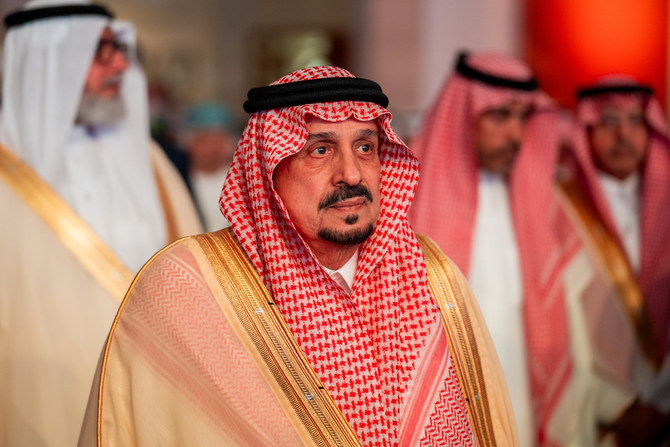
The Governor of Riyadh Province, Prince Faisal bin Bandar bin Abdulaziz Al-Saud, was among the dignitaries who graced the event. (Abdulrahman Bin Shalhoub/AN)
2 / 3
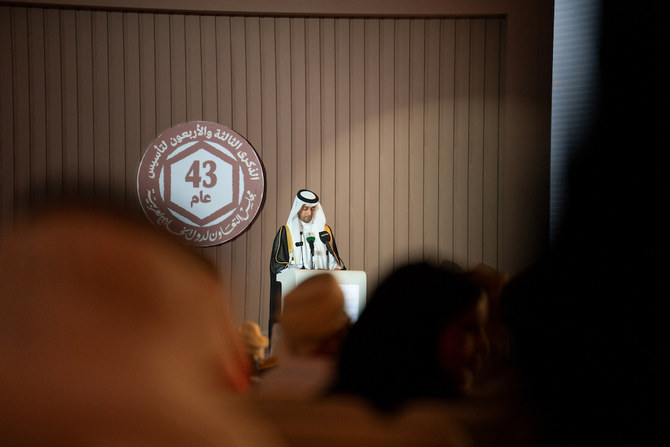
Bandar bin Mohammed Al-Attiyah, Qatar’s ambassador to Saudi Arabia, delivers a speech during the event. (Abdulrahman Bin Shalhoub/AN)
3 / 3
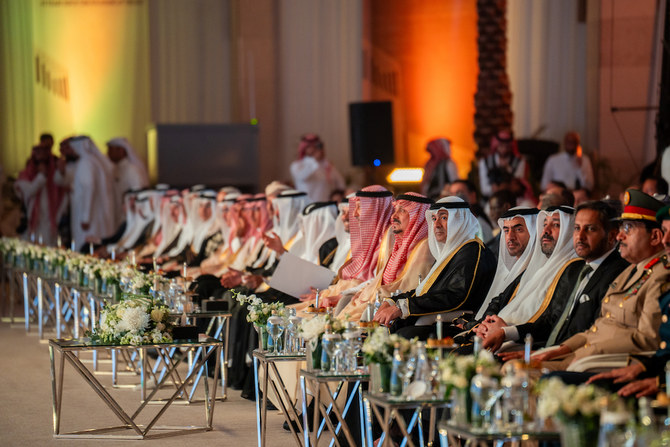
The GCC was formed on May 25, 1981, at a conference in Abu Dhabi, bringing together the UAE, Saudi Arabia, Bahrain, Oman, Qatar and Kuwait. (Abdulrahman Bin Shalhoub/AN)
Short Url
Updated 27 May 2024
Follow

GCC chief emphasizes nations’ shared vision for integration

  • Riyadh event celebrates 43 years of unity, calls for regional stability

RIYADH: The Gulf Cooperation Council marked its 43rd anniversary in Riyadh on Sunday with a ceremony attended by its members, ambassadors, and various guests including Riyadh Gov. Prince Faisal bin Bandar.

In his speech, GCC Secretary-General Jasem Al-Budaiwi said the council was an “icon and embodiment of the shared religious, historical, social, and cultural values that are reinforced by the geographical extension of the GCC countries.”

Al-Budaiwi said the council has had a clear vision for integration since its inception.

The GCC was formed on May 25, 1981, at a conference in Abu Dhabi, bringing together the UAE, Saudi Arabia, Bahrain, Oman, Qatar and Kuwait. A charter was signed creating the council for the Arab states.

The six-member bloc was initially formed as an economic group but then grew with the wider mission to provide stability and security for the region. The cooperation grew further to include other areas including energy, agriculture, telecommunications and education.

Al-Budaiwi said the region was facing difficult and unprecedented challenges, citing the killings, forced displacements, and other violations committed by Israel against the Palestinian people.

“We underscore the firm position of the GCC regarding the Israeli aggression. Therefore, we call for an immediate and sustainable ceasefire and an end to the Israeli military operations in all parts of Gaza, including the city of Rafah, and ensuring the provision of all humanitarian aid, relief, and essential needs to its population,” Al-Budaiwi said.

He urged the international community to adopt policies that would end the violence against the Palestinians in the West Bank, Jerusalem, and Islam’s holy sites.

Al-Budaiwi said the GCC supported the establishment of an independent Palestinian state within the 1967 borders, with East Jerusalem as its capital — in line with the Arab Peace Initiative and UN resolutions.

He also highlighted the achievements of the GCC in recent years.

“Our commitment to enhancing economic relations and opening new markets for the GCC countries is not only aimed at diversifying our economic activities but also at positioning the council’s countries as a strategic player on the global trade stage.

“Faced with these achievements and joint GCC projects, we now have a great responsibility to continue and preserve the gains that have been achieved during this blessed journey,” Al-Budaiwi said.

He added: “We have confidence in the capabilities and energy of our youth, whom we see as our strongest bet to achieve success and further strengthen the role and position of the cooperation council regionally and internationally.”

There was also a speech delivered by the ambassador of Qatar to Saudi Arabia, Bandar bin Mohammed Al-Attiyah, before the closing ceremony.

The event ended with traditional songs and dances of each member nation, including Saudi Arabia’s Ardah dance.


‘Echoes of Movement’ exhibition explores Italy–Saudi artistic dialogue

Updated 6 sec ago
Follow

‘Echoes of Movement’ exhibition explores Italy–Saudi artistic dialogue

RIYADH: Italian Ambassador to Saudi Arabia Carlo Baldocci recently inaugurated the exhibition “Echoes of Movement: Dialogues between Italy and Saudi Arabia,” presented within the framework of the Diriyah Biennale, the Kingdom’s leading contemporary art event and one of the most significant cultural platforms in the international art scene.

The exhibition, which runs until Feb. 12, is conceived as a space for cultural dialogue between Italy and Saudi Arabia, bringing contemporary artistic practices into conversation through the theme of movement, understood not only as physical displacement, but also as symbolic, historical and cultural crossing. Movement thus becomes a metaphor for travel, exchange and transformation — elements that have long shaped relations between peoples, territories and civilizations, particularly in the Mediterranean and Middle Eastern contexts.

The exhibition reflects on journeying as a shared human condition, evoking dynamics of migration, encounter, and mutual influence that have profoundly shaped cultural histories and continue to define the present. In this sense, “Echoes of Movement” positions itself as a space for reflection on the circulation of ideas, forms and imaginaries, highlighting art’s capacity to serve as a universal language that transcends geographical and temporal boundaries.

The exhibition features works by Mimmo Paladino and Davide Rivalta, two leading figures in contemporary Italian art. Eleven lithographs by Mimmo Paladino offer a poetic, contemporary interpretation of the medieval treatise by Emperor Frederick II, “De arte venandi cum avibus” — a foundational work of European scientific and symbolic thought, conceived in a historical context shaped by dialogue among different cultures.

The text has been extensively studied by Prof. Anna Laura Trombetti of the University of Bologna, whose research inspired the exhibition. Through his distinctive symbolic and expressive language, Paladino reinterprets the treatise from a contemporary perspective, bringing historical memory into dialogue with present-day sensibilities.

Alongside the graphic works, the exhibition is enriched by a monumental sculpture by Davide Rivalta, whose sculptural practice — marked by strong evocative tension and direct engagement with space — amplifies the sense of movement and presence, inviting visitors into a physical and conceptual encounter with the artwork.

The exhibition was realized through a fruitful collaboration with Black Engineering, an Italian company renowned for its excellence in designing and producing major cultural and artistic events at the international level. Its portfolio includes high-profile projects such as the Islamic Arts Biennale in Jeddah, the Diriyah Biennale, the construction of the iconic Maraya building in AlUla, and the production and curation of numerous art festivals, as well as the teaser for the Salone del Mobile Milano in Riyadh.

Equally significant was the contribution of Particle, an Italian company specializing in advanced digital experiences, which developed a digital pathway for the exhibition. This enhances accessibility to the content and extends its availability beyond the show’s physical duration, strengthening the project’s innovative dimension and long-term impact.