

Bangladesh cyclone toll rises to 10, around 30,000 homes destroyed

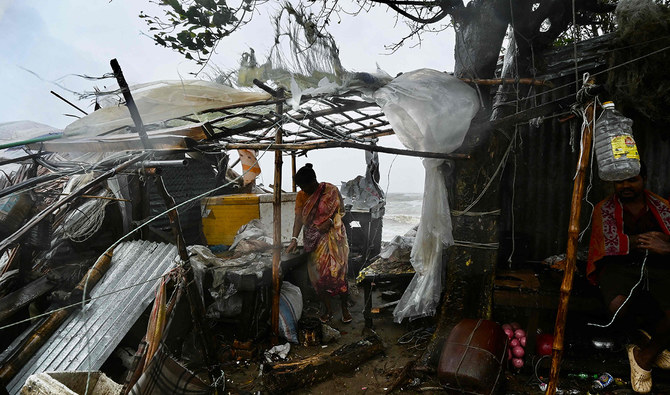
A woman stands next to her damaged house after Cyclone Remal made landfall near a beach in Kuakata on May 27, 2024. (Reutes)
Short Url
Updated 27 May 2024
Follow

Bangladesh cyclone toll rises to 10, around 30,000 homes destroyed

  • Around a million people in Bangladesh and India took shelter from cyclone, fleeing inland for concrete shelters
  • Cyclones, who are occurring more frequently, have killed hundreds of thousands in Bangladesh in recent decades

PATUAKHALI: Residents of low-lying areas of Bangladesh and India surveyed the damage Monday as a cyclone that lashed the coast weakened into a heavy storm after killing at least 10 people and destroying thousands of homes.

Fierce gales and crashing waves battered the coast as Cyclone Remal made landfall on Sunday night.

By Monday afternoon it had eased, but winds and rain still hammered residents as they picked through the wreckage of their houses.

Villages had been swamped by storm surges, tin roofs had been ripped off, trees uprooted and powerlines cut, an AFP reporter in the affected area said.

“Heavy rains unleashed by the cyclone are going on, and the wind speed is also high,” said Showkat Ali, government administrator of Barisal district, where seven people died.

“They mostly died after they were crushed under fallen houses or collapsed walls,” he told AFP.

Three others died in neighboring districts, including by drowning.

Cyclones have killed hundreds of thousands of people in Bangladesh in recent decades, but the number of superstorms hitting its densely populated coast has increased sharply, from one a year to as many as three, due to the impact of climate change.

In Khulan district, two people died, government administrator Helal Mahmud told AFP.

“The cyclone has damaged more than 123,000 homes in the division, and among them some 31,000 homes were completely damaged,” he said.

At its peak, Remal’s wind speeds hit 111 kilometers (69 miles) per hour, said Muhammad Abul Kalam Mallik, senior weather forecaster at the state-run Bangladesh Meteorological Department.

While scientists say climate change is fueling more storms, better forecasting and more effective evacuation planning have dramatically reduced the death toll.

Around a million people in Bangladesh and neighboring India took shelter, fleeing inland for concrete storm shelters away from the dangerous waves.

Most of Bangladesh’s coastal areas are just a meter or two (three to six feet) above sea level, making them vulnerable to high storm surges.

Sumita Mondal, 36, who hunkered down overnight away from India’s coast, said she had fled with only what she could carry.

“My three-year-old son is crying for food,” she told AFP by telephone.

Kamrul Hasan, secretary of Bangladesh’s disaster management ministry, said “embankments in several places have been breached or submerged, inundating some coastal areas.”

In India’s West Bengal, the “cyclone has blown off the roofs of hundreds of houses” and “uprooted thousands of mangrove trees and electricity poles,” senior state government minister Bankim Chandra Hazra told AFP.

“Storm surges and rising sea levels have breached a number of embankments,” Hazra added. “Some island villages are flooded.”

At least 800,000 Bangladeshis fled and more than 150,000 people in India moved inland from the vast Sundarbans mangrove forest, where the Ganges, Brahmaputra and Meghna rivers meet the sea.

Mallik, the Bangladeshi weather expert, said the expansive mangrove forests helped dissipate the worst of the storm.

“Like in the past, the Sundarbans acted as a natural shield to the cyclone,” he said.

But Abu Naser Mohsin Hossain, Bangladesh’s senior forest official for the Sundarbans, said the storm surge had swamped crucial freshwater areas with salt water.

“We are worried,” said Hossain. “These ponds were the source of fresh water for the entire wildlife in the mangroves — including the endangered Bengal tigers.”


Bahraini commander witnesses Pakistan Navy passing-out parade in Karachi

Updated 18 sec ago
Follow

Bahraini commander witnesses Pakistan Navy passing-out parade in Karachi

  • Rear Admiral Ahmed Mohamed bin Ali says it is a matter of immense pleasure for him to review commissioning of personnel at his alma mater
  • The training you have received has prepared you to step into a challenging yet deeply satisfying career, he tells young officers, midshipmen

ISLAMABAD: Rear Admiral Ahmed Mohamed Ebrahim Al bin Ali, commander of Royal Bahrain Naval Force, witnessed passing-out parade of Pakistan Navy’s 124th Midshipmen and 32nd Short Service Commission Course in Karachi, where he spoke with the newly inducted officers.

The passing-out parade was held at the Pakistan Naval Academy, at which Commandant Commodore Zia-ur-Rehman congratulated 90 midshipmen and 38 cadets who had completed short service commission after going through academic and training phases.

In his address, Rear Admiral Ali said it was a matter of immense pleasure for him to review the commissioning of personnel at his alma mater, the Pakistan Naval Academy, which he had joined as a cadet in February 1983.

“You must be confident and self-assured that you have been trained at one of the best naval academies of the region. The training you have received at Pakistan Naval Academy has prepared you to step into a challenging yet deeply satisfying career,” he told the young officers and midshipmen.

“It has equipped you with essential military and academic skills and you should spare no effort to build up on these to achieve excellence in your professions.”

Pakistan armed forces have long been training cadets and officers from friendly countries. Currently, the Pakistan Naval Academy is training future officers from Bahrain, Djibouti, Iraq, Sri Lanka and Turkiye.

The Bahraini commander said that being here as the chief guest had taken him back to yesteryears and he would have flashbacks of the familiar sounds and aura of this naval academy.

“I cannot help but marvel at the wonderful transformation that has taken place since my days,” he said.

Pakistan and Bahrain have maintained close diplomatic, security, trade and defense relations and have undertaken joint training and security initiatives, besides regular high-level exchanges.

Bahrain’s Read Admiral Ali met Pakistan Naval Chief Admiral Naveed Ashraf earlier this week, according to Pakistan Navy. They discussed matters of mutual interest, regional maritime security and avenues for bilateral naval cooperation.

Earlier in Sept., Pakistan and Bahrain agreed to enhance cooperation in naval training and regional maritime security operations. During the same month, the Bahraini Chief of Defense Staff Lt. Gen. Thiab Saqer Abdulla Al-Nuaimi met with Pakistan’s Air Chief Marshal Zaheer Ahmed Baber Sidhu and expressed Bahrain’s interest in learning from the PAF’s experience in multi-domain operations.