



ISLAMABAD: Pakistani artist Ahmer Farooq, a self-taught maestro whose work has been displayed at shows across the UAE, US, UK and Europe, has developed a unique Urdu script in his latest collection to tell the stories of Pakistan’s diverse socio-cultural landscape and put a spotlight on its many marginalized communities.
On a global scale, contemporary Pakistani art has largely been recognized for two movements: truck art and neo-miniature art. Kaleidoscopic murals of flowers, Islamic motifs, calligraphy, snow-capped Himalayan peaks, local mosques and popular figures are renowned examples of Pakistani truck art. Over time, the art form has extended beyond trucks and streets, and can now be seen on everything from shoes to teapots, with contemporary artists like Karachi-born and bred Haider Ali exhibiting their distinctive truck art style to museums and exhibitions across the world.
Similarly, neo-miniature art has been championed by the likes of Shahzia Sikander and Imran Qureshi, a new generation of Pakistani artists who have transformed the historical miniature painting from the Mughal courts into a contemporary art form. Recently, a painting by Pakistani figurative artist Salman Toor sold for a record $1.2 million and his work is now included in the permanent collection of Tate Modern, one of the largest museums of modern and contemporary art in the world.
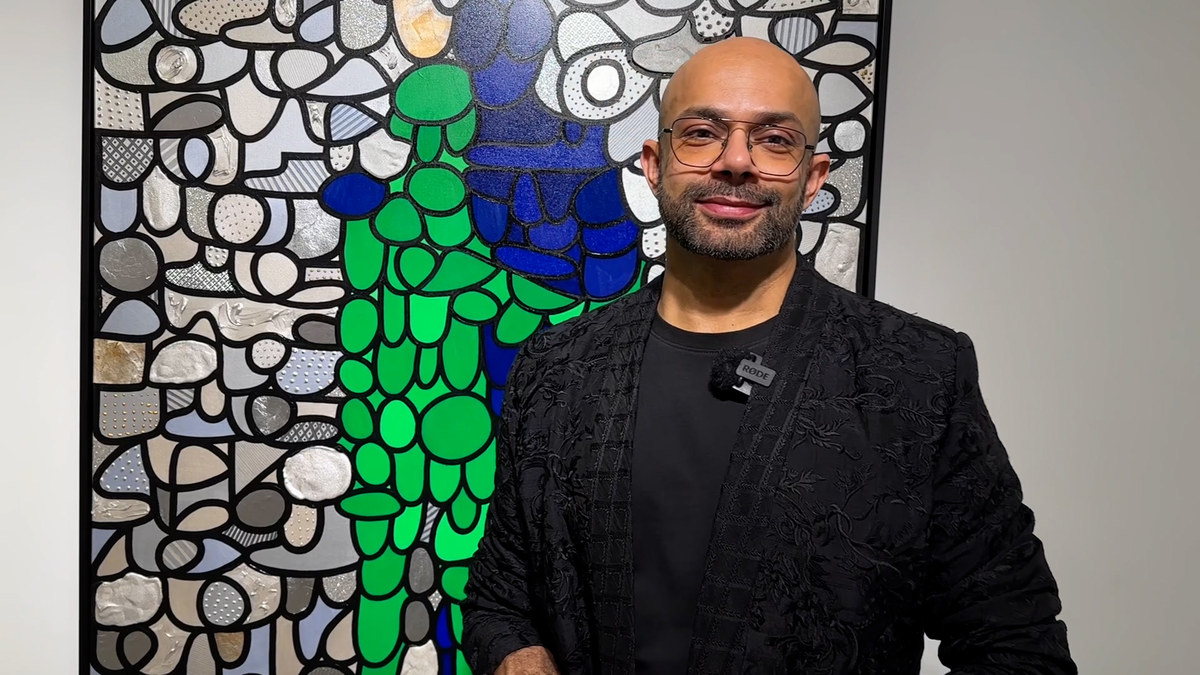
Pakistani artist Ahmer Farooq photographed next to his work during an exhibition on May 24, 2024, at Tanzara Gallery in Islamabad, Pakistan. (AN Photo)
In the past two decades, the Pakistani artistic community has also encouraged a vital culture of public art through the advent of local biennials, most notably the Lahore Biennial, established in 2018, and the Karachi Biennial, which held its first edition in 2017.
Against this background, Farooq, a Lahore-based former business graduate, has taken it upon himself to share the narratives he believes are often silenced by conservative Pakistani society. From the voices of religious minorities to the transgender community and large swathes of the population facing poverty, Farooq’s brush strokes capture the “essence of resilience and defiance against the odds.”
“Ahmer’s work has a very, when you see it, these bold vibrant paintings, but they’re very, very deep,” said Noshi Qadir, the curator of the artist’s latest show at Islamabad’s Tanzara Gallery, held in collaboration with the Norwegian Embassy.
“The way he navigates the topography of the canvas, portraying the sufferings, the triumphs and the emotions of humans and their identity. So it’s very deep, it’s very thought provoking.”
This time, Farooq’s work has a twist: as a secret keeper of Pakistan’s marginalized, as he likes to describe himself, and to exercise discretion about their very private triumphs and tribulations, he has developed a unique script in Urdu, Pakistan’s national language.
“When you would look at the canvas, you would see that the information or the text is not really readable,” Farooq said as he pointed to large stylized calligraphic alphabets on his colorful canvases.
“And that’s done deliberately because for example, when you’re looking at an individual like a person here, standing here, you would only see a person, but you would not really know their story or what all they’re going through. This information is private information.”
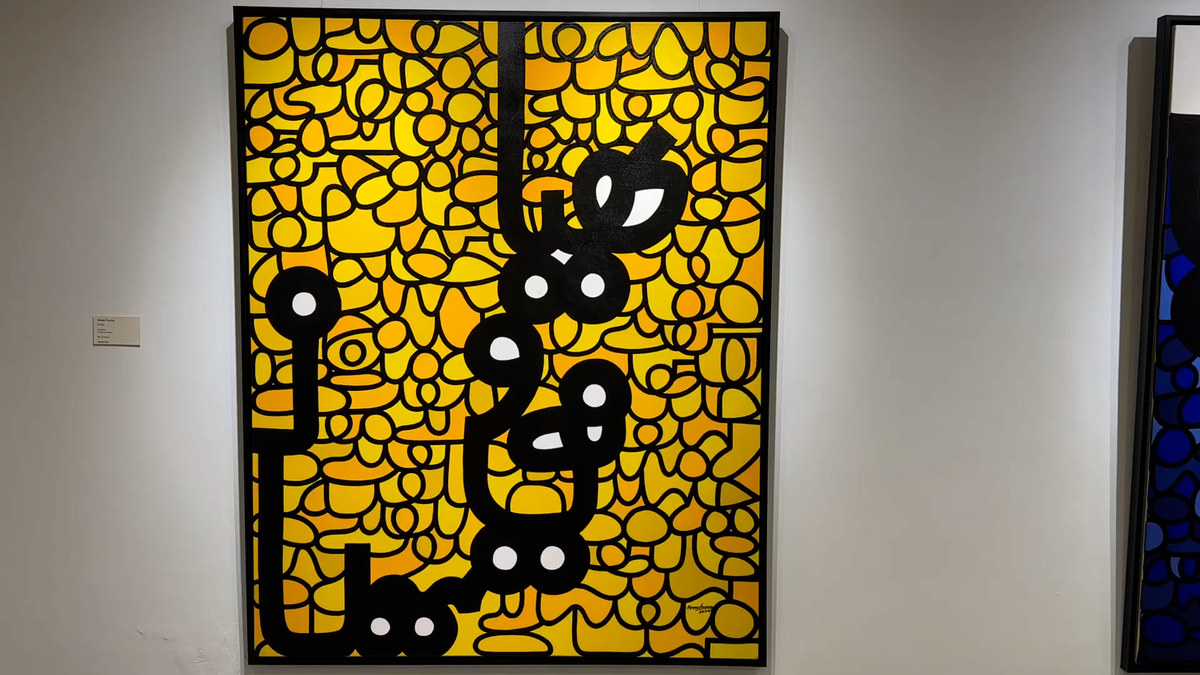
A painting by Pakistani artist Ahmer Farooq displayed at an exhibition on May 24, 2024, at Tanzara Gallery in Islamabad, Pakistan. (AN Photo)
The use of a secret new language was because his latest collection was all about “the stories of marginalized communities” of Pakistan, the artist said:
“And the marginalized communities can be anyone, it can be religious marginalized communities, it could be people from the transgender community. It could be people like you and I, like who don’t fit into a certain norm which the society tells us to follow.”
“ARCHIPELAGO OF THE SELF”
Per Albert Ilsas, the Norwegian ambassador to Pakistan who inaugurated the collection entitled Archipelago of the Self, said Farooq’s “captivating” work explored the “complex interplay between personal and societal forces, expertly navigating the multifaceted nature of the Self.”
An archipelago, sometimes called an island group or island chain, is a chain, cluster, or collection of islands, or sometimes a sea containing a small number of scattered islands.
“Farooq’s art sheds light on the fragmented realities of marginalized individuals, illustrating the negotiating of public, private and secret selves. Farooq’s work, the emotional burden caried by those living on the margins — women, religious minorities, ethnic and other minorities — is palpable.”
The ambassador said each brush stroke spoke of the “anxiety and emotional turmoil inherent in navigating a world where one’s identity is constantly scrutinized and judged.”
Ahmer described the Self as a collection of archipelagos, or a “scattering of isolated islands amidst the relentless ties of societal currents” and said his latest collection was an invitation to enable the “courage, resilience and hope of building bridges that reconnect all our islands.”
Zainab Shuja, an art student from Rawalpindi visiting Farooq’s exhibition, reflected on the significance of experiencing Pakistani contemporary art firsthand:
“We don’t see much contemporary art because we’re being trained [in the classical tradition] right now, and it’s always good to go out and experience what Pakistani contemporary art looks like. And we see all those influences here, and it’s really refreshing to see.”
Jonathan Andre from the Swiss Embassy in Islamabad praised Farooq’s art for its authenticity, highlighting the power of art to transcend boundaries and foster understanding.
“I think his art is very particular, very special, very authentic, very original,” he said. “And it’s great to see such an art scene in Pakistan to see a mix of culture with art and it translates very well in artworks.”


