

‘Ground trembles’ as Hezbollah launches 150 missiles in revenge strike

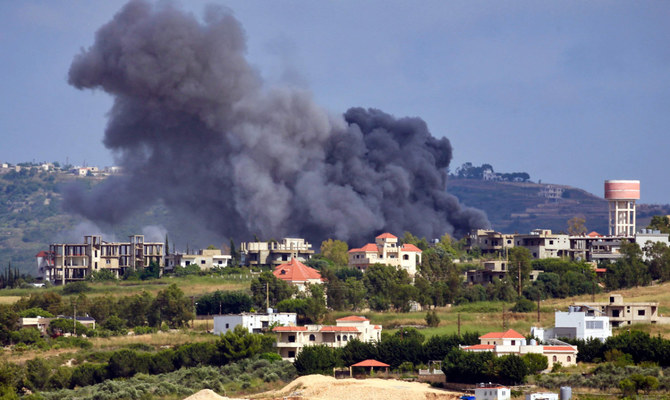
Smoke billows from the site of an Israeli airstrike on the Lebanese village of Jebbain, near the border with Israel on May 25, 2024, amid ongoing cross-border clashes between Israeli troops and Hezbollah fighters. (AFP)
Short Url
Updated 26 May 2024
Follow

‘Ground trembles’ as Hezbollah launches 150 missiles in revenge strike

  • The attacks marked a significant deterioration in the situation on the southern Lebanese border

BEIRUT: Residents of southern Lebanon’s border area took shelter late on Sunday as Hezbollah launched more than 150 missiles at targets inside Israel in one of the largest attacks since the conflict began.

“The ground trembles beneath us and the sky is covered by missiles,” one resident told Arab News.

Hezbollah’s barrage followed a series of Israeli drone strikes earlier in the day that killed at least eight of the group’s members and civilians.

Hezbollah responded by launching missiles toward Kiryat Shmona, the Golan, and military sites in the Al-Manara and Misgav Am areas. 

The attacks marked a significant deterioration in the situation on the southern Lebanese border.

“These are unprecedented barrages of missiles,”  the resident said.

“The area is shaking from the sounds of missiles above our heads heading toward the other side of the border. We see Iron Dome explosions above the towns all the way to the Nabatiyeh area.”

After the two deadly attacks on Naqoura and Aita Al-Shaab earlier on Sunday, the Israeli army struck a motorcycle in the town of Hula with a missile from a military drone, killing three Hezbollah members, Tariq Awad, Hussein Salman Mustafa, and Wissam Ali Hamid, whose brother was killed in an Israeli attack on the city of Bint Jbeil a few weeks ago.  

The Israeli army attacked the town of Yaron in the Bint Jbeil district with two air-to-surface missiles, killing two Hezbollah members. 

The towns of Aitaroun and Al-Adisa were hit by dozens of phosphorus shells, causing’ fires in several neighborhoods.


UN: Sudan war civilian death toll more than doubled in 2025

Updated 3 sec ago
Follow

UN: Sudan war civilian death toll more than doubled in 2025

  • Rights chief Volker Turk says RSF paramilitaries inflicted "carnage” in attacks last year on Zamzam campand El-Fasher in Darfur
  • Recent drone attacks in Kordofan region and elsewhere have 'killed or injured nearly 600 civilians'
GENEVA: Killings of civilians in Sudan’s war more than doubled in 2025 compared with the previous year, the United Nations rights chief said Thursday, warning that thousands more dead are unidentified or remain missing.
Since April 2023, Sudan has been engulfed in a conflict between the army and the Rapid Support Forces (RSF) that has killed tens of thousands, displaced 11 million people and triggered one of the world’s worst humanitarian crises.
“This war is ugly. It’s bloody and it’s senseless,” Volker Turk told the UN Human Rights Council, blaming both warring sides, which have so far rejected any form of humanitarian truce. He also blamed foreign sponsors funding what he called a “high-tech” conflict.
“In 2025, my office’s documentation points to an over two and a half times increase in killings of civilians compared with the previous year. Many thousands are still missing or unidentified,” Turk said.
There have been no official figures on the overall death toll in the conflict.
Turk condemned what he called the “heinous and ruthless” brutalities committed, including sexual violence, summary executions and arbitrary detentions.
He highlighted “carnage” inflicted by the RSF during an attack on the Zamzam displacement camp in April, and again in October in El-Fasher, which was the army’s last foothold in western Darfur.
Sexual violence, including rape, gang rape, sexual torture and slavery, has also surged, Turk said, with more than 500 victims documented in 2025. “The bodies of Sudanese women and girls have been weaponized to terrorize communities.”
He added that he is “extremely worried these crimes may be repeated.”

- ‘Madness’ -

Since the fall of El-Fasher, the fighting has moved deeper into neighboring Kordofan where drone strikes have killed dozens at a time.
Since January, escalating drone attacks in the southern Kordofan region and beyond have “killed or injured nearly 600 civilians,” Turk said, including in attacks on humanitarian aid convoys.
The UN’s resident and humanitarian coordinator for Sudan, Denise Brown, said on Thursday that access to the cities of Kadugli and Dilling in South Kordofan — long cut off by an RSF siege until the army recently lifted it — had been effectively impossible.
“We were not able to get supplies in. We had to remove our staff for their own safety,” she said, after stepping off the first UN flight to Khartoum since the war began on Thursday.
Famine was declared last November in the North Darfur capital El-Fasher and in Kadugli, the capital of South Kordofan, according to a UN-backed assessment. The same assessment said Dilling in South Kordofan is also likely facing famine conditions.
Turk said both the army and the RSF continued to use “explosive weapons in densely populated areas, often without warning — showing utter disregard for human life.”
Turk highlighted the “increased use of advanced long-range drones,” which has “expanded harm to civilians in areas far from the front lines that were previously peaceful.”
Turk also voiced concern over “the growing militarization of society,” including the recruitment of children and young people into the fighting.