

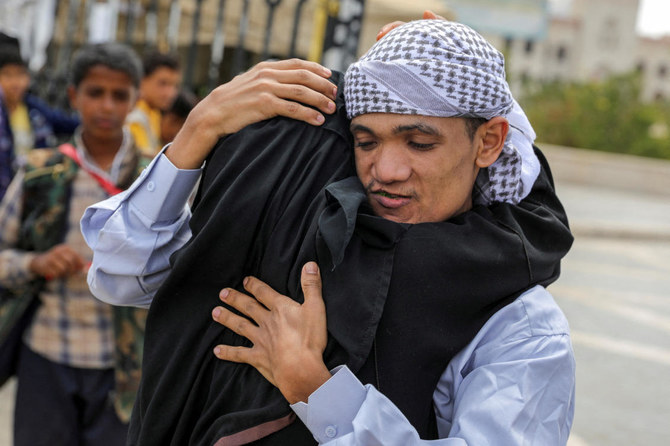

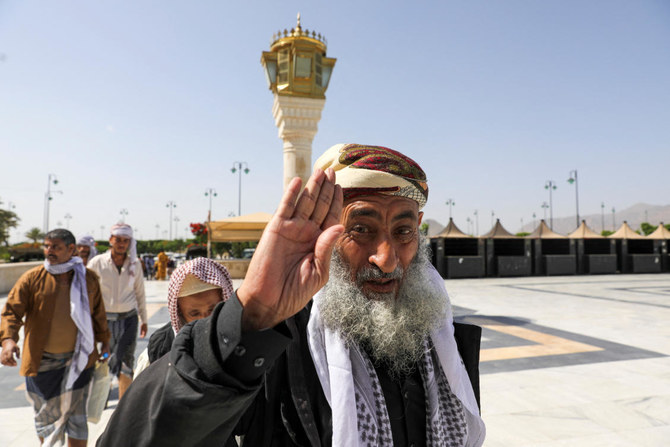


AL-MUKALLAH: The Houthi militia released 112 Yemeni government prisoners on Sunday, a move supported by the International Committee of the Red Cross but not welcomed by their opponents.
At a press conference in Sanaa attended by the released prisoners, Abdulkader Al-Murtada, head of the Houthi National Committee for Prisoners’ Affairs, said that the release was in response to an order from their leader, Abdul Malik Al-Houthi, to release Yemeni government forces who were captured on the battlefields and are sick, disabled, wounded or elderly.
He urged the Yemeni government to match the initiative by releasing their prisoners and engaging in prisoner-exchange negotiations, noting that 920 inmates had previously been freed unilaterally.
“This initiative should push you to stop bad and inhuman practices with our prisoners in your prisons, as well as stop obstructing progress in this file and obstructing the implementation of the agreements that you previously signed under the auspices of the United Nations,” the Houthi official said.
The ICRC delegation in Sanaa said that it supported the Houthis’ release of the prisoners by visiting the prisoners before leaving Houthi prisons to verify their identity and ensure that they agreed to return to their homes. Doctors examined prisoners’ health before release and determined whether they were in good enough health to travel.
“We hope this paves the way for further releases, bringing comfort to families eagerly anticipating reunification with their loved ones,” Daphnee Maret, the ICRC’s head of delegation in Yemen, said in a statement.
The Yemeni government and the Houthis have regularly accused each other of undermining prisoner-exchange talks aimed at releasing hundreds of Yemeni inmates.
More than 800 inmates were released under UN and ICRC supervision in April 2023 — the last significant prisoner exchange between Yemen’s warring factions.
In October 2020, the Houthis and their opponents swapped more than 1,000 detainees in the first big prisoner exchange since late 2014, when the Houthis militarily gained control of Yemen.
The Yemeni government responded to the Houthis’ unilateral release by saying that the freed detainees were civilians who the Houthis had seized from the streets and their workplaces.
Majed Fadhail, deputy minister of human rights and member of a government delegation involved in prisoner swap talks with the militia, told Arab News that none of the released prisoners are among the more than 1,800 names of government prisoners held by the Houthis and whose release the government has called for in negotiations.
“The Houthis will release 100 people right now and abduct 300 more later. None of those who have been freed are among those sought by the government,” he said.
In a post on X, Yahya Kazman, head of the Yemeni government’s team in prisoner swap talks, condemned the Houthi unilateral move as “open and scandalous plays” that entail kidnapping regular people from the streets and their homes and using their agony for political benefit.
“The first step in settling the case is for the militia to tell the fate of the missing people,” Kazman said.
The Yemeni government has vowed to boycott prisoner-exchange discussions with the Houthis until they provide information regarding the whereabouts of Mohammed Qahtan, a prominent Yemeni politician detained by the Houthis since 2015, and allow his family to see him.
Local and international rights organizations and activists have strengthened calls for a prisoner exchange after the deaths of scores of captives in Houthi jails as a result of abuse.
Meanwhile, the US Central Command said that the Houthis launched two anti-ship ballistic missiles into the Red Sea from regions under their control on Saturday morning.
This is the latest in a series of Houthi missile and drone attacks on international commercial and navy ships in international waters near Yemen.
“This continued malign and reckless behavior by the Iranian-backed Houthis threatens regional stability and endangers the lives of mariners across the Red Sea and Gulf of Aden,” the US military said in a statement.
The Houthis claim that their attacks on ships are in support of the Palestinian people and are intended to push Israel to end the war in Gaza.


