

Artist captures Saudi charm with digital works

1 / 2
Drawing from the beauty of Saudi culture and traditions, many of Ghada Al-Shammari artworks depict men and women in tradition Najdi-style garments. (Supplied)
2 / 2
Drawing from the beauty of Saudi culture and traditions, many of Ghada Al-Shammari artworks depict men and women in tradition Najdi-style garments. (Supplied)
Short Url
Updated 25 May 2024
Follow

Artist captures Saudi charm with digital works

  • Ghada Al-Shammari says art can be a means to showcase nation’s rich heritage

RIYADH: Timeless Arabic songs and heartfelt poetry provide the inspiration for Ghada Al-Shammari’s digital art, which showcases the Kingdom’s culture and society.

Al-Shammari's first artwork in 2017 was inspired by a popular Saudi song by Majed Al-Esa called “Hwages,” which means “concerns” in English.

The music video provided a comment on society by using satire, showcasing women driving cars, skateboarding, and playing basketball — activities that at the time were not easily accessible for women.

“I liked how they portrayed women in the traditional Saudi abaya, which motivated me to draw it,” Al-Shammari told Arab News.

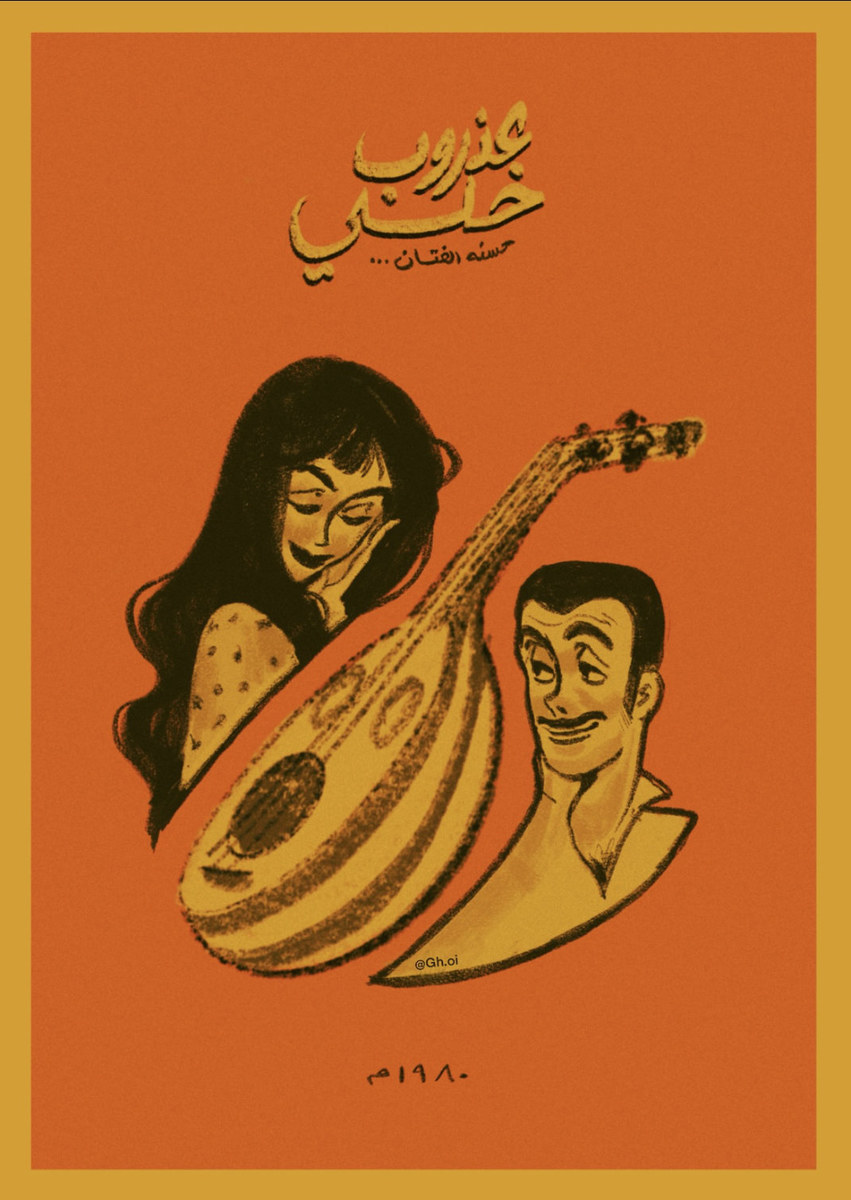
For one of her artworks Al-Shammari was inspired by a poem by literary icon Prince Badr bin Abdul Mohsen and popularly performed by the late Saudi singer Talal Maddah.

The drawing depicts a man glancing at a woman who has her eyes downcast, with an oud instrument between them, and the 1980 song title “Forgive Me” written in Arabic text above the illustration.

The Saudi artist said that she tries to capture the poet’s feelings with her artwork, adding: “Romantic songs with descriptions of the poet’s beloved have been particularly inspiring for me.” 
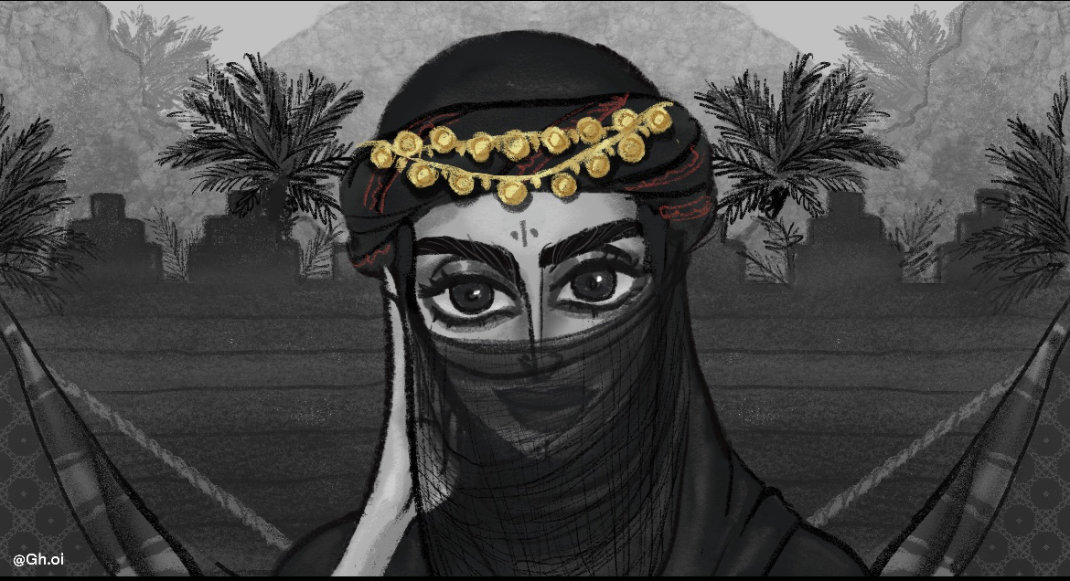
Al-Shammari draws inspiration from the beauty within the Kingdom’s culture. Many of her artworks depict women wearing traditional Najdi-style dresses and gowns with draping silhouettes and glimmering gold headpieces and turbans.

The men are depicted with striking features and wearing traditional garments like the head coverings called ghutra or shemagh, and bisht, the men’s cloak commonly worn in Saudi Arabia and other Gulf countries.

“Saudi culture and traditions have significantly impacted my work. Growing up, I used to think of Saudi Arabia as just what was around me in terms of environment, customs, and traditions,” Al-Shammari said. 

When she moved from her hometown of Hafar Al-Batin to the capital Riyadh, Al-Shammari said her friendships and acquaintances showed her a new world of ideas that elevated her artistic vision. 
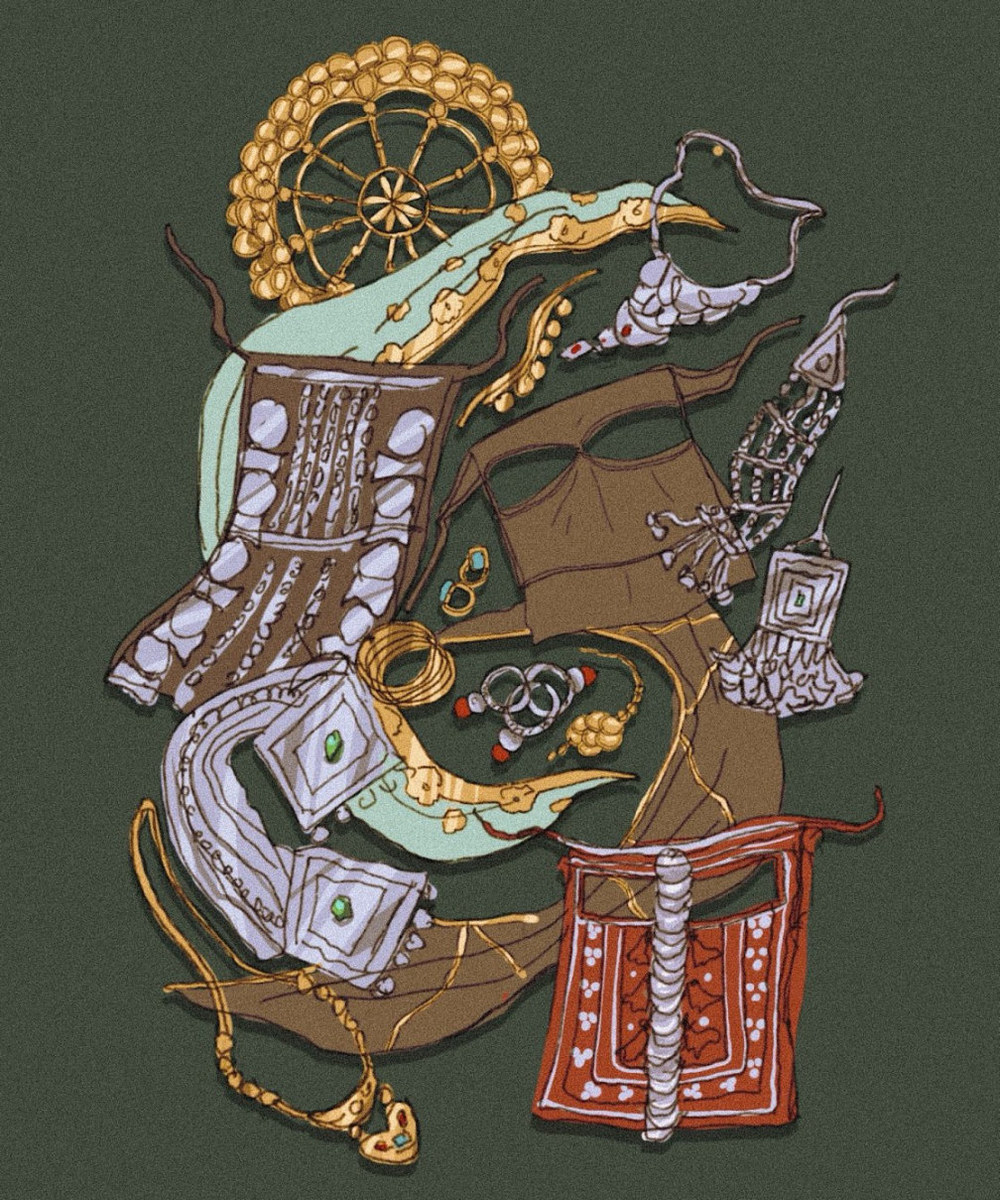
She added: “They shared stories about their region, important landmarks, and fascinating tales that were unique to their areas. This motivated me to learn more about my country and enjoy drawing the diversity and differences I discovered in my artworks.

“Saudi Arabia is full of exciting things, and its diversity is what fascinates me the most. Each region has its own heritage, traditions, architecture, and unique dialect, which makes me eager to learn more and create works that reflect this beautiful diversity.”

Al-Shammari said she selects particular color combinations to evoke the emotions she aims to convey, opting for brighter colors for her cheerful and vibrant works. 
Al-Shammari graduated from the College of Arts and Design at Princess Nourah bint Abdulrahman University with a bachelor’s degree in fine arts.

She added: “Through this specialization, I discovered many artistic and historical aspects, learned about various artists, and got to understand their ideas and philosophies, which transformed my perspective of my work.”

Her love of art began as a child when she would draw characters from her favorite anime and cartoons.

“I started focusing on drawing from an educational perspective at the age of 12 through YouTube tutorials on drawing anime and cartoons, which sparked my artistic journey,” Al-Shammari said.

She added that art is important as it showcases the cultural aspect of a country and its heritage, conveying its history and traditions that help define life in the past and present.

She said: “It serves as a way to preserve and transmit this heritage from one generation to the next, seeking to document knowledge and memories.

“Additionally, from an economic standpoint, art is considered a means to attract tourists interested in discovering the country and its civilization.”

For more information on the artist, visit her Instagram @gh.oi.


Absher Hackathon finalists highlight scale of Saudi tech talent

Updated 14 December 2025
Follow

Absher Hackathon finalists highlight scale of Saudi tech talent

  • World’s largest hackathon underscores growing national enthusiasm for tech innovation

RIYADH: Saudi Arabia’s push to position itself as a global hub for digital innovation was on display this weekend as the Absher Tuwaiq Hackathon 2025 — billed as the world’s largest hackathon — concluded with the announcement of finalist teams competing for prizes totaling SR1 million ($266,000). 

The three-day hackathon, organized by the Ministry of Interior in partnership with Tuwaiq Academy, brought together innovators from across the Kingdom to develop digital solutions aligned with the ministry’s digital transformation goals. 

The finalist teams recognized for their projects were: Shadow, Wusool, Watheeq , Tanabbah, HRS, Ikhlaa, Amal, Mustabiq, Al‑Dahna, Inspire, Saqour Al‑Watan, Thaqib, Sawt Al‑Mustaqbal, Manee, and YS Advance International. 

The finalists were announced at the end of the three-day Absher Tuwaiq Hackathon organized by the Ministry of Interior in partnership with Tuwaiq Academy. (AN photo/Supplied)

In addition to cash prizes, the competition offered SR450,000 in support from the National Technology Development Program, along with incubation opportunities at Invi Lab to help teams turn prototypes into market-ready products.   

Tariq Al‑Hamid, official spokesperson for the Absher Conference, told Arab News that the hackathon has generated strong momentum nationwide.  

This year’s event included more than 4,000 participants from all regions of the Kingdom — “a reflection of the growing national enthusiasm for digital innovation,” he said. 

HIGHLIGHT

The Absher Tuwaiq Hackathon brought together innovators from across the Kingdom to develop digital solutions aligned with the ministry’s digital transformation goals. 

According to Al‑Hamid, the 2025 event was structured around four specialized tracks: digital identity and security applications; artificial intelligence for predictive and proactive security; Internet of Things applications supporting field operations; and innovations to enhance or expand services on the Absher Platform. 

Tariq Al-Hamid (center) said that the hackathon’s impact extends beyond prize money. (Supplied)

He added that this focused approach allowed participants “to present high‑quality ideas and advanced prototypes at levels comparable to international competitions.” 

Participants also took part in more than 80 training programs delivered by global partners including Google Cloud, Meta, NVIDIA, and Huawei, an experience Al-Hamid said significantly strengthened both the competition and participants’ skills. 

Al-Hamid said that the hackathon’s impact extends beyond prize money. “More important than the cash reward is the opportunity to turn creative ideas into real products that make an impact on citizens, residents, and visitors.” 

Standout participants often attract the attention of leading national technology companies seeking new talent, he added. 

Participation was open to individuals and teams from across Saudi Arabia, from high school students to industry professionals, highlighting the inclusivity of the event and the breadth of the Kingdom’s innovation ecosystem.  

The hackathon forms part of the wider Absher Tuwaiq initiative, a core pillar of the upcoming Absher Conference 2025, which will empower more than 100,000 participants across seven technical tracks in 16 cities, in partnership with 20 local and international organizations. 

The conference, organized by the Ministry of Interior and Tuwaiq Academy, sponsored by Elm Company and held in strategic partnership with the Saudi Data and Artificial Intelligence Authority, will take place in Riyadh from Dec. 17 -19. 

The event will showcase national digital innovations and reinforce Saudi Arabia’s role in global technology.