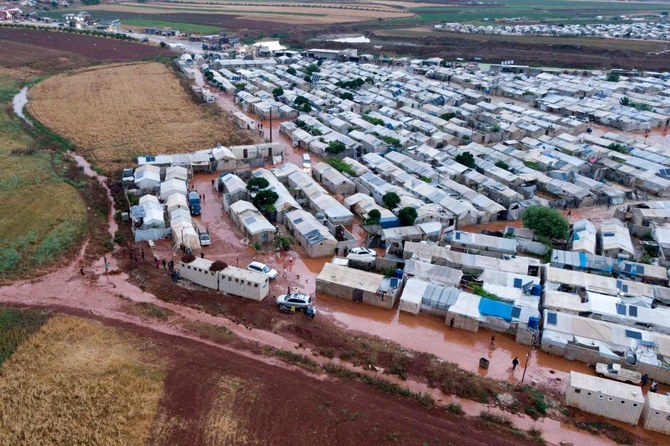
BEIRUT: More than a quarter of Syrians live in extreme poverty, the World Bank said Saturday, 13 years into a devastating civil war that has battered the economy and impoverished millions.
The World Bank published two new reports on Syria, which found that “27 percent of Syrians — about 5.7 million individuals — live in extreme poverty.”
“Extreme poverty, while virtually non-existent before the conflict, affected more than one in four Syrians in 2022” and might have further deteriorated after a deadly earthquake last year, one of the reports said.
The quake killed about 6,000 people in the country.
According to the United Nations, about 90 percent of Syrians live in poverty, while it previously estimated that around 2 million lived in extreme poverty after more than a decade of war.
The report cited neighbor Lebanon’s economic meltdown in late 2019, the Covid-19 pandemic and the war in Ukraine, as having eroded the welfare of Syrian households in recent years.
The civil war in Syria has also ravaged the economy, infrastructure and industry, while Western sanctions have added to the country’s woes.
“Continued funding shortfalls and limited access to humanitarian assistance” have further strained poor Syrians, already coping with “soaring prices, reduced access to essential services and rising unemployment,” the World Bank said.
The UN told AFP previously that its humanitarian response plan for Syria for 2024 requires more than $4 billion but that it is only six percent funded.
The international community is set to meet in Brussels Monday to try and muster funds for Syria at a yearly pledging conference.
A lack of opportunities and dwindling aid has pushed many Syrians to rely on money sent from relatives abroad to survive, with the World Bank estimating that “in 2022, the total value of remittances received by Syrian households reached about $1.05 billion.”
Syria’s estimated GDP stood at around $6.2 billion in 2023.
Syria’s “real GDP is projected to contract by 1.5 percent in 2024, extending the 1.2 percent decline in 2023,” the report said.
“Inflation is anticipated to remain high in 2024 due to the pass-through effects of currency depreciation, along with persistent shortages and potential further subsidy cuts (for) food and fuel,” it said.
Syria’s war has killed more than half a million people and displaced millions more since it erupted in 2011 after Damascus cracked down on anti-government protests.


More than one in four Syrians ‘extremely poor’: World Bank
https://arab.news/c8v8d
More than one in four Syrians ‘extremely poor’: World Bank

- 27 percent of Syrians — about 5.7 million individuals — live in extreme poverty
- “Continued funding shortfalls and limited access to humanitarian assistance” have further strained poor Syrians, the World Bank said


Two Syrian soldiers injured during mine-clearing in Latakia
- Engineering units were removing mines and unexploded ordnance from agricultural land and forested areas in the village of Nahshaba
- Mines and unexploded ordnance left by the former Bashar Assad regime continue to pose a significant hazard to civilians in various parts of Syria
LONDON: Two members of the Syrian army engineering unit were injured on Tuesday when an anti-personnel mine detonated during a clearance operation in Latakia countryside, near the Mediterranean.
Engineering units were removing mines and unexploded ordnance from agricultural land and forested areas in the village of Nahshaba, located in the Jabal Al-Akrad region, according to the Syrian Arab News Agency.
The operation is part of a nationwide effort to secure areas affected by the country’s civil war, which lasted from 2011 to 2024, and to allow residents to return to their villages. Mines and unexploded ordnance left by the former Bashar Assad regime continue to pose a significant hazard to civilians in various parts of the Syrian Arab Republic, the SANA added.
Last week, two members of the Syrian Internal Security Forces were killed, and three were injured by a landmine in Al-Sanamayn, a city in the Daraa province of southern Syria.


