Pakistan plans medical education reforms amid return of students from Kyrgyzstan

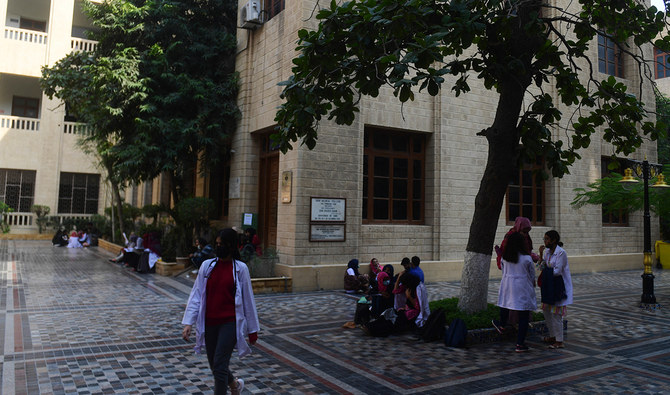
In this picture taken on January 13, 2022, students gather at a yard of the Dow University of Health Sciences, where Pakistan-born surgeon Muhammad Mansoor Mohiuddin studied in the 1980s, in Karachi. (AFP/File)
Short Url
Updated 25 May 2024
Follow

Pakistan plans medical education reforms amid return of students from Kyrgyzstan

  • Deputy PM Ishaq Dar takes up the issue after mob attack on Pakistani medical students in the Kyrgyz capital of Bishkek last week
  • Kyrgyz medical schools have over the decades become popular among aspiring doctors, thanks to affordable fees and living expenses

ISLAMABAD: Deputy Prime Minister Ishaq Dar on Friday called for improving regulatory framework for medical education in Pakistan to make it at par with international standards and to resolve issues faced by Pakistani students studying abroad, Pakistani state media reported.
The decision was made at a meeting of a government committee on medical education in Islamabad, which was presided over by Dar. The committee reviewed medical education system, including fee structures, and identified key areas for improvement to align it with global standards.
The development came days after hundreds of Pakistani medical students returned from Kyrgyzstan following last week’s mob attacks on residences of foreign students studying in the Kyrgyz capital of Bishkek over an earlier brawl between several Kyrgyz men and some Egyptian students.
Medical schools of Kyrgyzstan have over the last few decades become popular among aspiring doctors from India, Pakistan and some other Asian and Arab countries, in part thanks to relatively affordable fees and living expenses.
“The Deputy Prime Minister underlined the need to establish coordination mechanism between medical institutions and the public and private sector to ensure uniform high-quality education in all provinces,” the Radio Pakistan broadcaster reported.
“The meeting decided to constitute a sub-executive committee to review the existing TORs [terms of reference], synergize the regulatory bodies, streamline procedures for foreign students in Pakistan and uniformity in curricula.”
PM Shehbaz Sharif constituted the committee on medical education on May 20. The committee, which includes representatives of the medical community, education sector and government officials, was set up to reform medical education, improve health care standards and ensure highest quality of medical training for future generations of health care professionals.
“The sub-committee will prepare its report with the objective to ensure that medical graduates in Pakistan are equipped with the knowledge and skills required to meet contemporary health care challenges,” the report read.


Pakistan joins OIC, Islamic nations to reject Israel’s recognition of Somaliland

Updated 28 December 2025
Follow

Pakistan joins OIC, Islamic nations to reject Israel’s recognition of Somaliland

  • Foreign ministers of 21 Islamic nations, OIC issue joint statement to condemn Israel’s move to recognize breakaway African region
  • Joint statement describes Israel’s move as a “grave violation of the principles of international law and the United Nations Charter“

ISLAMABAD: Pakistan on Sunday joined the Organization of Islamic Cooperation (OIC) and other Arab and Islamic nations in condemning Israel’s recognition of Somaliland, a breakaway African region, calling it a violation of international law and reaffirming its support for the sovereignty and territorial integrity of Somalia. 

Israel this week announced it had recognized Somaliland — a self-declared region that broke away from Somalia in 1991 but has not previously been recognized by any United Nations member state — triggering condemnation from Somalia and criticism from regional bodies.

The joint statement shared by Pakistan’s foreign ministry on Sunday was endorsed by the foreign ministers of 20 other Muslim countries including Jordan, Egypt, Saudi Arabia, Palestine, Qatar, Libya, Iran, Iraq, Türkiye, Yemen and others as well as the OIC. 

“Their unequivocal rejection of Israel’s recognition of the ‘Somaliland’ region of the Federal Republic of Somalia on 26 December 2025, given the serious repercussions of such unprecedented measure on peace and security in the Horn of Africa, the Red Sea, and its serious effects on international peace and security as a whole, which also reflects Israel’s full and blatant disregard to international law,” the joint statement said. 

The statement said Israel’s recognition constitutes a “grave violation of the principles of international law and the United Nations Charter,” pointing out that it reflects Tel Aviv’s expansionist agenda.

The Muslim states said they reject any measures that undermine Somalia’s unity, territorial integrity or sovereignty over its entire territory.

“The full rejection of any potential link between such a measure and any attempts to forcibly expel the Palestinian people out of their land, which is unequivocally rejected in any form as a matter of principle,” the statement said.

The statement was referencing international media reports earlier this year that said Israel and the US had reached out to East African states, including Somaliland, to take in Palestinians from Gaza.

Pakistan’s foreign office on Saturday issued a separate statement condemning Israel’s recognition of Somaliland. 

“Pakistan strongly condemns any attempts to undermine the sovereignty, unity, and territorial integrity of Somalia, and rejects, in this regard, the announcement made by Israel recognizing the independence of the so-called Somaliland region of the Federal Republic of Somalia,” the foreign office had said. 

Somalia’s government has said Israel’s recognition of Somaliland violates its sovereignty, while the African Union has opposed unilateral recognition of breakaway regions on the continent.

Israeli Prime Minister Benjamin Netanyahu said on Friday his country had recognized Somaliland “in the spirit of the Abraham Accords,” referring to US-brokered deals that helped establish ties between Israel and Arab states.