THE HAGUE: The top United Nations court has ordered Israel to halt its military operations in the southern Gaza city of Rafah. Israel insists it has the right to defend itself from Hamas militants and is unlikely to comply with the ruling.
The order by the International Court of Justice further ratchets up international pressure on an increasingly isolated Israel to rein in its war on Hamas in Gaza.
Friday’s decision marked the third time this year the 15-judge panel has issued preliminary orders seeking to rein in the death toll and alleviate humanitarian suffering in Gaza.
While orders are legally binding, the court has no police to enforce them.
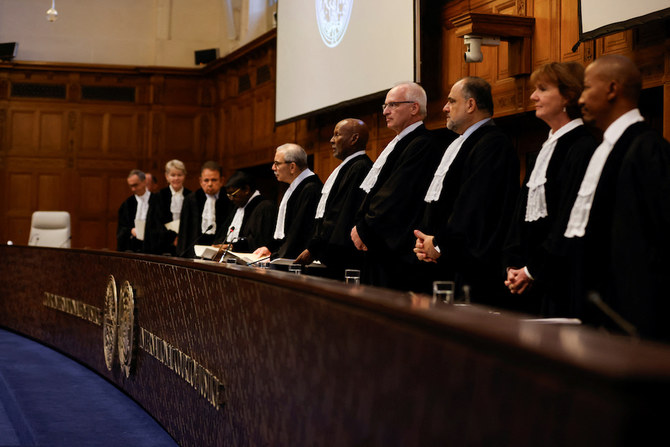
Earlier Friday, the ICJ opened its hearing to rule on the request to order Israel to halt its military operation in Gaza and withdraw from the enclave.
Criticism of Israel’s conduct in the war in Gaza has been growing — even from its closest ally, the United States, which warned against an invasion of the southern city of Rafah, where hundreds of thousands of Palestinians have sought shelter from fighting elsewhere. And this week alone, three European countries announced they would recognize a Palestinian state, and the chief prosecutor for another UN court requested arrest warrants for Israeli leaders, along with Hamas officials.
Israeli Prime Minister Benjamin Netanyahu is also under heavy pressure at home to end the war, which was triggered when Hamas-led militants stormed into Israel, killing 1,200 people, most civilians, and taking some 250 captive. Thousands of Israelis have joined weekly demonstrations calling on the government to reach a deal to bring the hostages home, fearing that time is running out.
While the International Court of Justice has broad powers to order an end to the Israeli military campaign and any such ruling would be a blow to Israel’s international standing, it does not have a police force to enforce its orders. In another case on its docket, Russia has so far ignored a 2022 order by the court to halt its full-scale invasion of Ukraine.
Israel signaled it, too, would brush off an ICJ order to stop its operations. “No power on earth will stop Israel from protecting its citizens and going after Hamas in Gaza,” Avi Hyman, the government spokesperson, said in a press briefing Thursday.
The court’s president, Nawaf Salam, opened Friday’s hearing, as a small group of pro-Palestinian protesters demonstrated outside.
The ceasefire request is part of a case filed late last year by South Africa accusing Israel of committing genocide during its Gaza campaign. Israel vehemently denies the allegations. The case will take years to resolve, but South Africa wants interim orders to protect Palestinians while the legal wrangling continues.
At public hearings last week at the International Court of Justice, South Africa’s ambassador to the Netherlands, Vusimuzi Madonsela, urged the panel of 15 international judges to order Israel to “totally and unconditionally withdraw” from the Gaza Strip.
The court has already found that Israel’s military operations pose a “real and imminent risk” to the Palestinian people in Gaza.
Israel’s offensive has killed more than 35,000 Palestinians, according to Gaza’s Health Ministry, which does not distinguish between combatants and civilians. The operation has obliterated entire neighborhoods, sent hundreds of thousands of people fleeing their homes, and pushed parts of the territory into famine.
“This may well be the last chance for the court to act,” Irish lawyer Blinne Ní Ghrálaigh, who is part of South Africa’s legal team, told judges last week.
Israel rejects the claims by South Africa, a nation with historic ties to the Palestinian people.
“Israel takes extraordinary measures in order to minimize the harm to civilians in Gaza,” Tamar Kaplan-Tourgeman, a member of Israel’s legal team, told the court last week.
In January, ICJ judges ordered Israel to do all it can to prevent death, destruction and any acts of genocide in Gaza, but the panel stopped short of ordering an end to the military offensive. In a second order in March, the court said Israel must take measures to improve the humanitarian situation.
The ICJ rules in disputes between nations. A few kilometers (miles) away, the International Criminal Court files charges against individuals it considers most responsible for war crimes, crimes against humanity and genocide.
On Monday, its chief prosecutor, Karim Khan, said he has asked ICC judges to approve arrest warrants for Netanyahu, Defense Minister Yoav Gallant and three top Hamas leaders — Yahya Sinwar, Mohammed Deif and Ismail Haniyeh — of war crimes and crimes against humanity in the Gaza Strip and Israel.
Israel is not an ICC member, so even if the arrest warrants are issued, Netanyahu and Gallant do not face any immediate risk of prosecution. But the threat of arrest could make it difficult for the Israeli leaders to travel abroad.


![]()

Top UN court orders Israel to halt military operation in Rafah, Israel is unlikely to comply
Short Url
https://arab.news/z7frk
Top UN court orders Israel to halt military operation in Rafah, Israel is unlikely to comply
- The ICJ order further ratchets up international pressure on an increasingly isolated Israel to rein in its war on Hamas in Gaza
- Friday’s decision marked the third time this year the 15-judge panel has issued preliminary orders seeking to rein in the death toll and alleviate humanitarian suffering in Gaza


Latest updates


© 2026 SAUDI RESEARCH & PUBLISHING COMPANY, All Rights Reserved And subject to Terms of Use Agreement.