TOKYO: Saudi Arabia is moving aggressively with its investments in more gaming companies, the Canadian industry veteran steering the kingdom’s push to become a global hub for the sector told AFP Friday.
The kingdom has already been spending heavily with a $38-billion push into gaming under Crown Prince Mohammed bin Salman’s Vision 2030 program, part of a plan to diversify the economy away from oil.
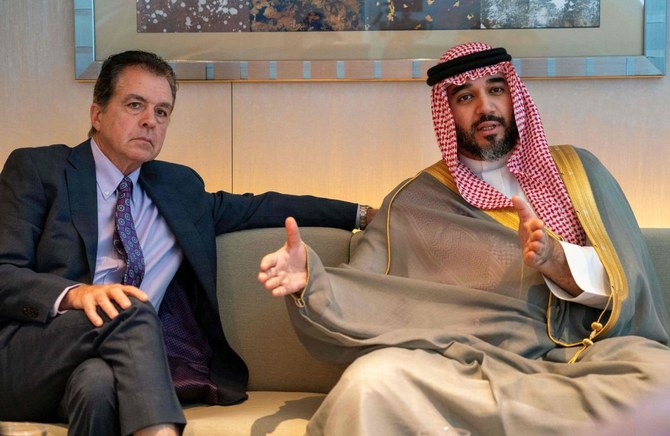
“We don’t pause. We don’t do neutral,” Savvy Games CEO Brian Ward said in a joint interview in Japan with Prince Faisal bin Bandar bin Sultan Al Saud, chair of the Saudi eSports Federation.
“It’s a good time to be in the market, looking for good teams in studios,” said Ward, a former executive at “Call of Duty” maker Activision Blizzard, Electronic Arts and Microsoft.
Saudi Arabia’s Public Investment Fund (PIF) has bought stakes in “Resident Evil” maker Capcom and Japanese giant Nintendo, as well as in Activision Blizzard and Electronic Arts.
Savvy, a PIF subsidiary, in 2022 bought a $1.1-billion stake in Sweden’s Embracer in 2022 and bought Scopely, the US mobile games company behind “Monopoly Go!,” for $4.9 billion last year.
“There’s a lot we want to do to get it done and to reach our targets at 2030,” said Prince Faisal, who is also Savvy vice-chairman.
“But we also want to make sure that we are taking the time to study things, to look at things. And make sure we’re making the right steps and not just throwing cash out there to see what hits,” he said.
ESports World Cup
In eSports, Savvy also bought tournament organizer ESL Gaming and the platform FaceIt. Riyadh will also host the eSports World Cup in July and August, when 2,500 gamers will battle for $60 million in prize money.
Prince Faisal, who credits video games for giving him insights into real-life history, said the tournament would help put Saudi Arabia on the global gaming map.
“A gaming industry is something you can start now and you’ll see the results in five to 10 years. And so to start momentum going, to start a conversation, esports is a great entry point,” he said.
Saudi Arabia aims to create 250 gaming companies and studios on its soil, 39,000 game-related jobs, be in the top three of professional gamers per capita and to produce a blockbuster “AAA” game by 2030.
The objective at the same time is for gaming to account for one percent of gross domestic product, something which Prince Faisal admits “keeps me up most at night.”
“One of the amazing things is we have a long history of storytelling in our region. It’s typical Bedouin culture is sitting around a fire telling the story,” he said.
“The tools are there... I think we can come up with not just the next great game, but the next great story.”
Saudi Arabia’s gaming drive
“There’s a lot of misconceptions about Saudi and who we are as Saudis,” Prince Faisal said.
“And the best way that I can say to answer that is to come and see and what you’ll see on the ground is very different than the conception that’s out there.”
Ward said he had been assured that Saudi Arabia’s gaming drive would be “consistent with the values and culture of our industry.”
“We have been given carte blanche to operate like a true games company. We don’t do anything different at Savvy being based in Riyadh than we would if we were in New York, Los Angeles, or Berlin.”


![]()

Saudi Arabia spending big for a place on the gaming map
Short Url
https://arab.news/z7jdj
Saudi Arabia spending big for a place on the gaming map
- The kingdom has already been spending heavily with a $38-billion push into gaming


Latest updates


© 2026 SAUDI RESEARCH & PUBLISHING COMPANY, All Rights Reserved And subject to Terms of Use Agreement.