

More aid getting from US pier to people in Gaza, officials say, after troubled launch

1 / 3
Palestinians climb onto trucks to grab aid that was delivered into Gaza through a US-built pier, as seen from central Gaza Strip, on May 18, 2024. (REUTERS)
2 / 3
A truck carries humanitarian aid across Trident Pier, a temporary pier to deliver aid, off the Gaza Strip near the Gaza coast on May 19, 2024. (US Army Central/Handout via REUTERS)
3 / 3
Palestinians gather in the hope of obtaining aid delivered into Gaza through a US-built pier, as seen from central Gaza Strip on May 19, 2024. (REUTERS)
Short Url
Updated 24 May 2024
Follow

More aid getting from US pier to people in Gaza, officials say, after troubled launch

  • Crowds overrun some of the first trucks coming from the new US-led sea route and taking its contents over the weekend, leading to a two-day suspension of aid distribution
  • At maximum capacity, the pier would bring in enough food for 500,000 of Gaza’s people. US officials stressed the need for flow through open land crossings for the remaining 1.8 million

WASHINGTON: A six-day-old US pier project in Gaza is starting to get more aid to Palestinians in need but conditions are challenging, US officials said Thursday. That reflects the larger problems bringing food and other supplies to starving people in the besieged territory.

The floating pier had a troubled launch, with crowds overrunning some of the first trucks coming from the new US-led sea route and taking its contents over the weekend. One man in the crowd was shot dead in still-unexplained circumstances. It led to a two-day suspension of aid distribution.
The US military worked with the UN and Israeli officials to select safer alternate routes for trucks coming from the pier, US Vice Admiral Brad Cooper told reporters Thursday.
As a result, the US pier on Wednesday accounted for 27 of the 70 total trucks of aid that the UN was able to round up from all land and sea crossings into Gaza for distribution to civilians, the United States said.
That’s a fraction of the 150 truckloads of food, emergency nutrition treatment and other supplies that US officials aim to bring in when the sea route is working at maximum capacity.
Plus, Gaza needs 600 trucks entering each day, according to the US Agency for International Development, to curb a famine that the heads of USAID and the UN World Food Program have said has begun in the north and to keep it from spreading south.
Only one of the 54 trucks that came from the pier Tuesday and Wednesday encountered any security issues on their way to aid warehouses and distribution points, US officials said. They called the issues “minor” but gave no details.
A deepening Israeli offensive in the southern city of Rafah has made it impossible for aid shipments to get through the crossing there, which is a key source for fuel and food coming into Gaza. Israel says it is bringing aid in through another border crossing, Kerem Shalom, but humanitarian organizations say Israeli military operations make it difficult for them to retrieve the aid there for distribution.
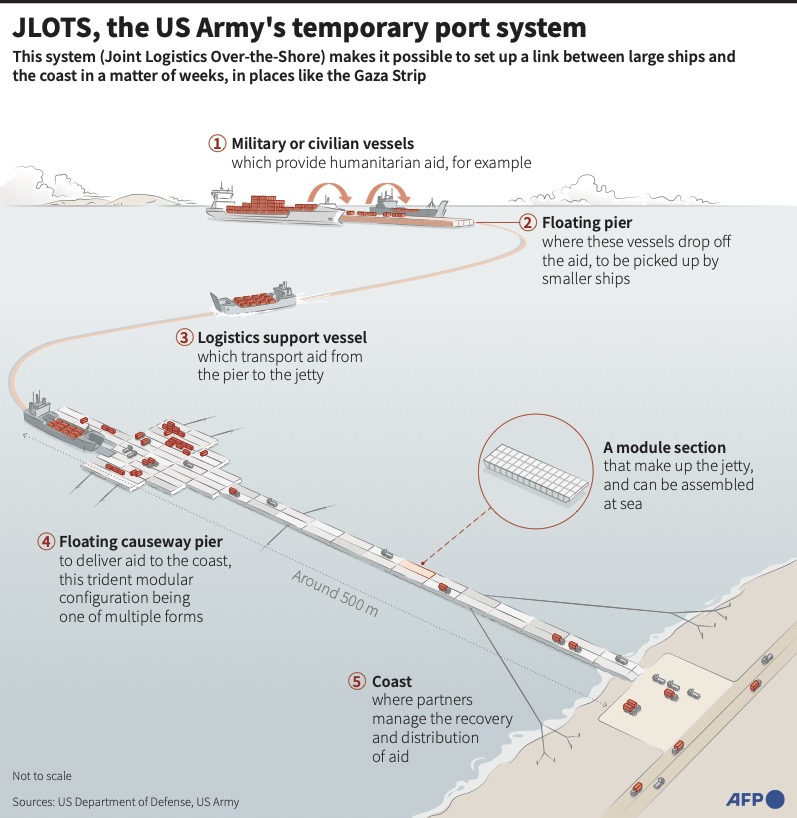
The Biden administration last week launched the $320 million floating pier for a new maritime aid route into Gaza as the seven-month-old Israel-Hamas war and Israeli restrictions on land crossings have severely limited food deliveries to 2.3 million Palestinians.
For all humanitarian efforts, “the risks are manifold,” Daniel Dieckhaus, USAID’s response director for Gaza, said at a briefing with Cooper. “This is an active conflict with deteriorating conditions.”
Dieckhaus rejected charges from some aid groups that the pier is diverting attention from what the US, UN and relief workers say is the essential need for Israel to allow full access to land crossings for humanitarian shipments.
For instance, Jeremy Konyndyk, a former USAID official now leading Refugees International, tweeted that “the pier is humanitarian theater.”
“I would not call, within a couple of days, getting enough food and other supplies for tens of thousands of people for a month theater,” Dieckhaus said Thursday when asked about the criticism.
At maximum capacity, the pier would bring in enough food for 500,000 of Gaza’s people. US officials stressed the need for flow through open land crossings for the remaining 1.8 million.


Soleimani warned Al-Assad about ‘spy’ Luna Al-Shibl: Al-Majalla

Updated 09 December 2025
Follow

Soleimani warned Al-Assad about ‘spy’ Luna Al-Shibl: Al-Majalla

LONDON: The late Iranian General Qassem Soleimani confronted Syria’s National Security Bureau chief Ali Mamlouk in late 2019 after seeing Luna Al-Shibl leaving his office. Al-Majalla magazine claims its reporters reviewed a document containing the full Arabic transcript of their exchange.

Soleimani reportedly asked, “Who is this?” and Mamlouk replied, “She is Louna Al-Shibl, the president’s adviser.”

The Quds Force commander pressed further: “I know, I know… but who is she really? Where did she work?”

According to Al-Majalla, a sister publication of Arab News, he said her former salary was “ten thousand dollars,” compared with her current salary of “five hundred thousand Syrian pounds,” before asking: “Does it make sense for someone to leave ten thousand dollars for five hundred thousand pounds? She is a spy.”

Both Soleimani and Maher Al-Assad, commander of the Syrian army’s powerful Fourth Division, had warned the ousted president’s inner circle about Al-Shibl, Al-Majalla reported.

‘Suspicious’ car crash

On July 2, 2024, Al-Shibl was involved in what officials described as a traffic accident on the Damascus-Dimas highway. She was hospitalized and died four days later.

But Al-Majalla reported that photos of her armored BMW showed only minor damage, raising immediate questions among those close to the case.

Eyewitnesses told the magazine that the crash was intentional. One said, “a car approached and rammed her vehicle,” and before her bodyguard could exit, “a man attacked her and struck her on the back of the head,” causing paralysis that led to her death.

She was first taken to Al-Saboura clinic, then transferred to Al-Shami Hospital. Several senior regime-linked figures, including businessman Mohammed Hamsho and an aide to Maher Al-Assad, were present when her condition deteriorated. One witness told Al-Majalla that when her bodyguard tried to explain what had happened, “he was arrested immediately in front of the others.”

The presidency later issued a brief statement announcing her death. Her funeral was attended only by a handful of officials. Then president Al-Assad did not attend.