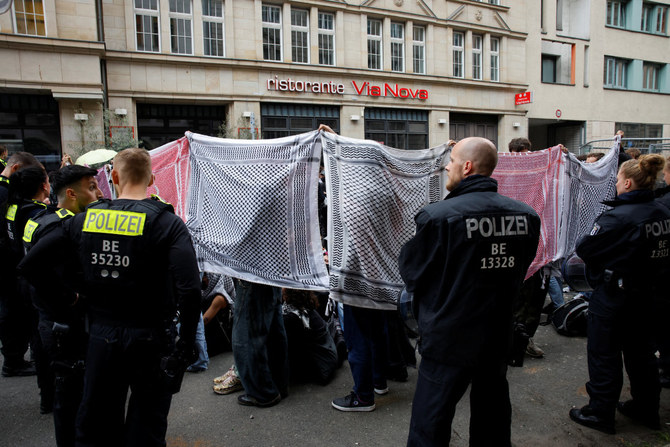
German police clear pro-Palestinian protesters from Berlin university

1 / 3
Police detains a pro-Palestinian demonstrator during a protest at the Humboldt University in Berlin, Germany, on May 22, 2024. (REUTERS)
2 / 3
Police officers stand in front of pro-Palestinian demonstrators, who occupied a courtyard at the Social Sciences building at the Humboldt University in Berlin, Germany, on May 22, 2024. (REUTERS)
3 / 3
Pro-Palestinian demonstrators occupy a courtyard at the Social Sciences building at Berlin's Humboldt University. (REUTERS)
Short Url
Updated 24 May 2024
Follow

German police clear pro-Palestinian protesters from Berlin university

  • Activists had occupied several rooms of the Humboldt University’s Institute for Social Sciences in downtown Berlin on Wednesday

BERLIN: German police cleared about 150 pro-Palestinian demonstrators from a Berlin university faculty on Thursday, ending one of a wave of student-led protests across Europe over Israel’s conduct in its war against Hamas.
Activists had occupied several rooms of the Humboldt University’s Institute for Social Sciences in downtown Berlin on Wednesday.
Student Coalition Berlin, the group which organized the protest, called in a statement posted on social media for the university to “take an active role in ending the genocide against the people of Palestine and their decades-long suffering.”
University administrators agreed after talks with protest leaders to let them stay until Thursday evening. But they called in the police when some of them refused to leave, German news agency dpa reported.
Police spokeswoman Beate Ostertag said that, while some of the demonstrators left voluntarily, police officers had to lead others from the building. Police said about 130 people were briefly detained during the operation, in which officers broke through several barricaded doors.
Student protests over the war in Gaza that began in the United States have spread to university campuses in many European countries. In Germany, protests have taken place this week at universities in cities including Munich and Leipzig.
Berlin authorities have taken a tough line against anti-Israeli demonstrations, urging police to step in if demonstrators use slogans that could incite hatred against Jews – taboo in a country marked by the memory of the Holocaust.
“There is no place for hate and anti-Semitism in Berlin and at our universities,” said Burkard Dregger, a lawmaker for the Christian Democratic Union, which leads the Berlin state government.


Report highlights role of British Muslim charitable giving in supporting UK public services

Updated 7 sec ago
Follow

Report highlights role of British Muslim charitable giving in supporting UK public services

  • The study, “Building Britain: British Muslims Giving Back,” finds that donations from British Muslims are helping to bolster overstretched service

LONDON: British Muslim charitable giving is playing an increasingly significant role in supporting frontline public services across the UK, according to a new report by policy and research organization Equi.

The study, “Building Britain: British Muslims Giving Back,” finds that donations from British Muslims are helping to bolster overstretched services, including local councils, the NHS and welfare systems, at a time of growing financial pressure.

The report estimates that Muslim donors contribute around £2.2 billion ($2.9 billion) annually, making them the UK’s most generous community.

This figure is around four times the national giving average and rises to almost 10 times the average among higher earners.

According to the findings, Muslim-led charities are providing a wide range of support, including housing assistance, emergency cash grants, food provision and mental health services, easing demand on statutory services.

Equi points to evidence from 2023 showing that housing support delivered by the National Zakat Foundation helped prevent evictions that would have cost councils an estimated £28.8 million, with every £1 of charitable spending generating £73 in public sector savings.

The report also highlights a generational shift, with younger British Muslims increasingly directing their donations toward domestic causes such as homelessness, child poverty and mental health challenges.

Despite their growing impact, Muslim charities face a number of barriers, including de-banking, restrictive funding rules, securitization measures and what the report describes as limited recognition from government. Equi argues that these challenges are constraining the sector’s ability to maximize its contribution.

“British Muslim giving is not just generosity but a lifeline for public services that needs recognizing,” said Equi Managing Director Prof. Javed Khan.

“From preventing evictions to supporting mental health, these donations are saving millions for the taxpayer and strengthening communities across Britain. The evidence is clear that Muslim-led action is delivering frontline support where the state is struggling,” he added.

Equi is calling on policymakers to engage more closely with Muslim-led charities and to move beyond what it describes as symbolic recognition.

The report recommends measures such as UK-based match-funding schemes and greater faith literacy within policymaking, which it says could unlock billions of pounds in additional domestic spending while maintaining the UK’s global humanitarian commitments.

The study concluded that with greater collaboration between government and Muslim charities, charitable giving could play an even more transformative role in strengthening public services and social cohesion across the country.