

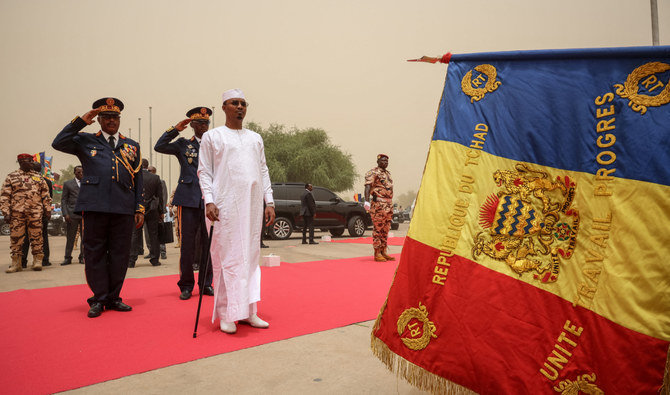

N’DJAMENA: General Mahamat Idriss Deby Itno, who has led Chad’s military junta for three years, was sworn in as president on Thursday after an election victory contested by the opposition.
Deby officially won 61 percent of the May 6 vote that international NGOs said was neither credible nor free and which his main rival called a “masquerade.”
Taking the oath of office, Deby said he swore “before the Chadian people... to fulfil the high functions that the nation has entrusted in us.”
Eight African heads of state as well as Constitutional Council members and hundreds of guests watched as the 40-year-old, dressed in his customary white boubou, was inaugurated as president at the Palace of Arts and Culture in the capital N’Djamena.
The presidential term runs for five years and can be renewed once.
In a speech he had earlier declared a “return to constitutional order” and pledged to be “the president of Chadians from all backgrounds and of all sensibilities.”
Deby was proclaimed transitional president in April 2021 by a junta of 15 generals after his father, iron-fisted president Idriss Deby Itno, was shot dead by rebels after 30 years in power.
The swearing-in marks the end of three years of military rule in a country crucial to the fight against jihadism across Africa’s restive Sahel region.
In 2021, Deby was quickly endorsed by an international community led by France, whose forces in recent years have been ousted by military regimes in its other former colonies Mali, Burkina Faso and Niger.
The investiture ceremony also makes official what the opposition has denounced as a Deby dynasty.
Former ambassador to China Allamaye Halina was named prime minister, according to a presidential decree read out on public television later on Thursday.
His predecessor Succes Masra, one of Deby’s fiercest opponents before becoming prime minister, handed in his resignation on Wednesday in the wake of his party’s election defeat after just four months in office.
Masra, an economist who won 18.5 percent of the vote, contested the results and did not attend the inauguration.
He had claimed victory after the first round of voting but faced accusations of being a junta stooge by the opposition, which has been violently repressed in Chad, with its top members barred from the election.
After the Constitutional Council rejected Masra’s bid to annul the result, he said there was “no other national legal recourse” and called on supporters to “remain mobilized” but “peaceful.”
Deby’s own cousin Yaya Dillo Djerou, who had emerged as the leading opposition candidate to the general, was shot and killed at point-blank range during an army assault on February 28, his party said.
The turnout of heads of state at the investiture was an opportunity to gauge international support for the president.
The eight who were present were all from African nations. Other countries were represented by ministers or ambassadors.
French President Emmanuel Macron, who traveled to N’Djamena in 2021 to pay homage to the late Marshal Deby in front of his son and successor, sent his minister for foreign trade and Francophonie, Franck Riester.
Chad, one of the world’s poorest nations, is France’s last military foothold in the Sahel region, with 1,000 soldiers, and Macron was one of few leaders to publicly congratulate Deby on his election.
Several Sahel nations, reeling from jihadist insurgencies, have strengthened ties with Russia after severing them with Paris.
Russian President Vladimir Putin was among the first to congratulate Deby.


