

Pakistan to pay $2.5 million to families of Chinese nationals killed in March suicide bombing

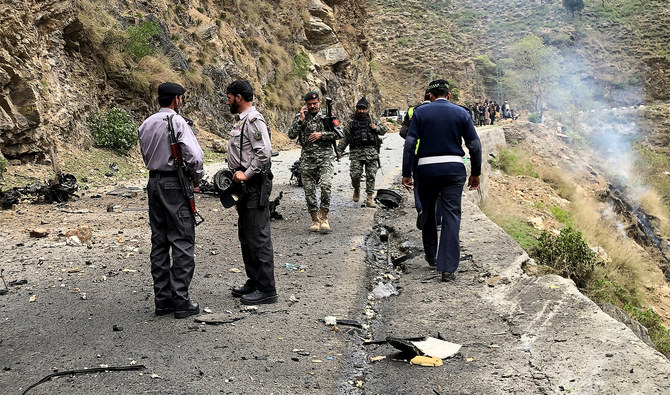
Security personnel inspect the site of a suicide attack near Besham city in the Shangla district of Khyber Pakhtunkhwa province on March 26, 2024. (AFP)
Short Url
Updated 23 May 2024
Follow

Pakistan to pay $2.5 million to families of Chinese nationals killed in March suicide bombing

  • Five Chinese workers, Pakistani driver were killed in suicide bomb attack in northwestern Pakistan on Mar. 26
  • Chinese interests have increasingly come under attack in Pakistan where Beijing has pledged $65 billion investment

ISLAMABAD: Pakistan’s top economic body on Thursday approved $2.5 million in compensation for families of Chinese workers who were killed in March when a suicide bomber targeted their vehicle in northwestern Pakistan. 

Five Chinese workers and their Pakistani driver were killed on Mar. 26 while they were on their way to the Dasu hydropower project in Pakistan’s northwestern Khyber Pakhtunkhwa province. 

Pakistan has vowed to trace the masterminds of the suicide attack and increase security of Chinese personnel, projects and institutions in the South Asian country. The Pakistan army said earlier this month the suicide bomber was an Afghan national, and the attack was planned in Afghanistan. The Taliban rulers in Kabul deny the accusations. 

“The ECC considered and approved proposals for Technical Supplementary Grants, including: $2.58 million and Rs. 2.5 million to the Ministry of Water Resources as compensation packages for Chinese and local casualties at Dasu Hydropower Project,” the Finance Division said, referring to the Economic Coordination Committee (ECC).

The package was approved by Finance Minister Muhammad Aurangzeb who chaired the meeting of the ECC.

Pakistan’s Interior Minister Mohsin Naqvi said earlier this month the South Asian country would introduce new standard operating procedures (SOPs) for the security of Chinese nationals in Pakistan. 

The Dasu attack was the third major one in a little over a week on China’s interests in the South Asian nation, where Beijing has pledged over $65 billion in energy, infrastructure and other projects as part of its wider Belt and Road initiative. 

The Mar. 26 bombing followed a Mar. 20 attack on a strategic port used by China in the southwestern province of Balochistan, where Beijing has poured billions of dollars into infrastructure projects, and a Mar. 25 assault on a naval air base, also in the southwest. Both attacks were claimed by the Baloch Liberation Army (BLA), the most prominent of several separatist groups in Balochistan.

Dasu, the site of a major dam, has been attacked in the past, with a bus blast in 2021 killing 13 people, nine Chinese among them, although no group claimed responsibility, like the Mar. 26 bombing.
 
Pakistan is home to twin insurgencies, one mounted by religiously-motivated militants and the other by ethnic separatists who seek secession, blaming the government’s inequitable division of natural resources in southwestern Balochistan province.

Chinese interests are mostly under attack primarily by ethnic militants seeking to push Beijing out of mineral-rich Balochistan, but that area is far from the site of the Mar. 26 bombing. 


Pakistan to discuss regional issues, economic ties at UAE summit this week

Updated 9 sec ago
Follow

Pakistan to discuss regional issues, economic ties at UAE summit this week

  • Deputy PM Ishaq Dar to attend Sir Bani Yas Forum from Dec. 12-14, says Pakistan foreign office
  • Senior statemen, policymakers expected to discuss security and economic cooperation at summit

ISLAMABAD: Pakistan’s Deputy Prime Minister Ishaq Dar will attend the Sir Bani Yas Forum in the UAE from Dec. 12-14 to discuss regional issues with world leaders and explore economic partnerships, the foreign ministry said on Friday. 

The three-day summit features senior statesmen, policymakers and global experts from around the world with discussions likely to revolve around key regional and international issues such as peace, security and economic cooperation.

Dar, who is also Pakistan’s foreign minister, attended the 15th edition of the Bani Yas Forum last year. He is attending this year’s summit at the invitation of his UAE counterpart, Sheikh Abdullah bin Zayed Al Nahyan, the foreign office said. 

“During the Forum, the Deputy Prime Minister/Foreign Minister will engage with international leaders and experts on matters related to regional stability, sustainable development, and the expansion of economic partnerships,” the statement said. 

“He will also present Pakistan’s perspectives on promoting dialogue, addressing regional challenges, and fostering enhanced opportunities for economic cooperation.”

The Forum is expected to feature important discussions on Israel’s war in Gaza and the fragile ceasefire in the Middle East. 

Pakistan has consistently criticized Israel for violating the ceasefire in Gaza and has called on the international community to intervene and ensure the fragile agreement does not collapse. 

Islamabad has also been eyeing economic partnerships with regional allies, particularly Gulf countries, at such global summits in recent months. 

It has entered into economic, defense, trade and investment agreements with traditional allies such as China, Saudi Arabia, UAE, Qatar and Central Asian states in recent months.