

Italian shipbuilding giant floats Saudi Arabia partnership plan

1 / 4
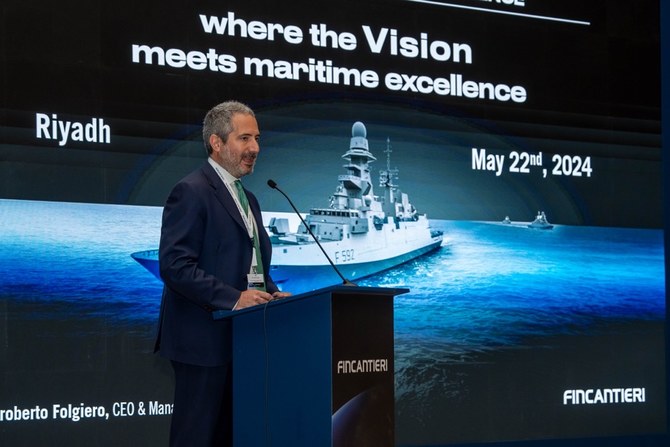
CEO of Fincantieri, Pieroberto Forgiero, during his speech at the event. (AN photo/Huda Bashatah)
2 / 4
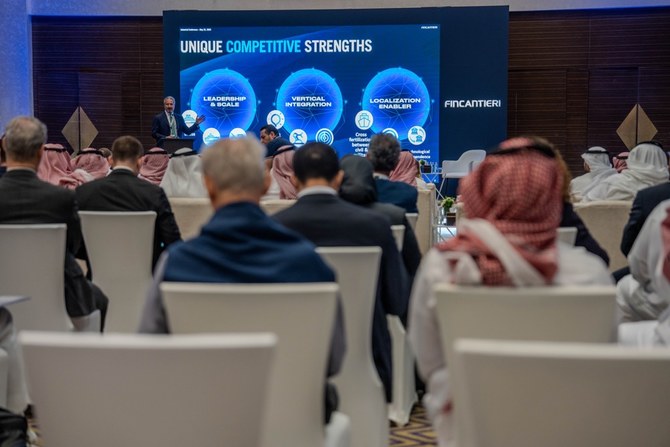
CEO of Fincantieri, Pierroberto Folgiero, during his speech. (AN photo/Huda Bashatah)
3 / 4
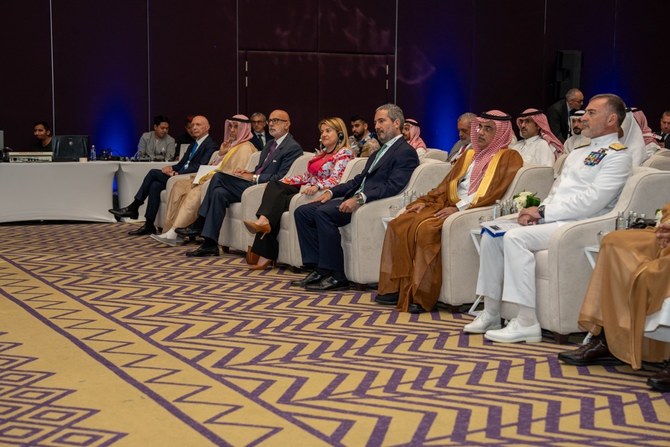
Saudi decisionmakers from related sectors in Riyadh joined Italian officials in a range of sessions at the forum. (AN photo/Huda Bashatah)
4 / 4
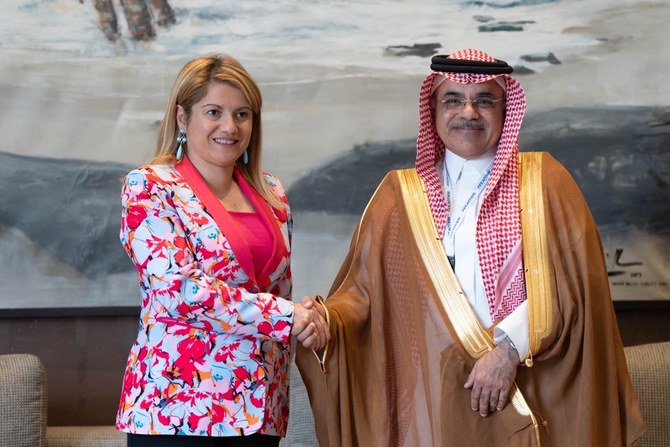
Her Excellency Maria Tripodi, Undersecretary of State for Foreign Affairs, and His Excellency Khalil Ibrahim Bin Salamah, Deputy Minister for Industry Affairs. (AN photo/Huda Bashatah)
Short Url
Updated 25 May 2024
Follow

Italian shipbuilding giant floats Saudi Arabia partnership plan

  • Fincantieri stands out in the shipbuilding industry for its innovation, says CEO

RIYADH: One of the world’s biggest shipbuilders will work in partnership with Saudi Arabia to strengthen the Kingdom’s maritime sector, with a focus on sustainability and the development of “green shipping.”

Fincantieri, an Italian company and Europe’s largest shipbuilding group, highlighted its commitment to Saudi Arabia’s Vision 2030 agenda at a conference under the theme “Where Vision Meets Maritime Excellence” held in Riyadh on Wednesday.

Saudi decisionmakers from related sectors in Riyadh joined Italian officials in a range of sessions at the forum.

During the event, Fincantieri CEO Pierroberto Folgiero outlined the shipbuilder’s plans to collaborate with Saudi companies in line with Vision 2030.

“Our commitment to the Kingdom of Saudi Arabia is steadfast,” he said.

Fincantieri stands out in the shipbuilding industry for its innovation, and has a leading role in the naval, cruise, and oil and gas sectors, Folgiero said.

The CEO highlighted the importance of developing green ships, designed to minimize the environmental impact of maritime operations, as part of Saudi Arabia’s commitment to achieving net-zero emissions by 2060.

Digitizing shipyard operations through innovations such as AI also aligns with the goals of Vision 2030, Folgiero said.

“Today, the shipping industry and the maritime industry, in general, is coping with environmental regulation. For us, it is not only a source of compliance, but also a source of distinctiveness. So, we believe that in the maritime sector, in the shipbuilding sector, mastering energy transition and new technologies will be a source of competitiveness and distinctiveness,” he said.

“That is why we are engaged in all the solutions (regarding) energy transition at sea. We are a new engine. We are in biofuels. We are in methanol. We are in LNG. We are in ammonia. We are in hydrogen. We are everywhere there is innovation at sea.”

Maria Tripodi, undersecretary of state for foreign affairs at the Italian Ministry of Foreign Affairs and International Cooperation, discussed the significance of keeping operations and businesses sustainable.

Fincantieri’s ships are built to produce zero carbon emissions, which helps to protect the environment and marine ecosystem, she said.

Khalil Ibrahim bin Salamah, deputy minister for industry affairs at the Saudi Ministry of Industry and Mineral Resources, said: “Localization for us is a key factor. Key components are crucial, but the whole supply chain is equally important.”


Lebanese social entrepreneur Omar Itani recognized by Schwab Foundation

Updated 23 January 2026
Follow

Lebanese social entrepreneur Omar Itani recognized by Schwab Foundation

  • FabricAID co-founder among 21 global recipients recognized for social innovation

DAVOS: Lebanon’s Omar Itani is one of 21 recipients of the Social Entrepreneurs and Innovators of the Year Award by the Schwab Foundation for Social Entrepreneurship.

Itani is the co-founder of social enterprise FabricAID, which aims to “eradicate symptoms of poverty” by collecting and sanitizing secondhand clothing before placing items in stores in “extremely marginalized areas,” he told Arab News on the sidelines of the World Economic Forum in Davos, Switzerland.

With prices ranging from $0.25 to $4, the goal is for people to have a “dignified shopping experience” at affordable prices, he added.

FabricAID operates a network of clothing collection bins across key locations in Lebanon and Jordan, allowing people to donate pre-loved items. The garments are cleaned and sorted before being sold through the organization’s stores, while items that cannot be resold due to damage or heavy wear are repurposed for other uses, including corporate merchandise.

Since its launch, FabricAID has sold more than 1 million items, reached 200,000 beneficiaries and is preparing to expand into the Egyptian market.

Amid uncertainty in the Middle East, Itani advised young entrepreneurs to reframe challenges as opportunities.

“In Lebanon and the Arab world, we complain a lot,” he said. Understandably so, as “there are a lot of issues” in the region, resulting in people feeling frustrated and wanting to move away. But, he added, “a good portion of the challenges” facing the Middle East are “great economic and commercial opportunities.”

Over the past year, social innovators raised a combined $970 million in funding and secured a further $89 million in non-cash contributions, according to the Schwab Foundation’s recent report, “Built to Last: Social Innovation in Transition.”

This is particularly significant in an environment of geopolitical uncertainty and at a time when 82 percent report being affected by shrinking resources, triggering delays in program rollout (70 percent) and disruptions to scaling plans (72 percent).

Francois Bonnici, director of the Schwab Foundation for Social Entrepreneurship and a member of the World Economic Forum’s Executive Committee, said: “The next decade must move the models of social innovation decisively from the margins to the mainstream, transforming not only markets but mindsets.”

Award recipients take part in a structured three-year engagement with the Schwab Foundation, after which they join its global network as lifelong members. The program connects social entrepreneurs with international peers, collaborative initiatives, and capacity-building support aimed at strengthening and scaling their work.