WASHINGTON: The United States is expected to announce an additional $275 million in military aid for Ukraine on Friday as Kyiv struggles to hold off advances by Russian troops in the Kharkiv region, two US officials say.
This will be the fourth installment of military aid for Ukraine since Congress passed a long-delayed foreign aid bill late last month and comes as the Biden administration has pledged to keep weapons flowing regularly and to get them to the front lines as quickly as possible.
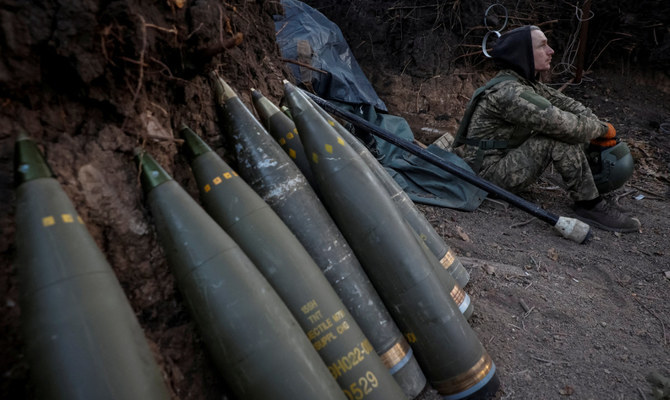
The package includes high mobility artillery rocket systems, or HIMARS, as well 155 mm and 105 mm high-demand artillery rounds, according to the two US officials. They spoke on the condition of anonymity to provide details of the aid package before the public announcement.
It follows a monthly gathering Monday of about 50 defense leaders from Europe and elsewhere who meet regularly to coordinate getting more military aid to Ukraine. At this latest meeting, Defense Secretary Lloyd Austin said Ukraine was in a “moment of challenge” due to Russia’s new onslaught on Kharkiv, Ukraine’s second-largest city. He pledged to keep weapons moving “week after week.”
Russia has sought to take advantage of Ukrainian shortages in manpower and weapons while the war-torn country waits for the arrival of more US assistance, which was delayed for months in Congress. Ukrainian forces have been pushed backward in places, while Russia has pounded its power grid and civilian areas.
In the month since President Joe Biden signed the $95 billion foreign aid package, which included about $61 billion for Ukraine, the US has announced and started to send almost $1.7 billion in weapons pulled from Pentagon stockpiles.
It’s also announced $6 billion in funding through the Ukraine Security Assistance Initiative. That pays for longer-term contracts with the defense industry and means that the weapons could take many months or years to arrive.
With this latest package, the US has now provided almost $51 billion in military assistance to Ukraine since Russia invaded in February 2022.


![]()

US will announce $275 million more in artillery and ammunition for Ukraine, officials say
Short Url
https://arab.news/66gfm
US will announce $275 million more in artillery and ammunition for Ukraine, officials say
- This will be the fourth installment of military aid for Ukraine since Congress passed a long-delayed foreign aid bill late last month
- Russia has sought to take advantage of Ukrainian shortages in manpower and weapons while the war-torn country waits for the arrival of more US assistance


Latest updates



© 2026 SAUDI RESEARCH & PUBLISHING COMPANY, All Rights Reserved And subject to Terms of Use Agreement.