Review: ‘99’ captures the drama of Manchester United’s annus mirabilis

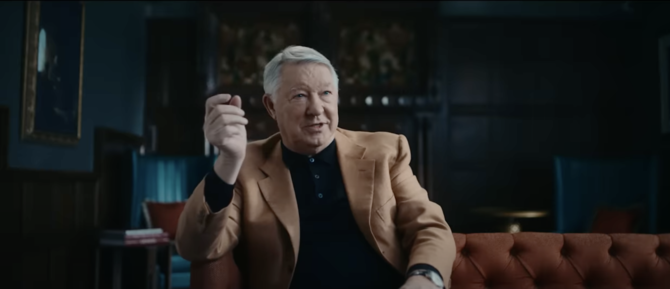
The documentary series “99” celebrates the 25th anniversary of one of the most remarkable achievements in sporting history: when Manchester United won England’s two biggest domestic trophies. (YouTube)
Short Url
Updated 26 May 2024
Follow

Review: ‘99’ captures the drama of Manchester United’s annus mirabilis

DUBAI: The documentary series “99” celebrates the 25th anniversary of one of the most remarkable achievements in sporting history: when Manchester United won England’s two biggest domestic trophies — the Premier League and the FA Cup — and the most prestigious tournament in European club competition — the UEFA Champions League — to complete a (then) unprecedented treble.

The fact that the feat has since been repeated (most recently by United’s arch rivals Manchester City), has taken some of the shine off it, but this was still one of the greatest single seasons in the history of any sport.

The show is stacked with interviews with the players who made history, as well as their fearsome manager, Alex Ferguson, whose obsession with winning the Champions League has been well-documented elsewhere. There isn’t much new insight here, and footballers aren’t renowned for their eloquence, but the filmmakers have done a good job of getting them to dig beyond the platitudes and explore the sometimes-thorny relationships between certain players, the pressure of playing for (at least then) arguably the biggest club in the world, and the self-doubt that could creep in during the biggest games.

But even if its makers had managed to get nothing from the interviewees, they would have known that “99” couldn’t fail to grip even the most casual of sports fans, because the story of the actual football during the season is so outlandish that even a Hollywood exec might question anyone pitching it. Throughout the season, and particularly in the last couple of months, United staged numerous late comebacks in situations where it seemed they’d blown their chance of making history — not least in the last game, the Champions League final against Bayern Munich, when they famously scored two goals in three minutes of injury time to turn almost-certain defeat into the unlikeliest of victories: an act of what seemed like sheer willpower, inspired by the manager’s self-belief. As Ferguson said at the end of that game, “Football. Bloody hell!” The makers of “99” have successfully captured that sentiment.


Sotheby’s ‘Origins II’: Local heroes go under the hammer 

Updated 15 January 2026
Follow

Sotheby’s ‘Origins II’: Local heroes go under the hammer 

  • Regional highlights from Sotheby’s ‘Origins II’ auction, which takes place Jan. 31 in Diriyah 

DUBAI: Here are some of the regional highlights from Sotheby’s ‘Origins II’ auction, which takes place Jan. 31 in Diriyah.

Mohamed Siam 

‘Untitled (Camel Race)’ 

Siam is described by Sotheby’s as “one of the most significant voices of the Kingdom’s second generation of modern artists.” His “highly discernible visual aesthetic,” the auction catalogue states, references European cubists and Italian Futurism, using “multiple overlapping planes to create an endless sense of movement” — an approach that “fragments visual reality, enabling the viewer to experience multiple viewpoints simultaneously.” This work from the late 1980s “shrewdly captures through a fractured, shifting perspective two camel riders in an enthralling, head-to-head race.” It marks Siam’s auction debut and is expected to fetch between $70,000 and $90,000.  


Abdulhalim Radwi 

‘Untitled (Hajj Arafah)’ 

The Makkah-born artist is one of Saudi modernism’s most significant figures. His “multifaceted practice was shaped by a profound engagement with regional heritage and the evolving aesthetic currents of the 20th century,” the catalogue notes. This 1967 oil painting is hailed by Sotheby’s as “a vibrant example of Radwi’s practice (at the time), depicting a bustling arrangement of tented structures rendered in his characteristic Cubist-inflected idiom. The tightly interlocking forms, rhythmic repetitions, and cool, airy palette evoke the temporal architecture of the Hajj pilgrimage, distilled into a kaleidoscopic composition that celebrates the textures and visual poetry of life in Makkah.” 


Mohammed Al-Saleem 

‘Untitled’ 

Another of the Kingdom’s modern-art pioneers, Al-Saleem was born in 1939 in Al-Marat province. His work, Sotheby’s says, “is celebrated for its distinct visual language, a style which the artist coined ‘Horizonism.’ Drawing inspiration from the shifting sands and gradating skyline of Riyadh as seen from the desert, as well as the intensity of the Saudi sun, Al-Saleem reimagined his beloved landscape through the prism of abstraction.” In works such as this 1989 oil painting, he “replaced the traditional horizon line with stylized forms resembling organic forms and Arabic calligraphy … a fusion of modernist abstraction and cultural identity.” 


Taha Al-Sabban  

‘Untitled’ 

This mixed-media-on-canvas work from 2005 typifies the Makkah-born artist’s modernist approach, which, Sotheby’s states “has been described as both an act of conservation and a homage to the nature and culture of his homeland.” The artist “used expressive color and form to preserve local memory — palm groves, open waters, and traditional architecture — while transforming the traditional cityscape into ascending, abstracted rhythms.” His work is often described as “nostalgic,” but the Al-Sabban is quoted by the Al-Mansouria Foundation as saying: “Although I am acutely aware of the passage of time, my aim is not nostalgia; instead I seek to capture the moment and reveal the life in the world.” 


Zeinab Abd El-Hamid 


‘Untitled (Shisha Shop)’ 

This 1987 watercolor is the work of one of Egypt’s most significant female artists of the modern era who belonged, Sotheby’s says “to a generation of artists who came of age during the cultural reawakening that followed Egypt’s independence.” Abd El-Hamid, the catalogue states, “painted with a refined sensibility, grounded in her belief in humanity’s ability to transcend hardship. She did not seek to romanticize the past, but to distill its forms and emotions into something enduring. Her work carries a sense of nostalgia for a rhythm of life rooted in shared dignity and poetic structure … rooftops, cafés, and courtyards become vessels of memory, harmony, and inner light.” 


Samia Halaby 

‘Copper’ 

Central to the Palestinian artist’s practice was the belief that “abstraction, like any visual language, is shaped by social forces and reflects the movements of working people and revolutionary ideas,” Sotheby’s states. This 1976 oil painting combines Halaby’s exploration of the diagonal as “a dynamic formal element” and of the reflective properties of metals. The work “eschews traditional linear perspective in favor of a compositional strategy that flattens and destabilizes the viewer’s gaze. Halaby achieves a sense of spatial infinity — not through illusion, but through repetition and variation.” 


Mahmoud Sabri 

‘Demonstration’ 

The Iraqi painter’s career, Sotheby’s says, was unique among his peers in his homeland. “He simultaneously explored Arab and European cultures, studied the history of painting, and created his own unique art language and style.” That language arrived after this particular oil painting from the early Sixties, a time in which “Sabri often returned to the subject of revolutionary martyrdom and probably referring to the events of the 1963 coup d’état.” In the foreground, a group of women surround a bereaved mother, who is weeping for her murdered son.