Attacks on health care in war zones surge 25 percent last year, NGOs say

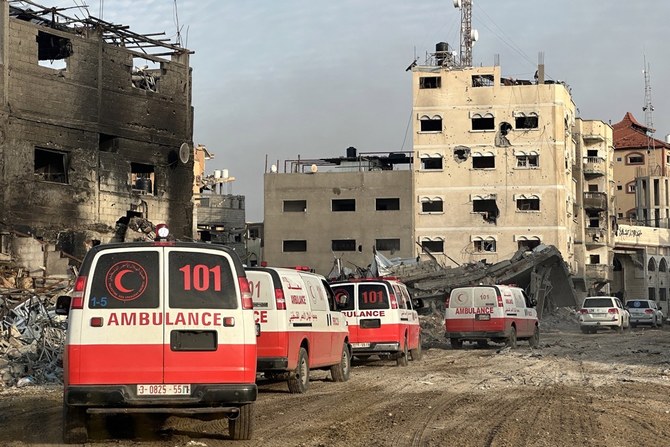
Attacks on medics and health facilities in war zones jumped in 2023 to the highest level since records began 11 years ago, a group of non-governmental organizations said on Wednesday, with nearly half attributed to state forces. (AFP/File)
Short Url
Updated 22 May 2024
Follow

Attacks on health care in war zones surge 25 percent last year, NGOs say

  • The Safeguarding Health in Conflict Coalition, composed of 40 groups including medical charities, reported 2,562 incidents
  • The group apportions responsibility and said governments were to blame for nearly half of the attacks

GENEVA: Attacks on medics and health facilities in war zones jumped in 2023 to the highest level since records began 11 years ago, a group of non-governmental organizations said on Wednesday, with nearly half attributed to state forces.
The Safeguarding Health in Conflict Coalition, composed of 40 groups including medical charities, reported 2,562 incidents of violence or obstructions including arrests, killings and kidnappings of doctors and strikes across hospitals in 30 conflicts including Gaza, Ukraine and Sudan.
That is up by about a quarter compared with 2022.
Unlike the World Health Organization which also documents attacks on health care, the group apportions responsibility and said governments were to blame for nearly half of the attacks.
Len Rubenstein, chair of the coalition and a Johns Hopkins University professor, called for “far more assertive action to end the scourge of violence against health care,” asking governments to cease arms transfers to perpetrators and press prosecutors to hold them accountable.
The group uses open source data and partner contributions and cross checks to ensure no double counting.
The coalition attributed 489 incidents in Gaza last year to Israeli forces, including medic deaths or injuries and strikes or raids on hospitals. No responsibility had been established in seven other cases, including the deaths of six Israeli military medics killed in fighting in separate incidents between October and December, and the bombing of the Al-Ahli Hospital on Oct. 17, 2023, it said.
Israel, whose military offensive in Gaza began after the deadly Hamas cross-border attacks of Oct. 7, says hospitals in the Palestinian enclave are used by Hamas militants as bases.


Bolivia and Israel to restore ties severed over the war in Gaza

Updated 5 sec ago
Follow

Bolivia and Israel to restore ties severed over the war in Gaza

  • Paz's government eased visa restrictions on American and Israeli travelers last month
  • The Bolivian foreign ministry said its top diplomat would meet his Israeli counterpart in Washington later Tuesday to discuss the revival of bilateral ties

LA PAZ, Bolivia: Bolivia's new right-wing government said Tuesday that it would restore diplomatic relations with Israel, the latest sign of the dramatic geopolitical realignment underway in the South American country that was once among the most vocal critics of Israeli policies toward Palestinians.
The Bolivian foreign ministry said its top diplomat would meet his Israeli counterpart in Washington later Tuesday to discuss the revival of bilateral ties, which Bolivia's previous left-wing government severed two years ago over Israel's devastating campaign against Hamas in Gaza.
Bolivia said the effort came as part of a new foreign policy strategy under conservative President Rodrigo Paz aimed at “rebuilding Bolivia's international prestige, opening new economic opportunities and strengthening alliances that directly benefit the country and our citizens abroad."
Bolivian Foreign Minister Fernando Aramayo is in the midst of a whirlwind trip to Washington for meetings with American officials as his government works to warm long-chilly relations with the United States and unravel nearly two decades of hard-line, anti-Western policies under the Movement Toward Socialism, or MAS, party that left Bolivia economically isolated and diplomatically allied with China, Russia and Venezuela.
Paz's government eased visa restrictions on American and Israeli travelers last month.
In announcing his expected meeting with Aramayo on Monday, Israeli Foreign Minister Gideon Saar thanked Bolivia for scrapping Israeli visa controls and said he spoke to Paz after the center-right senator's Oct. 19 election victory to express “Israel’s desire to open a new chapter” in relations with Bolivia.
Paz entered office last month, ending the dominance of the MAS party founded by Evo Morales, the charismatic former coca-growing union leader who became Bolivia's first Indigenous president in 2006. Not long after taking power, Morales sent Israel's ambassador packing and cozied up to Iran over their shared enmity toward the U.S. and Israel.
When protests over Morales' disputed 2019 reelection prompted him to resign under pressure from the military, a right-wing interim government took over and restored full diplomatic relations with the U.S. and Israel as it sought to undo many of Morales’ popular policies.
But 2020 elections brought the MAS party back to power with the presidency of Luis Arce, who in 2023 once again cut ties with Israel in protest over its military actions in Gaza.
Other left-wing Latin American countries, like Chile and Colombia, soon made similar moves, recalling their ambassadors and joining South Africa’s genocide case against Israel before the United Nations’ highest judicial body.