

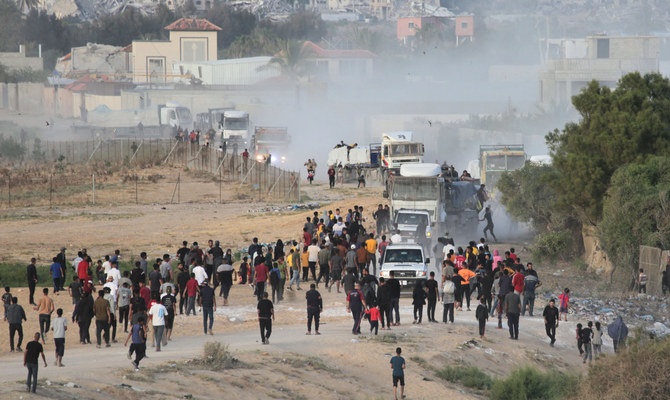

UNITED NATIONS/WASHINGTON: The United Nations has planned new routes within the Gaza Strip to transport aid from a US-built floating pier after crowds of desperate Palstinians intercepted 11 trucks, causing a halt to deliveries that continued for a third day on Tuesday.
The temporary pier was anchored to a Gaza beach last Thursday as Israel comes under growing global pressure to allow more supplies into the besieged coastal enclave, where it is at war with Palestinian militants Hamas and a famine looms.
Operations began on Friday and 10 aid trucks were driven by UN contractors to a World Food Programme warehouse in Deir El Balah in Gaza. But on Saturday, only five trucks made it to the warehouse after 11 others were intercepted.
“Crowds had stopped the trucks at various points along the way. There was ... what I think I would refer to as self-distribution,” UN spokesman Stephane Dujarric told reporters in New York on Tuesday.
“These trucks were traveling through areas where there’d been no aid. I think people feared that they would never see aid. They grabbed what they could,” he said.
Distribution was paused as the UN planned new routes and coordination of deliveries in a bid to prevent more aid being intercepted, said Abeer Etefa, a WFP spokesperson in Cairo.
“The missions were planned for today using the new routes to avoid the crowds,” she said. Dujarric later said there had been no transportation of aid from the pier since Saturday.
‘WAITING FOR AMERICAN AID’
The pier has been met with hope and skepticism by residents in Gaza. The pier operation — announced by US President Joe Biden in March — is estimated to cost $320 million and involve 1,000 US service members.
“The pier should be there when the (Israeli) occupation completely ends. Then, it will be good for us. It will be good to travel, to get things,” said Abu Nadi Al-Haddad, questioning why it was needed now, given there were several land crossings.
Another resident, Abu Nasser Abu Khousa, came to the coastal road close to where the pier is located with his four-year-old son and a donkey-drawn cart in the hope of receiving aid.
“We are waiting for the American aid, but we did not get anything,” he said, adding that he had lost his home in the war and had been displaced multiple times. “We will come back tomorrow, God willing, in the hope that we will get some aid, that will help us survive.”
US officials have said that once up and running the pier would initially handle 90 trucks a day, but that number could go to 150 trucks. The UN has said at least 500 trucks a day are needed to enter Gaza.
Aid offloaded at the pier comes via a maritime corridor from Cyprus, where it is first inspected by Israel. Two ships carrying aid left Cyprus earlier this month and the Pentagon said more than 569 metric tons of aid had been delivered to Gaza.
“More is on the way, so you’re going to see those numbers increase,” Pentagon spokesman Brig. Gen. Pat Ryder told reporters on Tuesday.
It was not immediately clear how much of the 569 metric tonnes of aid — which the Pentagon said had been donated by the US, Britain, the United Arab Emirates and the European Union — was still waiting to be transported by UN-contracted trucks.
Israel is retaliating against Hamas in Gaza — an enclave of 2.3 million people — over the Oct. 7 attack by the Palestinian militants where more than 1,200 people were killed and over 250 taken hostage, according to Israeli tallies. Nearly 130 hostages are believed to remain captive in Gaza.
Israel launched an air, ground and sea assault on the blockaded Palestinian territory, killing more than 35,000 Palestinians, according to Gaza health authorities.
Aid access into southern Gaza has been disrupted since Israel stepped up military operations in Rafah, a move that the UN says has forced 900,000 people to flee.


