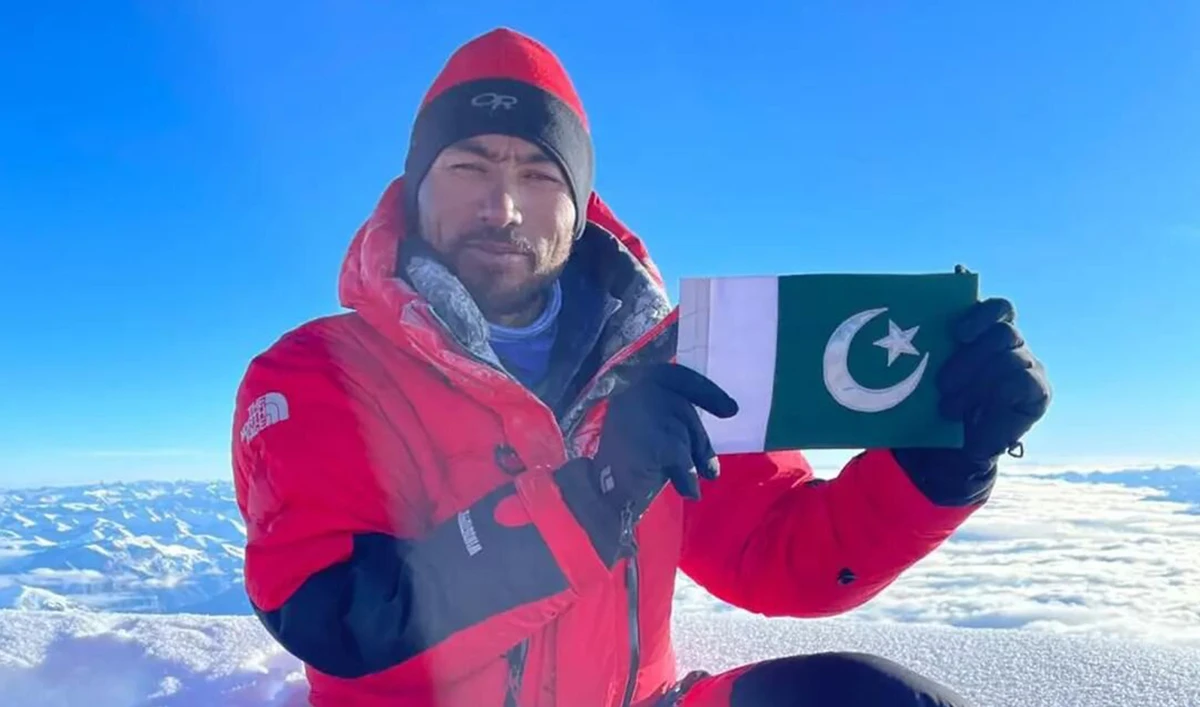
- Khan is the first Pakistani to summit 11 out of 14 ‘eight-thousanders’ without using supplementary oxygen
- He was part of ‘Imagine Nepal 2024 Everest Expedition,’ which included 14 international climbers, 18 sherpas
KHAPLU, GILGIT-BALTISTAN: Pakistani mountaineer Sirbaz Khan on Tuesday achieved another milestone by successfully scaling the world’s tallest mountain, Mount Everest, without supplementary oxygen, Pakistani and Nepalese expedition organizers said.
Born and raised in Ali Abad village in Pakistan’s mountainous Hunza district, Khan has previously summited 13 of the 14 peaks in the world above the height of 8,000 meters, including K2.
He was part of the ‘Imagine Nepal 2024 Everest Expedition’ team, which included 14 international climbers and 18 sherpas who reached the 8,849-meter-high summit on Tuesday morning, according to the Imagine Nepal tour company and the Alpine Club of Pakistan.
“Congratulations to Sirbaz Khan on successfully summiting Mount Everest 8,848.86 meters (29,031.69 feet) without the use of supplemental oxygen,” Karrar Haidri, secretary-general of the Alpine Club of Pakistan, said in a statement.
The team of 14 international climbers and 18 sherpas summitted Everest in “various hours between NPT 5:15 a.m. and 10:00 a.m. on the morning of 21 May 2024,” the Imagine Nepal tour company said in a Facebook post.
Khan’s family celebrated the feat in Pakistan, according to his younger brother, Shahbaz Khan.
“We are very happy because today Sirbaz summited Everest without supplementary oxygen. We are celebrating this moment and especially our mother is very excited. There is an environment of festivity at our home,” Shahbaz told Arab News over the phone.
“Whenever he [Sirbaz] starts his summit push, we offer special prayers for him. Because you know, we can’t trust the mountains. However, when he summits, we celebrate. Now we are also offering prayers for his safe descent.”
Khan planned to summit the 8,027-meter Shishapangma peak — the last of the 14 peaks above 8,000 meters — but had to delay the expedition as China did not open the mountain to international climbers, according to his brother.
He also climbed Everest in 2021 and is the first Pakistani to climb 11 out of 14 ‘eight-thousanders’ without oxygen support. Khan had summitted only Annapurna and Kangchenjunga peaks using oxygen support.
“Congratulations @sirbazkhan_mission14 for climbing Everest without supplemental oxygen and a personal sherpa. He is now the only Pakistani to climb 11 peaks without Oxygen,” Naila Kiani, a Pakistani woman climber, said in an Instagram post.
“Sirbaz is the second [Pakistani after] Sajid Ali Sadpara to climb Everest without O2, following our younger brother @sajidalisadpara, who climbed it last year. Sirbaz is also the only Pakistani to climb Everest twice. Climbing Everest without oxygen is a true test of human grit. Congratulations, Ustad.”