

US President Joe Biden: What’s happening in Gaza is not genocide

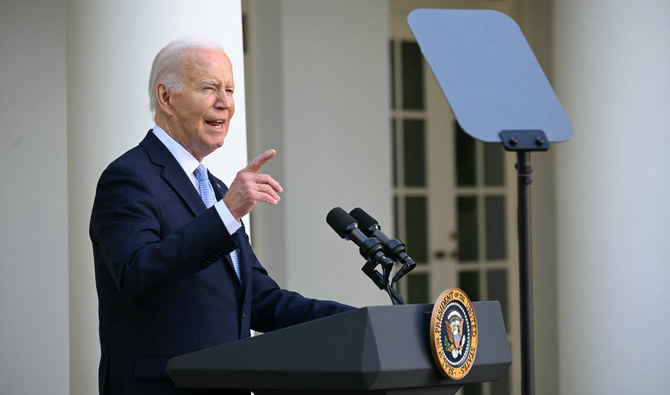
US President Joe Biden speaks during a celebration for Jewish American Heritage Month at the Rose Garden of the White House in Washington, DC on May 20, 2024. (AFP)
Short Url
Updated 21 May 2024
Follow

US President Joe Biden: What’s happening in Gaza is not genocide

  • US president also amps up his criticism of the International Criminal Court

WASHINGTON: US President Joe Biden denied Monday that Israel’s war in Gaza was genocide, as he slammed an “outrageous” request by the International Criminal Court’s prosecutor for an arrest warrant for Israeli leaders.
“What’s happening is not genocide,” Biden told a Jewish American Heritage Month event at the White House as he discussed the conflict sparked by Hamas’s October 7 attack on Israel.
His remarks referred specifically to a case at a different tribunal, the UN International Court of Justice (ICJ), which is dealing with allegations by South Africa that Israel’s war in Gaza is genocidal.
But he also amped up his criticism of the ICC, a separate war crimes court, saying that “we reject” ICC Prosecutor Karim Khan’s bid to arrest Israel’s Prime Minister Benjamin Netanyahu and its defense minister.
Khan also sought the arrest of top Hamas figures including the Palestinian militant group’s leader in Gaza, Yahya Sinwar, and political chief Ismail Haniyeh.
“Whatever these warrants may imply, there is no equivalence between Israel and Hamas,” Biden told the audience in the Rose Garden of the White House.
Biden pledged “ironclad” support for Israel, adding that “we stand with Israel to take out Sinwar and the rest of the butchers of Hamas.”
The US president further vowed to free hostages taken by Hamas during the October 7 attack “come hell or high water.”
Hours earlier, he had issued a written statement saying that the ICC warrants were “outrageous.”

Opinion

This section contains relevant reference points, placed in (Opinion field)

Biden’s expression of support comes despite recent tensions over Israel’s war in Gaza. Washington recently withheld a shipment of bombs to Israel in a bid to warn it off an offensive in the southern city of Rafah.
US Secretary of State Antony Blinken warned separately that the ICC prosecutor’s move “could jeopardize” ceasefire talks to end the Gaza conflict.
“We reject the prosecutor’s equivalence of Israel with Hamas. It is shameful,” Blinken said in a statement.
US lawmakers were reportedly considering a legislative response punishing the ICC amid bipartisan fury among Republicans and Democrats.
Republican House Speaker Mike Johnson slammed the court’s “baseless and illegitimate” decision.
He accused Biden of a “pressure campaign” against Israel, saying the country was “fighting a just war for survival.”
Biden faces political pressure on both sides ahead of a November election clash with Donald Trump, with pro-Gaza student protests roiling US campuses while Republicans accuse him of failing to fully back Israel.
The White House refused to comment on whether the United States could take retaliatory action, including sanctions, against the ICC if it targeted Israel.
In 2020, the administration of then-president Donald Trump targeted the ICC with sanctions over its investigation in Afghanistan, but the Biden administration later lifted them.
However Washington’s ambiguous position over the court is reflected in the fact that it has backed the ICC’s attempt to prosecute Russian President Vladimir Putin over the invasion of Ukraine.
Defense Secretary Lloyd Austin said Monday that the United States “will continue” to assist the ICC in its investigation into alleged war crimes in Ukraine, despite denouncing the Israel move.


Thailand PM Anutin consolidates power with dominating election win

Updated 1 sec ago
Follow

Thailand PM Anutin consolidates power with dominating election win

  • Bhumjaithai Party wins clear victory after a nationalist campaign amid Cambodia conflict
  • Vote also included a referendum on a new constitution to replace a 2017 military-backed charter
BANGKOK: Thai Prime Minister Anutin Charnvirakul’s Bhumjaithai Party won a clear victory in Sunday’s general election, raising the prospect that a more stable coalition may ​now succeed in bringing an end to a period of prolonged political instability.
Anutin set the stage for the snap election in mid-December during a border conflict between Thailand and Cambodia, a move political analysts said appeared to be timed by the conservative leader to cash in on surging nationalism.
It is a gamble that paid off for a prime minister, who — having taken over after premier Paetongtarn Shinawatra of the populist Pheu Thai party was ousted over the Cambodian crisis — then dissolved parliament less than 100 days later.
“Bhumjaithai’s victory today is a victory for all Thais, whether you voted for Bhumjaithai Party or not,” Anutin told a press briefing. “We have to do the utmost to serve the Thai people to our full ability.”
With nearly 95 percent of polling stations reporting, preliminary results released by the election commission showed ‌the Bhumjaithai Party winning ‌about 192 seats, compared to 117 for the progressive People’s Party, and 74 for ‌the ⁠once-dominant Pheu ​Thai party.
A ‌handful of other parties won a combined 117 spots in the 500-seat parliament, according to a Reuters calculation of election commission data.

Power to govern

When Anutin dissolved parliament in December, he cited dysfunction and infighting between rival parties as making it impossible to lead a minority government.
While the Bhumjaithai Party was unlikely to win a majority outright, the results suggest it is in a strong position to push through campaign pledges, said Napon Jatusripitak, a political scientist at the Bangkok-based Thailand Future think-tank. Those include implementing a consumer subsidy program and ditching an agreement with Cambodia over maritime claims.
“For the first time in a long time, we will likely have a government that has sufficient effective power to govern,” he said. “We are seeing ⁠what I would describe as a marriage of convenience between technocrats, conservative elites, and traditional politicians.”
Critical to Anutin’s success were his embrace of nationalism and Bhumjaithai’s strategy of winning over politicians ‌from rival parties in rural areas, analysts said.
“The scale of its victory was unanticipated, ‍perhaps demonstrating that the more nationalist political environment and its ability to ‍consolidate the conservative electorate all worked in its favor,” said Mathis Lohatepanont, an independent political analyst.

Coalition bid rejected

Speaking as ‍results were coming in, People’s Party leader Natthaphong Rueangpanyawut conceded that, while some votes had yet to be counted, his party did not look likely to win.
Natthaphong said the party would not join a Bhumjaithai-led government but would also not form a competing coalition.
“If Bhumjaithai can form a government, then we have to be the opposition,” he told a press conference.
With a message of structural change and reforms to Southeast Asia’s second-largest economy, the People’s ​Party had led most opinion polls during the campaign season.
But in a survey conducted during the campaign’s final week and released on Sunday, the National Institute for Development Administration projected that Bhumjaithai would be the winner with between ⁠140 and 150 seats in the 500-member House of Representatives, ahead of 125-135 for the People’s Party.
The progressive party’s earlier support for Anutin as prime minister was likely a severe miscalculation, undermining its own ideological purity and allowing Bhumjaithai to attain the benefits of incumbency, Mathis said.
Speaking to Reuters, Natthaphong said he did not see the election as the result of any mistakes by his party, but instead highlighted that its opponents had not been complacent.
“I’m not blaming any factors. Our responsibility now has to be to focus on the grassroots,” he said. “We’ve done a lot already but haven’t been able to crack what they have. It wasn’t good enough.”

Constitutional referendum

Thai voters were also asked during the vote to decide if a new constitution should replace a 2017 military-backed charter that critics say concentrated power in undemocratic institutions, including a powerful senate that is chosen through an indirect selection process with limited public participation.
The election commission’s early count showed voters backing the referendum by a margin of nearly two to one.
Thailand has had 20 constitutions since the end of its absolute monarchy in 1932, with most of the changes coming in the ‌wake of military coups.
The new government and lawmakers can start the amendment process in parliament with two more referendums required to adopt a new constitution.