Prayers from top Pakistani leaders as Iranian president’s helicopter crashes

1 / 2
This grab taken from handout video footage released by the IRINN Iranian state television network on May 19, 2024 shows Iran's President Ebrahim Raisi (L) with an unidentified memeber of his delegation on board a helicopter in the Jofa region of the western province of East Azerbaijan. (AFP)
2 / 2
This grab taken from handout video footage released by the IRINN Iranian state television network on May 19, 2024 shows rescuers heading towards the site of the "accident" involving a helicopter in the convoy of Iran's President in the Jofa region of the western province of East Azerbaijan. (AFP)
Short Url
Updated 19 May 2024
Follow

Prayers from top Pakistani leaders as Iranian president’s helicopter crashes

  • Iranian media says the helicopter landed roughly while crossing a mountainous area on way back from Azerbaijan
  • In April, President Raisi visited Pakistan as the two neighbors sought to mend ties after tit-for-tat strikes this year

ISLAMABAD: Pakistan’s Prime Minister Shehbaz Sharif and President Asif Ali Zardari on Sunday expressed concerns about the crash landing of a helicopter carrying President Ebrahim Raisi in Iran’s northwest and extended their wishes and prayers for his well-being.

The helicopter carrying Iranian President Ebrahim Raisi and Foreign Minister Hossein Amirabdollahian landed roughly when it was crossing a mountainous area in heavy fog on the way back from a visit to Azerbaijan, according to Iranian media.

The bad weather was complicating rescue efforts, the IRNA state news agency reported. Interior Minister Ahmed Vahidi told state TV that one of the helicopters in a group of three had “come down hard,” and that authorities were awaiting further details.

“Heard the distressing news from Iran regarding Hon. President Seyed Ibrahim Raisi’s helicopter. Waiting with great anxiety for good news that all is well,” PM Sharif said on Twitter.

“Our prayers and best wishes are with Hon. President Raisi and the entire Iranian nation.”

President Asif Ali Zardari said he was “deeply concerned” after hearing news about the helicopter incident.

“My heartfelt prayers & good wishes for the well-being & safety of President Raisi so that he may continue to serve the Iranian nation,” he said on X.

Reacting to the development, former foreign minister Bilawal Bhutto-Zardari said their thoughts were with President Raisi, FM Amirabdollahian and the brotherly people of Iran during this critical time.

“We earnestly pray for their safety and swift recovery,” he said in a post on X.

Raisi, 63, was elected president at the second attempt in 2021, and since taking office has ordered a tightening of morality laws, overseen a bloody crackdown on anti-government protests and pushed hard in nuclear talks with world powers.

In Iran’s dual political system, split between the clerical establishment and the government, it is the supreme leader rather than the president who has the final say on all major policies.

But many see Raisi as a strong contender to succeed his mentor, Supreme Leader Ayatollah Ali Khamenei, who has strongly endorsed Raisi’s main policies.

In April, Raisi arrived in Islamabad on a three-day official visit to Pakistan as the two Muslim neighbors sought to mend ties after unprecedented tit-for-tat military strikes earlier this year.

The Iranian president had held delegation-level meetings in the Pakistani capital as well as one-on-one discussions with Pakistan’s prime minister, president, army chief, Senate chairman and National Assembly speaker.

During the visit, Raisi had also overseen the signing of eight agreements between the two countries that covered different fields, including trade, science technology, agriculture, health, culture, and judicial matters.

IMF mission begins talks in Islamabad as Pakistan seeks next program review

Updated 5 sec ago
Follow

IMF mission begins talks in Islamabad as Pakistan seeks next program review

  • Finance ministry confirms ‘kick-off meeting’ with visiting IMF delegation
  • Review critical for next tranche under $7 billion bailout program

Karachi: Pakistan began formal talks with a visiting International Monetary Fund (IMF) delegation on Monday as the country prepares for the next review of its $7 billion bailout program.

The IMF team is in Pakistan to conduct a review under the Extended Fund Facility (EFF) approved in September 2024, a multi-year program aimed at stabilizing the economy after a balance-of-payments crisis, high inflation and dwindling foreign exchange reserves.

Pakistan has so far received roughly $3 billion of the EFF. Successful completion of the latest review could pave the way for the release of the next tranche of funds, subject to IMF board approval.

Separately in 2024, Pakistan also secured about $1.3 billion under the IMF’s Resilience and Sustainability Facility, a climate-focused funding window aimed at strengthening the country’s capacity to manage environmental and disaster-related risks.

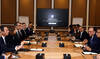
“Kick-off meeting with IMF Mission held today,” the finance ministry said on Monday as it shared visuals of Finance Minister Muhammad Aurangzeb and senior officials meeting the delegation in Islamabad.

IMF country representative in Pakistan, Mahir Binici, told Arab News in an emailed statement; 

“An IMF mission led by Ms. Iva Petrova has started discussions with the authorities in Karachi and Islamabad on the third review of Pakistan’s Extended Fund Facility (EFF) arrangement and the second review of the Resilience and Sustainability Facility (RSF).”

The discussions are expected to focus on Pakistan’s fiscal performance, revenue collection targets, structural reform implementation and broader macroeconomic stability measures agreed under the program.

The review comes at a sensitive time for Pakistan’s economy, with rising global oil prices and regional instability adding pressure to inflation and external accounts. Analysts say continued IMF engagement remains crucial for maintaining investor confidence and securing external financing.

Pakistan entered the IMF program to restore macroeconomic stability, strengthen public finances and rebuild foreign exchange reserves. Authorities have repeatedly described the reform agenda as necessary to ensure long-term economic resilience.

Further meetings between technical teams are expected over the coming days.