

Suspected rebels kill political activist in Indian-administered Kashmir

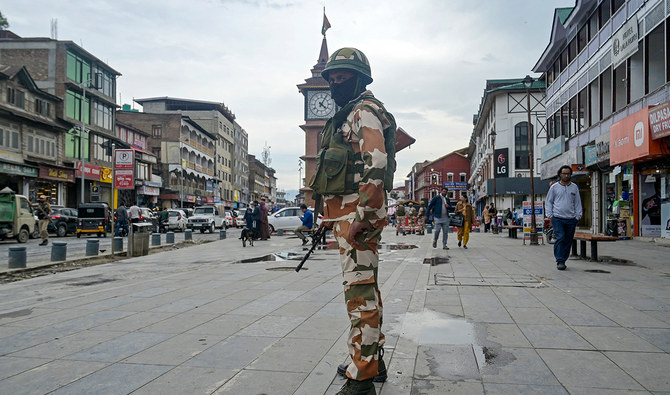
A security personnel stands guard at a market in Srinagar on May 10, 2024, ahead of the fourth phase of voting of India's ongoing general election. (AFP/File)
Short Url
Updated 19 May 2024
Follow

Suspected rebels kill political activist in Indian-administered Kashmir

  • Two Indian tourists visiting the Himalayan territory were also wounded in a separate attack in Anantnag
  • Rebel groups opposed to Indian rule have for decades waged an insurgency in Indian-controlled Kashmir

NEW DELHI: Suspected rebels shot dead an activist from Indian Prime Minister Narendra Modi’s party in Indian-administered Kashmir, local authorities said Sunday after the latest violent attack in the disputed region.

Police named the victim as Aijaz Ahmad, a local leader of the ruling Bharatiya Janata Party (BJP) who was fired upon in Shopian district on Saturday evening, days after the region began voting in India’s six-week national elections.

The BJP’s local office in Kashmir confirmed Sunday that Ahmad had died and announced plans to stage a protest against the attack.

Two Indian tourists visiting the Himalayan territory were also wounded in a separate attack by suspected rebels in nearby Anantnag on the same day, police said, adding that both had been hospitalized.

Security forces had cordoned off the surrounding area to find those responsible for separate incidents, police said.

Kashmir has been divided between India and Pakistan since their independence in 1947, with both claiming the Himalayan territory in full.

Rebel groups opposed to Indian rule have for decades waged an insurgency in Indian-controlled Kashmir, demanding either independence or a merger with Pakistan.

India accuses Pakistan of backing the militants — charges Islamabad denies.

The conflict has left tens of thousands of civilians, soldiers and militants dead.

Violence has drastically reduced since 2019, when Modi’s government canceled the Muslim-majority region’s limited autonomy and brought it under direct rule from New Delhi.

Security forces have reported a spate of clashes in Kashmir since voting began last month in ongoing general election.

Earlier this month suspected rebels killed an Indian air force member and injured four others in an ambush on a military convoy.


Bangladesh begins exhuming mass grave from 2024 uprising

Updated 07 December 2025
Follow

Bangladesh begins exhuming mass grave from 2024 uprising

  • The United Nations says up to 1,400 people were killed in crackdowns as Hasina attempted to cling to power — deaths that formed part of her conviction last month for crimes against humanity

DHAKA: Bangladeshi police began exhuming on Sunday a mass grave believed to contain around 114 unidentified victims of a mass uprising that toppled autocratic former prime minister Sheikh Hasina last year.
The UN-supported effort is being advised by Argentine forensic anthropologist Luis Fondebrider, who has led recovery and identification missions at mass graves worldwide for decades.
The bodies were buried at the Rayerbazar Graveyard in Dhaka by the volunteer group Anjuman Mufidul Islam, which said it handled 80 unclaimed bodies in July and another 34 in August 2024 — all people reported to have been killed during weeks of deadly protests.
The United Nations says up to 1,400 people were killed in crackdowns as Hasina attempted to cling to power — deaths that formed part of her conviction last month for crimes against humanity.
Criminal Investigation Department (CID) chief Md Sibgat Ullah said investigators believed the mass grave held roughly 114 bodies, but the exact number would only be known once exhumations were complete.
“We can only confirm once we dig the graves and exhume the bodies,” Ullah told reporters.

- ‘Searched for him’ -

Among those hoping for answers is Mohammed Nabil, who is searching for the remains of his brother Sohel Rana, 28, who vanished in July 2024.
“We searched for him everywhere,” Nabil told AFP.
He said his family first suspected Rana’s death after seeing a Facebook video, then recognized his clothing — a blue T-shirt and black trousers — in a photograph taken by burial volunteers.
Exhumed bodies will be given post-mortem examinations and DNA testing. The process is expected to take several weeks to complete.
“It’s been more than a year, so it won’t be possible to extract DNA from the soft tissues,” senior police officer Abu Taleb told AFP. “Working with bones would be more time-consuming.”
Forensic experts from four Dhaka medical colleges are part of the team, with Fondebrider brought in to offer support as part of an agreement with the UN rights body the OHCHR.
“The process is complex and unique,” Fondebrider told reporters. “We will guarantee that international standards will be followed.”
Fondebrider previously headed the Argentine Forensic Anthropology Team, founded in 1984 to investigate the tens of thousands who disappeared during Argentina’s former military dictatorship.
Authorities say the exhumed bodies will be reburied in accordance with religious rites and their families’ wishes.
Hasina, convicted in absentia last month and sentenced to death, remains in self-imposed exile in India.